



Introduction to CFD Brokers: The Gateway to CFD Trading
Contracts for Difference (CFDs) are essentially a method of trading on price changes, but not owning the asset directly. For example, rather than buying Apple shares, you are gambling on Apple share price going either up or down. The difference between the opening price and the closing price is then settled when the trade gets closed.
To allow the entire process to happen - the CFD broker is the entity enabling the transaction. The CFD broker is analogous to a ride-sharing service such as Uber - they connect you with the global financial markets. They offer you the platform to trade on, they match your buy and sell orders, and they charge a fee to facilitate the process.
So why should you consider the CFD broker to be an important part of your trading? - Because they affect the value of the trade you place and your overall trading experience. Putting it simply, a good CFD broker can save you money and facilitate a good trading experience; and a bad CFD broker can eat into your margins with high fees and technical issues.
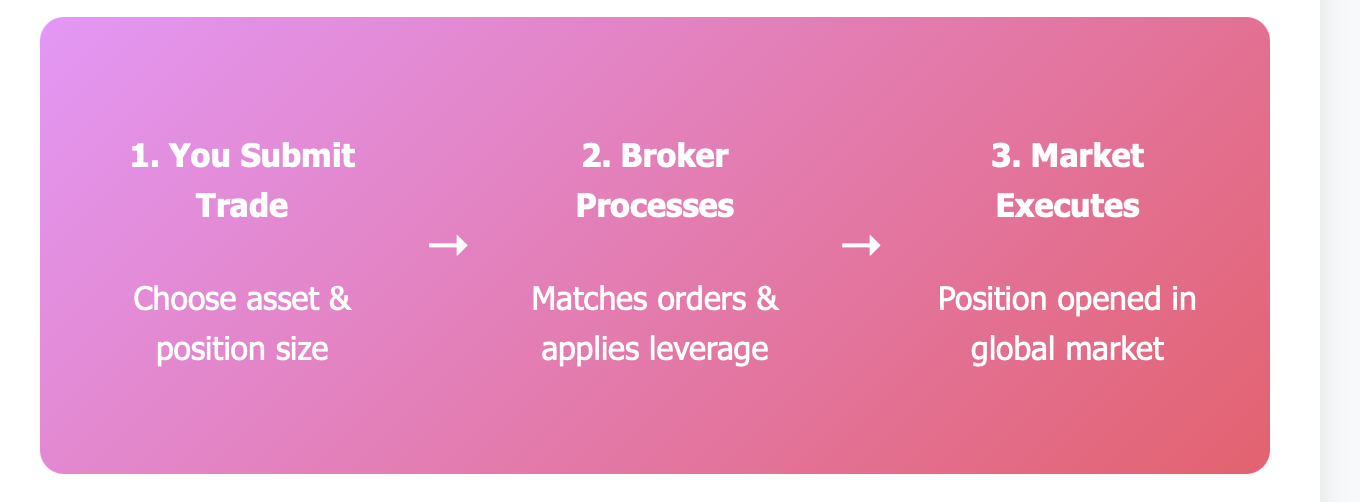
The order of the CFD trade is simple.
You submit a trade → the CFD broker processes the trade, → the market executes the trade. The CFD broker is in the center of the transaction as they provide you access to a platform to trade on and execute your orders.
Let’s say you want to trade gold via CFDs. The traditional way would mean you had to come up with thousands of dollars to buy physical gold bars from a jewellery store. A CFD broker will allow you to trade gold for only a fraction of that by using leverage. The CFD broker allows you to utilize their connection to all of the other markets, while you pursue your trading strategies.
Understanding how CFD brokers operate is not only helpful but it is a prerequisite for anyone who is serious about trading CFDs full time. Choosing the right CFD broker is the critical factor to being a profitable trader instead of being someone who is constantly frustrated.
What Is A CFD Broker? Full Description to Understand for Beginners
A CFD broker is a financial intermediary that provides you access to CFD trading. A CFD broker can be thought of as your access point to trading in the world markets, and they do so by facilitating the technical and regulatory issues preventing you from trading yourself.
What CFD Brokers Do for You
Platform Provision: CFD brokers provide trading platforms including, for example, MetaTrader 4, MetaTrader 5, cTrader, or their own web-based platforms (which some brokers offer). Trading Platforms are where you will find charts to analyse, place your trades and manage your open positions.
If you wanted to invest in gold CFD trading. You would need thousands of dollars to obtain actual gold bars from a jewelery store with the traditional option. But with the help of a CFD broker, you can trade gold through CFDs, and only put up a fraction of those thousands of dollars in the market, thanks to leverage. The broker can deal with all the technicalities related to the market, while you can turn your attention to making trading-related decisions.
On a related note, understanding how CFD brokers work is not just helpful, it is indispensable for anyone who is serious about trading through CFDs. The right CFD broker can make your trading experience profitable, or could make you feel like you are always banging your head at a wall.
What is a CFD Broker? Complete Explanation for Beginners
A CFD broker is a financial middleman that opens the door for you to trade CFDs in the market. In a sense, you might consider a CFD broker as a conduit to global markets, allowing you to focus on trading while the broker deals with the technical or regulatory details.
Here is what a CFD broker actually does for you:
Platform Provision: Brokers will typically provide trading platforms, including options like: MetaTrader 4, MetaTrader 5, cTrader or their own web-based platform. You will view the charts, enter trades or monitor your trades on the trading platform.
CFD brokers have made trading accessible for everyone. Previously, only institutional investors had access to certain markets, but now an individual retail trader can start trading in those same markets with only a few hundred dollars to make a trade.
How CFD Brokers Make Money: The Cost of Trading
CFD brokers have to make money to stay in business so they aren't helping you trade out of the goodness of their hearts. Knowing how CFD brokers make money helps traders understand their options regarding brokers and more specifically the cost of their trading.
Spreads as the Primary Source of Revenue
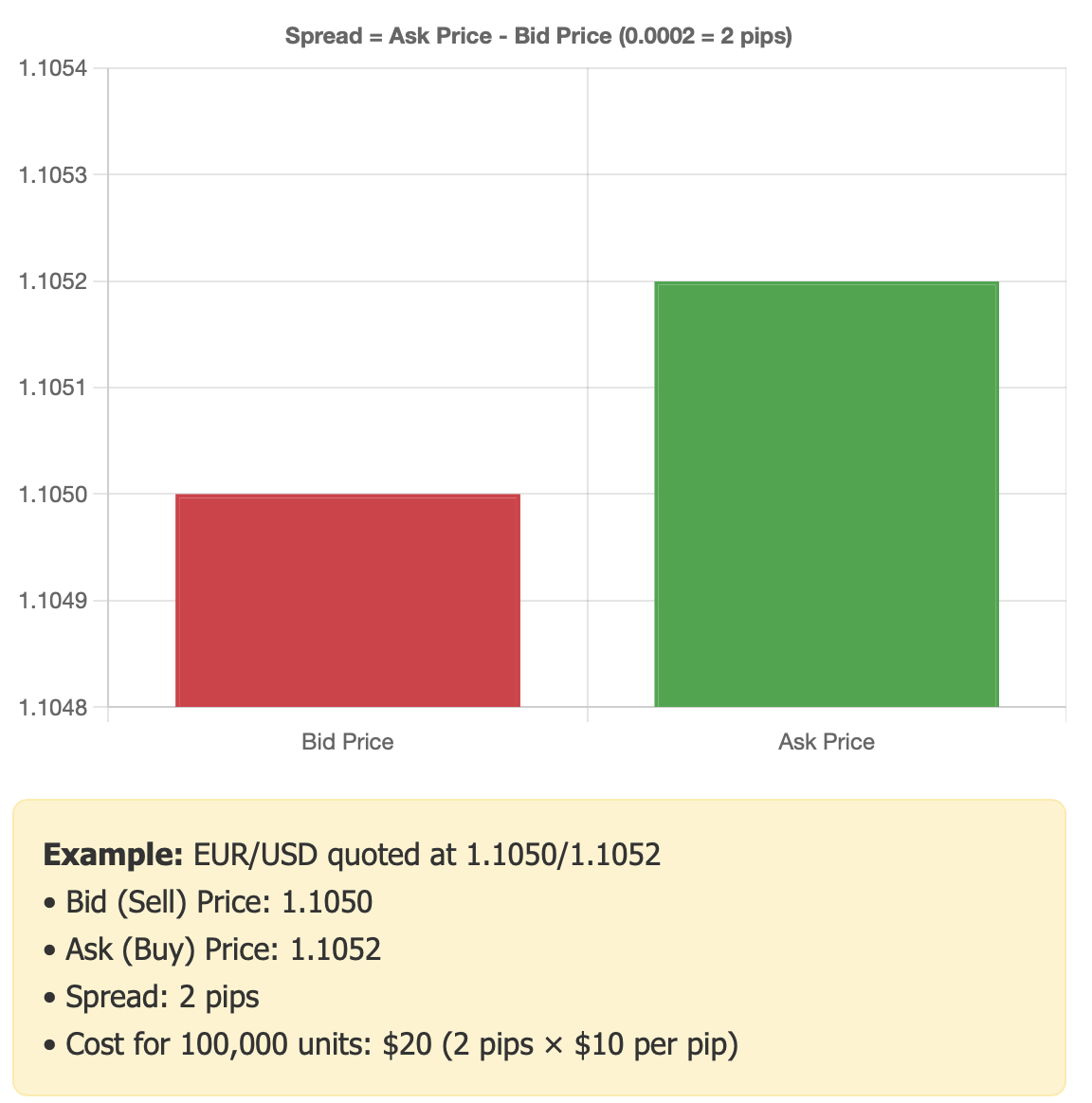
The spread is the difference between the buy price (ask) and the sell price (bid). When you see EUR/USD quoted as 1.1050/1.1052, the difference is 2 pips meaning the spread amount is 2 pips. Every time you open a position, you lose value immediately from the trade that's the equivalent of the spread amount.
Here is an example: you buy 100,000 units of EUR/USD with a 2-pip spread. Each pip is worth $10 for this size position, so you are down $20 just from placing the trade. That $20 value goes straight to the broker.
Commissions: Pay-Per-Trade Fees
Some brokers have commissions separate from (or added on to) the spread. These brokers may advertise: “0.1 pip spread + $3.5 commission per lot.” The total cost may be the equivalent, but it is a bit more transparent.
Overnight Financing (Swap Fees)
When you hold a CFD position overnight, you incur a financing charge because you are borrowing money to leverage your trade. For example, if you have a leveraged EUR/USD position and hold it overnight, you will have charged interest for the amount you borrowed. These fees can add up fast for long-held positions.
Additional Fees
Many brokers charge additional fees for services or products, including withdrawal fees ($25 per bank transfer), inactivity fees ($50 per month for inactivity), or account maintenance fees. These fees often appear nominal, but they quickly add-up for a small account.
You can think of this as you would with your banking account. As an example, your bank provides you services (like a CFD broker provides access to trading), and they charge fees to support that service. There are ATM fees (comparable to spread), an overdraft fee (comparable to a margin call), and a monthly maintenance fee (comparable to inactivity measures).
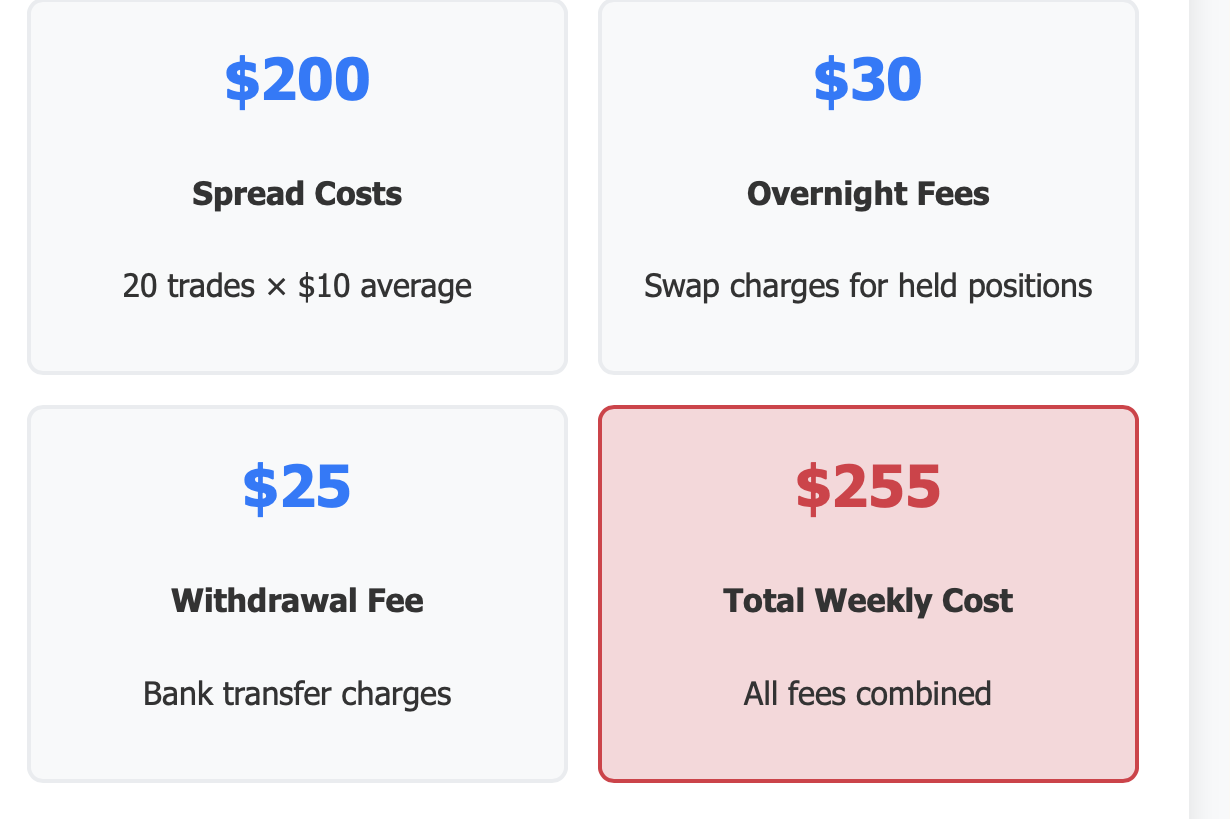
To summarize the total money spent in a weekly summary: For costs related to spreads: Assume 20 trades for a total of $200; for overnight finance charges assume $30; and for withdrawal fees assume $25. This would have $255 total costs incurred for the week.
The important thing is locating brokers with the best overall costs and not just one type of fee. A broker who has very tight spreads but charges high withdrawal fees may not actually be cheaper than someone else that offers slightly worse spreads, but no hidden fees.
Different Types of CFD Brokers: Market Maker vs STP vs ECN
Not all CFD brokers are the same. Being aware of the differences between the broker types will help inform what broker you choose to trade with that is best suited to your trading style and preferences.
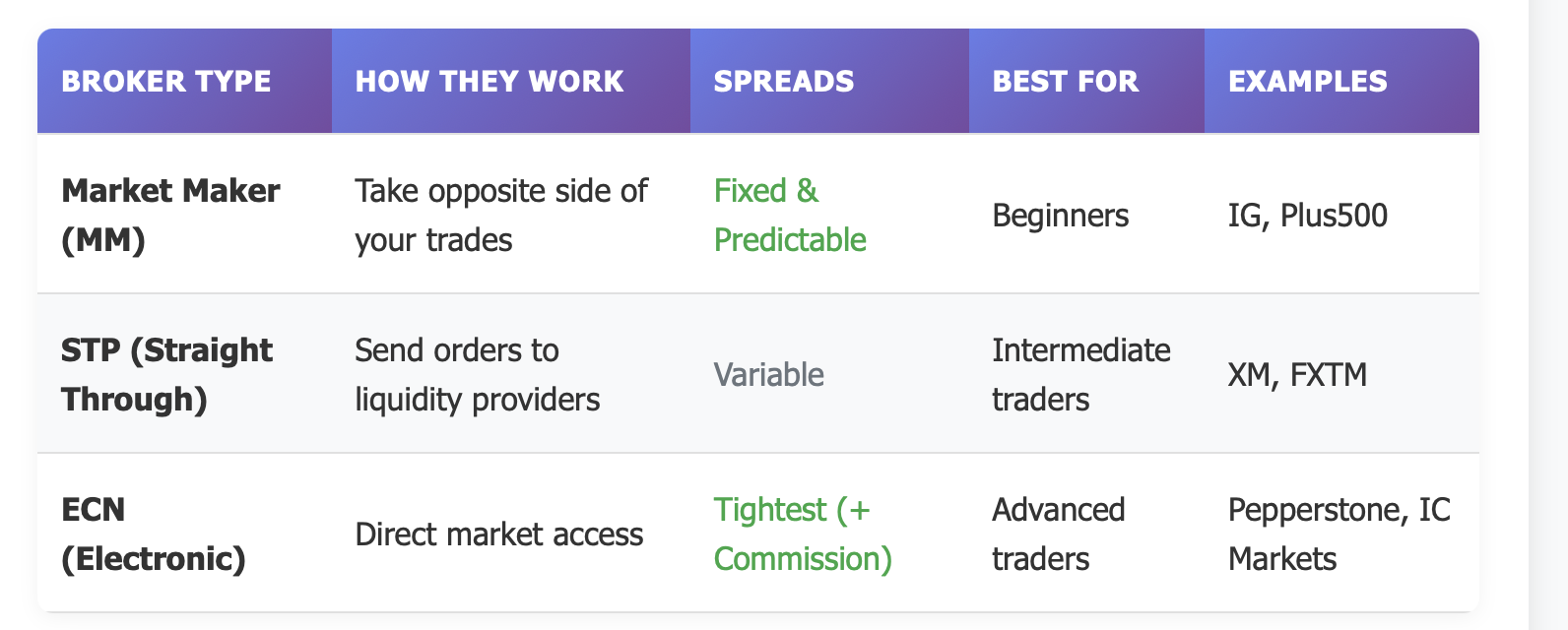
Market Maker (MM) Brokers
Market Makers essentially create their own prices and take the opposite side of your trades. If you buy EUR/USD, the market maker sells you the same asset from the broker’s inventory. The MM broker primarily makes money by profiting from spreads and sometimes losing traders.
Pros: Market Makers are usually priced with fixed spreads, have lower minimums account sizes, allow immediate execution of trades and are very user-friendly as pricing structures are simple to understand.
Cons: Market Makers may have conflicts of interests, as they would like their traders to incur losses that help them profit. In periods of higher volatility, market makers may consider widening their spreads or even rejecting orders (requotes) depending on market conditions
If think about the Market Maker brokerage like a used car dealer. The dealer finds a lower-cost vehicle for themselves where they can create their own price to sell. The dealer makes money from the spread between what they purchased the vehicle for, and then what you pay.
STP Brokers
STP brokers send your orders directly to liquidity providers (banks, hedge funds, other brokers), and they do not take the opposite side. They make profits just from spreads or commissions and not from your losses.
Pros: There is no conflict of interest (which means that they do not want you to lose money), spreads can be variable, and spreads might be tighter during better market conditions. Also, STP brokers usually have transparent order routing.
Cons: Spreads may widen if the market is volatile, and some brokers require higher minimum deposits.
ECN Brokers
ECN brokers give you access to the interbank market where real buyers and sellers meet. Your orders compete with buy/sell orders from institutions, banks, and other traders. Real ECN brokers provide market depth and allow you to see real liquidity.
Pros: Best price transparency, and the spreads are the tightest during better market conditions. True ECN brokers do not have dealing desks.
Cons: Most ECN brokers charge commissions, most require larger account sizes, and ECN spreads will typically widen sharply just before a news event.
The travel booking analogy is that market makers are like travel agents who set package prices and do all the booking themselves. STP brokers are like booking sites that give you access to airlines but charge you a minimal fee. ECN brokers use information displayed on airport departure boards that show all the options available from various airlines, allowing you to pick the best one.
For beginner traders, often a market maker (like IG) makes the most sense; they offer the most predictable cost structure and user experience. Advanced traders who appreciate transparency and prefer to “see their costs” during times of liquidity prefer ECN (like Pepperstone).
IG (as a market maker) has fixed spreads where they cater to a retail trader. Pepperstone (as a STP or ECN) will have variable spreads and commission costs for more active traders.
How do you decide on a CFD broker; factors to think about
Choosing the best CFD broker can make or break the trader's success. Below are some needs to consider.
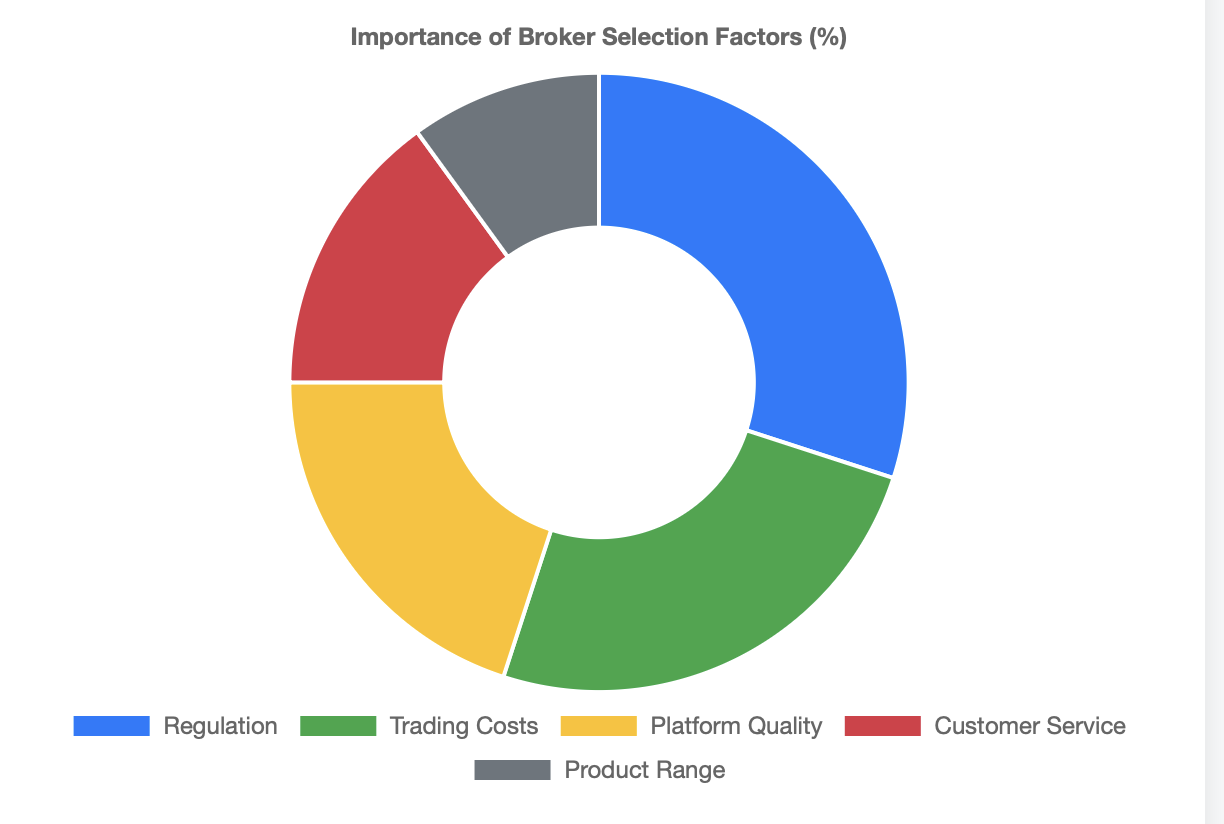
Regulation: Your Safety Blanket
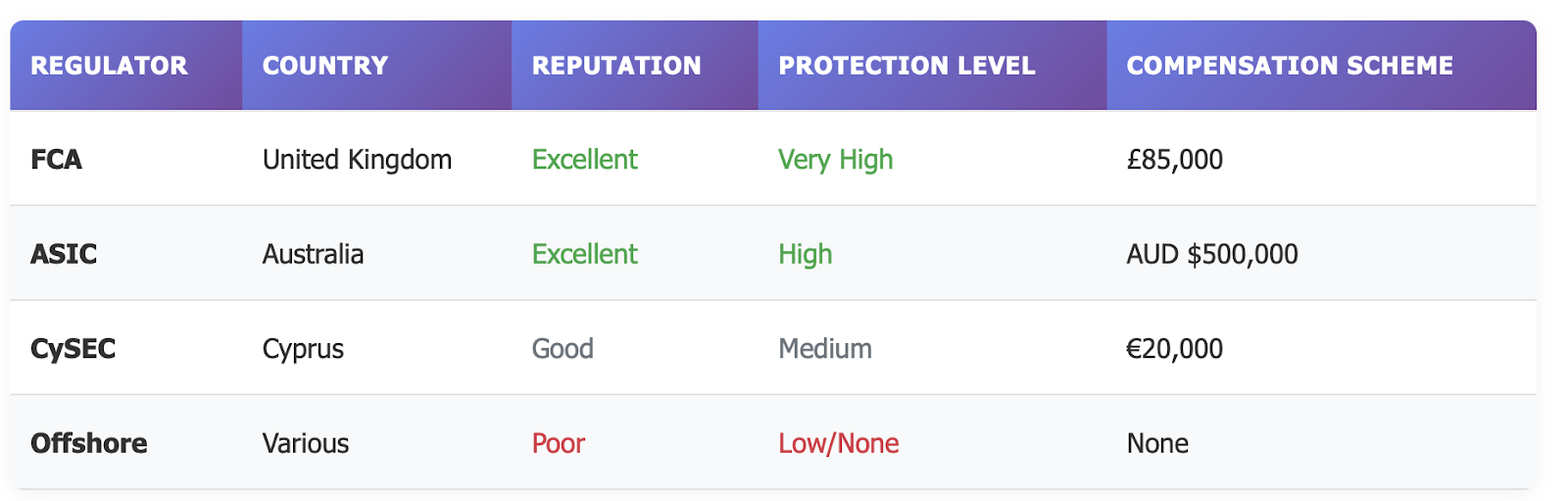
Regulation is more than “paperwork” – it gives you assurance against fraud, segregated funds, and other protections. Look for brokers regulated by top tier (FCA, UK), ASIC (Australia), CySEC (Cyprus) or at least top-tier regulators.
Regulated brokers are required to have certain minimum capital levels, undergo routine audits, and be part of a compensation scheme that protects some client funds. Stay away from offshore brokers that are poorly regulated, regardless of how well their marketing makes them look.
Trading Costs: The Make-or-Break Factor
Look at the overall buying and selling costs to trade, not just the headline spreads. For example, a broker may announce "0.5 pip EUR/USD spreads," but charge $7 per lot in commissions, while another broker may just simply show "1.2 pip spreads," but charge no commissions at all. Figure out which of the two is cheaper after considering your trading volume.
Don't forget about financing to hold orders overnight. Some brokers have a swap rate that is higher than others and will eat into trading profits on any position held for a longer period.
Platform Experience: Your Command Center for Trading
Your platform is where you will spend hours analyzing and then trading. Try demo accounts to review:
-
The quality of charts and the indicators available to analyze
-
The speed of order execution
-
The quality of the mobile app
-
The functionality of the platform during volatile periods
Apparently, MetaTrader 4 is still popular due to the availability of a large library of indicators, but newer platforms like cTrader offer significantly better charting and one-click trading.
Product Range: To Pursue Diversification
Different brokers offer different markets. Some provide a high level of specialization in forex while others may provide an even bigger suite of stock CFDs' crypto, or commodities. Select as appropriate for your goals:
-
FX only - 50+ currency pairs
-
Multi-Asset - Stocks, indices, commodities, crypto (CFDs)
-
Other Specialized - Crypto heavy focus or commodity focus
Customer Service: When Things Go Wrong
It is advisable to test customer service once you have narrowed down to a couple of brokers and before actually funding a live account. A practice you can employ with the broker- a question on their support channel and time how long it takes for a response, broker published response times can be unrealistic what may be highlighted as a normal wait for your specific issue. Good brokers will usually offer multi-lingual support with reasonable wait times.
It is even better if they offer phone support, you can get quicker helps when most times you are staring down the barrel of some essential issue that is happening when you are mid-trade or system.
Here is a simplistic and practical comparison process. Select three brokers to research that are regulated and legal in your intended location/region. Open demo accounts with three suggested brokers. Trade for at least a week, then add all the spreads, commissions, fees etc. total is this cost. You should also consider usability of their trading platform, customer responsiveness, and service levels.
For example, eToro has some excellent features in social trading, and a wide variety of crypto, however, it has wider spreads. IG has excellent regulation and platform reliability, their costs for active traders will be higher. XM has a decent spreads, low minimum deposit requirements but not as robust on stock CFDs to offer.
Understand brokerage selection in the same way you make an choice on a mobile phone plan. You will want coverage (regulation), cost (costs), reliability (platform), and fit (available markets).
The Global Role of CFD Brokers: Retail trader access to markets
CFD brokers have transformed who has access to global financial markets and instruments. Before, one needed to have considerable capital, invites from an institution, and follow complex procedures in order to trade large international markets.
Democratization of Ability for Trade
Because of CFD brokers, a student in Thailand can trade the movement of the German DAX index, a teacher in Brazil can speculate on oil prices, and a small business owner in South Africa can hedge against exposure of currency. With minimum account requirements usually ranging from $100 - $500 USD - the entry to trading accessible to normal people, around the world.
This accessibility is made possible through leverage. Instead of needing $100,000 to buy a full S&P 500 index exposure in long or short fashion - a trader can express that same exposure through leverage in a position size of between $1,000 - $5,000 depending on the level of leverage available. Although leverage is not a lack of risk, it allows access to an opportunity that retail capital does not have access to.
Global Access to Trading
CFD brokers provide an unmatched selection of markets.
-
Forex: Major, minor, and exotic currency pairs from across the globe
-
Indices: Abstract the whole performance of a stock market (S&P 500, FTSE 100, Nikkei 225)
-
Commodities: Gold, oil, agriculture, and metals
-
Individual Stocks: CFDs on shares from major exchanges across the world
-
Cryptocurrency: Exposure to Bitcoin, Ethereum, and altcoins without actual ownership.
A trader based in Europe, for instance, could wake up and begin trading Asian indices, trade in the commodity markets during European hours, and complete their trading with one or more US stock CFDs as the last trade of the day. Traditional brokers will likely not provide access to the global markets for a 24 hour/5 day working week (24/7 for crypto).
CFD Trading Regulation and Acceptance by Country
CFDs have become a popular and accepted market asset in Europe, Australia, and many developing markets yet are usually detered from access in the US based on regulation. In the EU, the European Securities and Markets Authority (ESMA) began enforcing policy regarding the relationship between a broker and trader by limiting leverage and requiring negative balance protection for retail clients. Likewise in Australia, brokers are required by ASIC disclose in percentage the amount of client accounts lost money in the previous year.
While some regulations restrict the market on trading that can occur, they have also raised standards of brokers, issuing much better protections for retail traders for accounts. Likewise, brokers are required to disclose what % of clients had a money loss, with over 70-80% of clients being CFD traders. Generally, this tends to set realistic expectations for new traders while also urging the trader to take corrective action.
Impact on Real-World:
Consider Maria, a Spanish nurse who engages in CFD trading to support her income. She can trade gold while on her lunch break, hold positions in the DAX index overnight, and close it all before her next shift. Once the domain of investment banks, trading opportunities via CFD now sit on her telephone.
Or consider James, an Australian entrepreneur who uses currency CFDs to hedge against his business's international payments. If his company is expecting a large USD payment in three months, he can place a CFD position to lock down satisfactory rates to protect his profit margins.
CFD brokers have developed a global marketplace where geographical barriers mean less than market knowledge and risk management capability.
Conclusion & Call to Action
CFD brokers are the essential link between retail traders and global financial markets. They provide trading platforms, execute orders for clients, offer clients leverage, and charge client fees for all these services. When you understand brokers' various business models from market makers to ECN providers, it enables you to make informed decisions about where to trade.
The main points are:
-
Only work with regulated brokers
-
Understand costs (in addition to spreads)
-
Test, test, test
-
Use the broker’s strengths to your advantage.
The right broker can save you money and make your trading better, regardless of whether you are trading forex, stocks, commodities or crypto CFDs.
It is important to keep in mind, trading CFDs well does not just entail using the cheapest broker. Your experience can differ enormously based on platform reliability and security, regulatory protection, customer service, and market selection. This is why it is very important to actually take the time to do your research into a variety of brokers and what they provide.
To start trading CFD's you will want to begin with practice and learning. Most reputable brokers will give you a demo account with loads of fun money to be able to test your trading strategies, and get used to their platform for a while before you begin to trade with your own money. Many successful traders will spend their first weeks or months trading in simulator accounts.
Now for the fun part - a list of things to do to help you research your selections: Look for brokers that are regulated for your jurisdiction, begin to open demo accounts with your top 3 brokers was about, and have some fun!
You'll want to pay attention to these elements and then choose a platform that fits well into your trading style.
The global financial markets are ready - and with a proper CFD broker, you will have the right tools to engage in this exciting and potentially profitable venture.
CFD Broker Due Diligence Checklist:
✓ Authority verified regulation
✓ Consideration paid to comprehensive trading costs
✓ Account demo tested
✓ Customer service responsiveness verified
✓ Markets available reflect your interests
✓ Minimum deposit requirement acceptable
✓ Educational resources and trading tools reviewed.
Practice, or paper trading is great, and while you may be excited to get into the actual platforms, take the time to play around as accurate and test out those platforms on demo accounts. Open demo account with BTCDana.com
Just as there are costs with traders based on costs - fees to get into a position and to exit, customer service may be a differential factor in your learning experience as well.