




Some people have referred to compound trading as the "8th Wonder of the World." While that sounds a little exaggerated, once you understand how compounding works in trading, it's easy to see why so many traders love compounding. Compounding isn't about "getting lucky" on a big trade or finding the next cryptocurrency that goes "moon shot." Instead, it involves allowing many of your returns to accumulate back into your trading account, over and over again. Eventually, this process can create exponential growth in your accounts that seems almost like magic! So let's take a closer look at compounding and break it down into steps.
What is Compound Trading? Understanding the "Eighth Wonder" of Trading
The straightforwardness of compound trading is evident. Instead of withdrawing your profits from your successful trades, you continually reinvest them back into your trading account, where your profit will create additional profit from your trading account's compound interest method. When you allow enough time, the original investment you made and the profits generated from that original investment will combine to dramatically increase the growth rate of your capital and the overall size of your trading capital.
As noted in the recent Albert Einstein reports about his retirement from the scientific community, he is quoted as making a compelling statement about the vast potential for gain associated with "compounding." Regardless of what Albert Einstein stated, it is clear through compounding, the investor does not only contribute the initial investment dollars; they generate an increasing cumulative benefit by growing their capital each year. Exponential returns will be created by this strategy.
As an example, imagine that when you put money into a savings account on December 31st of a given year, you are guaranteed to get back the same amount you put in plus another 5% of that amount in the first calendar year after you made your deposit. Therefore, at the end of your first calendar year of savings, which is one year after you deposited $1,000, your total balance will be $1,050.
However, if you chose to leave your savings account untouched for the second calendar year following your deposit, you would earn interest on the entire balance of $1,050 as opposed to earning interest only on the initial amount deposited of $1,000.Therefore, although $50 does not seem like a great deal of money today, multiply this effect out over the span of several years, compounded at a higher return, and the value will become astronomical.
Picture yourself applying this same rationale to your trading. For instance, starting with $1,000 and averaging 10% gains each month. If you have reinvested 100% of those profits during the year( which is the only way to take advantage of compounding), instead of ending up with $2,200 simply from the month-to-month gain, you would likely accrue closer to $3,138. That's where the compounding power comes from.
What is key to know is that compounding in trading is not about trying to make one huge gain in one shot, but rather it is about being patient, consistent, and allowing time to compound your gains. The longer the time that your gains are compounded, the more severe your growth curve will be.
The Math Behind Compound Trading: From Linear to Exponential Growth
Let's get into the numbers because understanding the math makes everything click.
The formula for compound growth is:
FV = PV × (1 + r)^n
Where:
-
FV = Future Value (what your account will be worth)
-
PV = Present Value (your starting capital)
-
r = rate of return per period
-
n = number of compounding periods
Don't let the formula intimidate you. It just means your money grows faster the more often you compound and the longer you wait.
There’s a big difference in the way that linear vs. exponential growth occurs. In linear growth, you are adding equal amounts of money in each time period. So if you earned $100 per month, then after a year you would have a total of $1,200 in your account. That’s simple mathematics!
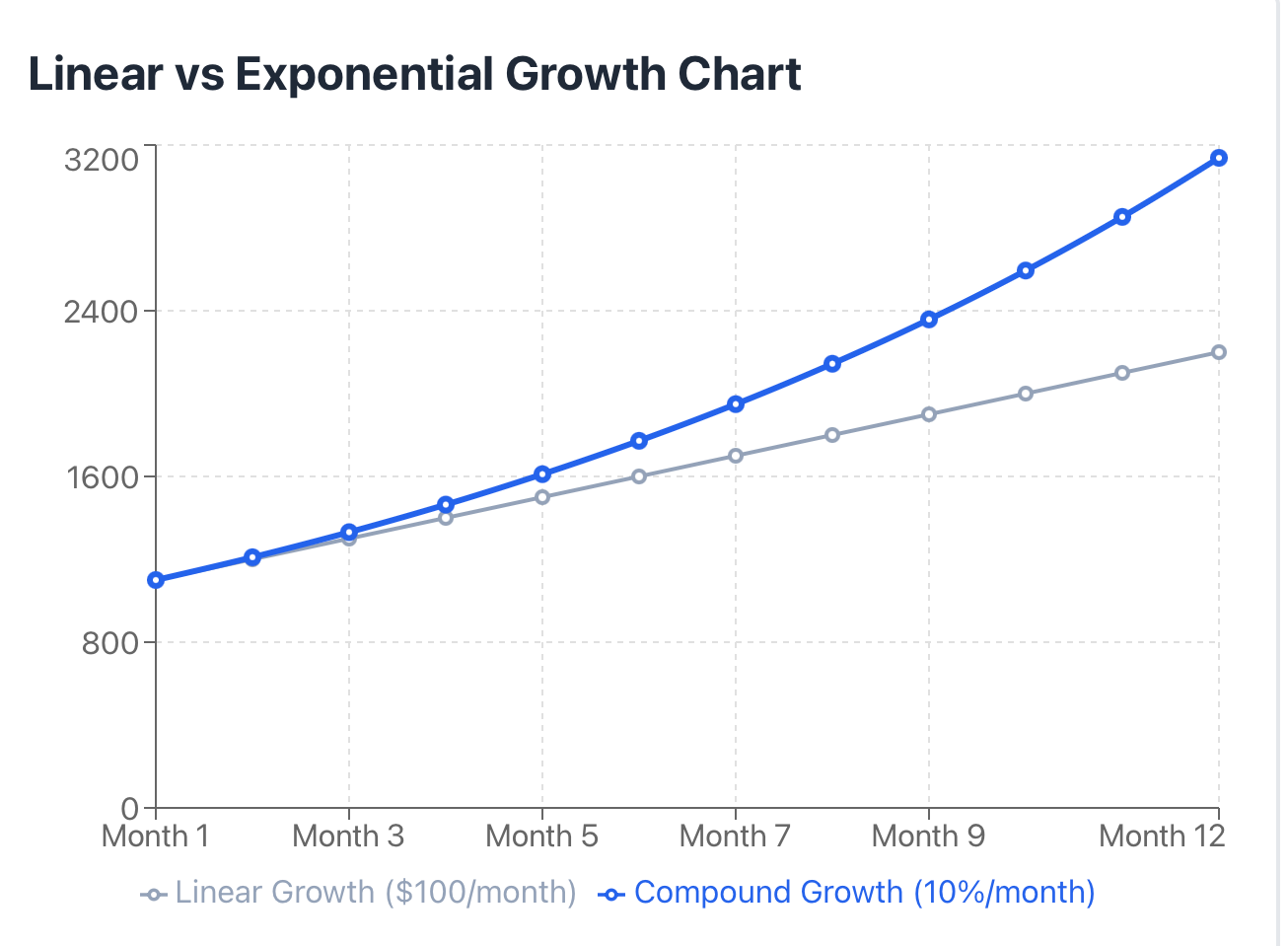
In contrast, with exponential growth (also known as compounding), every time you profit, you receive the profit from the prior period, and that previous profit now becomes your new base for the next profit period. Therefore, in the second profit period, you will receive a larger profit than in the first period (but maybe not by a large amount). With this sample math, after 12 months, you will not receive $100 again; instead, you will have received a much higher amount. Let me give you a concrete example:
For example, assume you begin trading with $1,000 and make a return of 5% on your investment each week. If you did not compound (let’s assume you kept the profits), you would receive $50 each week (which amounts to $2,600), but your account would always remain at $1,000. However, if you compounded every week, after one year, you would have approximately $12,000 in your account! Same amount of initial capital, same weekly return, but because of compounding, that's the impact and difference it makes.
Time is an advantage because the more time you allow compounding to occur, the greater your rate of return on invested capital will be. Also, compounding frequency of the original principal results in accelerated returns when the compounding frequency increases. High-frequency traders can compound at multiple frequencies, which, when coupled with their expertise in managing risk, enable them to experience remarkable levels of growth.
The primary reason for compounding is to achieve exponential growth of your account through consistent gains. It takes commitment and discipline to continue with your compounding strategy over time.
Core Strategies of Compound Trading: How to Reinvest Profits Safely
Many traders use compound trading as a means of reinvesting all of their earnings without any form of risk management; however, if they do not effectively manage their risks, they will lose their trading accounts quickly than they built them up.
The key to successful, safe compounding is risk management. This includes keeping your losses small by capping all trade losses between 1-3% of your total capital, so that even if you experience a period of negative returns, you will still have enough remaining in your account to recover from it and continue to grow your account through compounding profits.
When it comes to how you will reinvest profits, you can follow two different types of strategies: fixed percentage or variable percentage. In a fixed percentage strategy, you will always reinvest, for example, 50% or 75% of your profits into your trading account. In a variable percentage strategy, you would adjust the amount of reinvestment depending on the market conditions or your level of confidence.
To visualise this better, picture a set of blocks stacked on each other. Every time you place a new block on top of the stack, you will make sure that the previous layer is stable before placing it. If you try to stack blocks too quickly without ensuring the previous rows are secure, your whole tower could collapse. The same concept applies to compound trading. If you choose to use a fixed percentage strategy and do not manage the risks associated with compounding profits, one bad streak in trading could cause you to lose your entire trading account.
Suppose you made a 10% profit from a trade, rather than putting 100% of that back into the next trade; you would be better off putting back only 50%. This provides you with an opportunity to grow your position size without taking on too much risk; therefore, if the trade goes against you, you aren’t likely to suffer an enormous loss. You still receive the benefit of compounding while limiting yourself to a maximum loss.
One of the biggest mistakes traders make is over-leveraging their accounts. When they see that their accounts are growing, they want to increase their leverage or position size, believing that they can make even more money. One margin call later, they find themselves in the position of having to start all over from nothing.
Just remember: compounding is the reinvestment of profits for risk management, not about putting everything you've got into the next trade. It is also about continuing to see gradual and controlled growth, which can be continued over months and years.
The Role of Time in Compound Trading: How Compounding Frequency Impacts Growth
In trading, the timing of compounding your trading account is crucial. As more time passes between compounding events, the greater the snowball effect that occurs.
When you are considering the compounding intervals for your account, you also want to know how often you contribute to your account (daily, weekly, or monthly). These compounding periods have the same effect on the growth of your trading account over time.
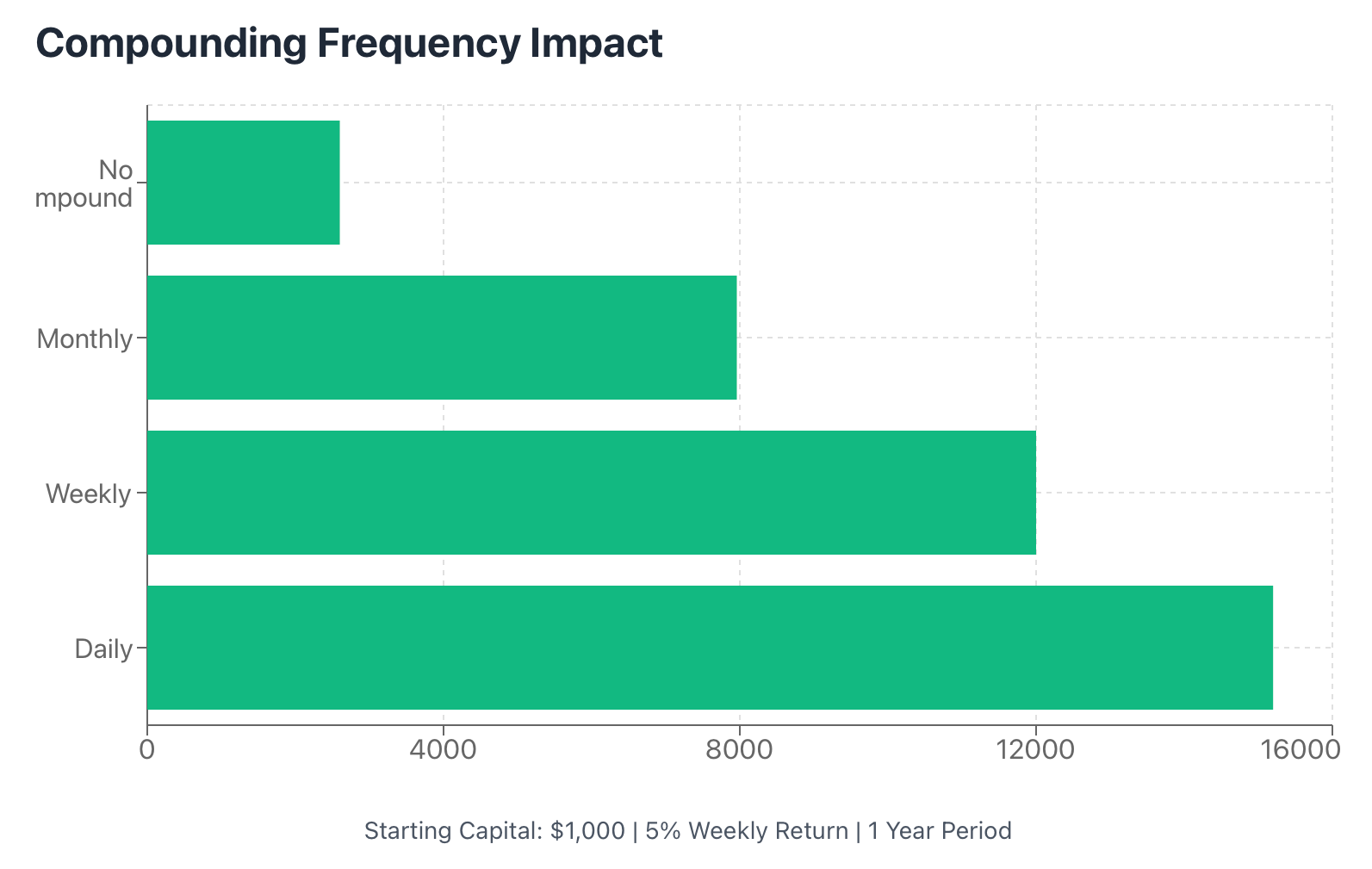
The advantage of compounding your account daily is that you are adding new funds daily, and since the amount of money that you add increases exponentially by compounding, you'll have accumulated more wealth quickly than with the other compounding strategies mentioned.
By compounding weekly, you still have ample time to assess your progress; however, you will have compounded enough to continue the growth of your earnings. Although the compounded earnings resulting from compounding monthly may take longer to achieve your greatest earnings potential, they will eventually exceed earnings from compounding with zero compounding.
To visualise this concept, picture rolling a snowball down a hill. As the snowball rolls, the amount of snow around it accumulates and grows. If you stop and check on the snowball every few feet while it is rolling, you will slow its growth. The same is true in trading; as long as you continue to compound your account without interruption, the larger your account will become.
The two comparisons being made with Trader A and Trader B are that Trader A makes a 2% profit every week using compounded interest. Trader B makes approximately 0.3% profit every day using compounded interest. When you compare the two after one year, the account of Trader B will be higher than Trader A's account, even though the daily profit appears to be very small compared with the weekly profit of Trader A. The reason for this is that Trader B compounds the gains from their daily profits on a more consistent basis than Trader A, compounding them on top of their previous gains.
In addition, what you need to take out of this is that compounding isn't a "quick fix". If you want to double your money overnight, this isn't going to work for you. However, if you are willing to take your time and allow the compound interest to work for you over an extended period of time, you will achieve incredible results! For instance, if you were to invest $1,000 over three years and receive an average compounded monthly return of 10%, you would end up with more than $50,000.
Remember: Be patient! Don't pull your profits out early, and don't stop using your compounding strategy after one bad month. Time is your biggest asset, and it is the only way to unlock exponential growth; therefore, don't rush it. Allow time to do its job!
The Psychology of Compound Trading: How to Stay Disciplined
The concept of compound trading appears attractive and appealing; the true challenge related to it will always be psychological. Greed and fear factor into your journey as a trader; if not controlled, they can disrupt your experience.
When you notice consistent growth in your portfolio, your mind will shift towards greed. You will begin to think to yourself, "If I increase my position size slightly, I will see even higher levels of growth." This method of thinking leads a trader to blow up. Conversely, if you hit a losing streak, fear takes over, and you enter into a state of panic, abandoning your trading plan and either quitting altogether or engaging in "revenge trading" to recoup your loss.
In order to successfully implement perpetual compounding, a trader must have discipline. By having a predetermined set of guidelines, a trader can remain focused on his/her goal regardless of how they are performing.
Set your predetermined stop-loss levels for every trade. Pre-determine what percentage of profits you are going to reinvest into your trading account, making sure to maintain the same reinvestment percentage every time. For instance, if you choose to reinvest 50 per cent of profits into your account, ensure that you reinvest 50per centt every single time, regardless of whether you are on a winning streak or a losing streak.
What happens after hitting 5 consecutive losing trades and your account decreases by 10%? Will this experience be painful? If you have successfully managed your risk, then your losses are only 10% of your account balance, and therefore will not completely wipe out your trading account, but rather will provide you with an opportunity to continue trading.
A disciplined trader will stick with their trading plan and understand that, eventually, through compounding, their account will recover from those losses over time. On the other hand, the emotional trader may become desperate to "get back" to their previous level, by increasing their position size and therefore continues to dig their hole deeper.
Managing anxiety is a big component of this process. Trading will always involve losses, and you cannot avoid them. However, by maintaining faith in mathematics and adhering to your trading strategy, you will be able to ride out the rough times because of the compound effect.
To sum it up? The importance of mindset is equal to that of your trading strategy. Keep your mindset disciplined, manage your emotions, and allow compounding to do the work for you.
Optimising Compound Trading: Multi-Market and Multi-Strategy Approaches
Instead of putting all your eggs in one basket, spread out your investments to reduce risk and volatility while compounding returns across many different asset classes.
If you're only speculating on a single market (e.g., cryptocurrency), then the ups and downs of that market will affect you significantly. If you're compounding returns across many different markets (e.g., Forex, stocks, CFDs), you'll be able to weather the storms and reduce your overall risk.
This isn't much different from making many small snowmen instead of one big snowman. If you have 10 small snowmen and one hits a rock and falls apart, you still have nine left. Because of this, your compounded return would grow consistently.
There are multiple levels of diversification. You can trade the various asset classes, use various timeframes, and use trading strategies that will be effective during different market conditions.
For instance, if you have compounded 60% of your capital into Forex pairs and the remaining 40% into cryptocurrency, then you'll see a steady growth from Forex and will be able to take advantage of explosive gains when cryptocurrency rallies. Your overall portfolio will be balanced between lower volatility asset classes and higher volatility asset classes.
Backtesting helps here. Run simulations on how a combined Forex + crypto strategy would've performed over the last few years. You'll probably find that the diversified approach has a smoother equity curve and fewer dramatic drawdowns compared to going all-in on one market.
By keeping things simple, you will be able to maximise your compound growth. You only need to utilise two or three of your best strategies in multiple markets to give you the maximum benefit of your compounding strategy without creating too much stress on yourself.
Maintaining a diversified trade will help to keep you sharp-minded, meaning that when one market moves slowly or causes you frustration, you have other positions that are still working for you. It is easier to stay disciplined and make good decisions with a manageable number of open trades rather than obsessing over one market position.
A diversified compound strategy will provide the best opportunity for long-term growth while giving you a more stable and less risky method to grow your capital.
Risk Management and Drawdown Control in Compound Trading
One of the least appealing yet most vital aspects of compounding is effectively managing your risk and controlling your drawdowns.
Regardless of how effective your compounding strategy appears to be, if you don't effectively manage risk, then a single losing period will nullify all of your hard work.
Two primary sources of risk arise when you either take excessive exposure to one particular position or allow your emotional state to direct your trading decisions; either scenario can result in catastrophic loss.
To fix this issue, set clear and concise rules; 1-3% max risk on any one trade. Use a stop-loss every time. When you reinvest your profits, be sure to do so in a proportional manner. Don't put everything into your next trade just because you feel good about it.
A good analogy here is to think of a snowball; it can collapse when it gets too large, too quickly. If you pack snow on one side of the snowball or roll the snowball over rough ground without paying attention to where you roll it, then the snowball will fail. The same is true for a trading account; controlled, downstream growth is sustainable over time; aggressive, excessive-compounding cannot be sustained.
Suppose you begin with $1,000 and immediately undergo a run of five consecutive losing trades where each trade costs you 2% of your account. By the end of these five losing trades, your account balance has dropped to roughly $904. That's a pretty rough experience, but it doesn't mean you're out of the game. You can still make a comeback. Now, let's change the scenario to where you are introducing a risk of 10% per trade instead. At the end of five trades, you would have lost approximately $590. This will take much longer to recover from, and it can weigh heavily on your psychology.
The purpose of controlling your drawdowns is to limit the distance that your trading account can drop during a period of difficult performance. With shallower drawdowns, you can recover and continue building your compounding.
One way to manage drawdowns is by using a method known as fixed proportional reinvestment. Instead of compounding 100% of your profits into the next round of trading, you could try reinvesting 50% or 75%. This will keep your trade sizes reasonable, thereby reducing the risk of over-trading during a period of high performance.
Another way to manage your drawdowns is to adjust your risk profile based on the amount of equity you currently have. If you've lost 10% of your peak equity, then it's wise to lessen the amount of risk you are taking on per trade until you've recovered your lost amount to a level above what you had previously. On the flip side, if you're up 20% from your account's peak value, then you can afford to take slightly greater levels of risk than before, but remember to only do so to a lesser degree than before.
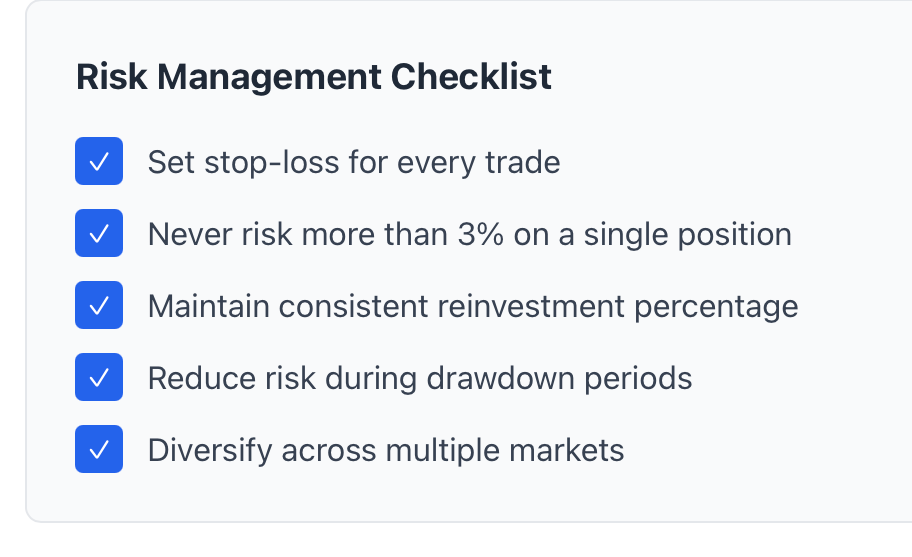
In conclusion, if you're compounding profits with zero risk management practices, you're simply gambling. However, using a disciplined approach to compounding that incorporates a clearly defined risk management strategy enables you to create long-term wealth.
Compound Trading in Action: From $1,000 to Exponential Growth
Now let's illustrate compounding in action with an example of starting with $1,000 and, through consistent profit generation, eventually seeing the result of exponential growth through compounding.
Let's say you initially invest $1,000 and achieve an average monthly profit of 10%, reinvesting the entire amount each month. Here is a summary of the projected results:
-
End of Year 1 - $3,138
-
End of Year 2 - $9,850
-
End of Year 3 - $30,912
As discussed previously, compound interest is defined as where the returns produced via investments also generate interest over time. While both parties had identical initial investment amounts ($1,000) and received identical monthly dividend payouts (10% or $100), there is a significant difference in how these returns will accumulate over the life of the investment.
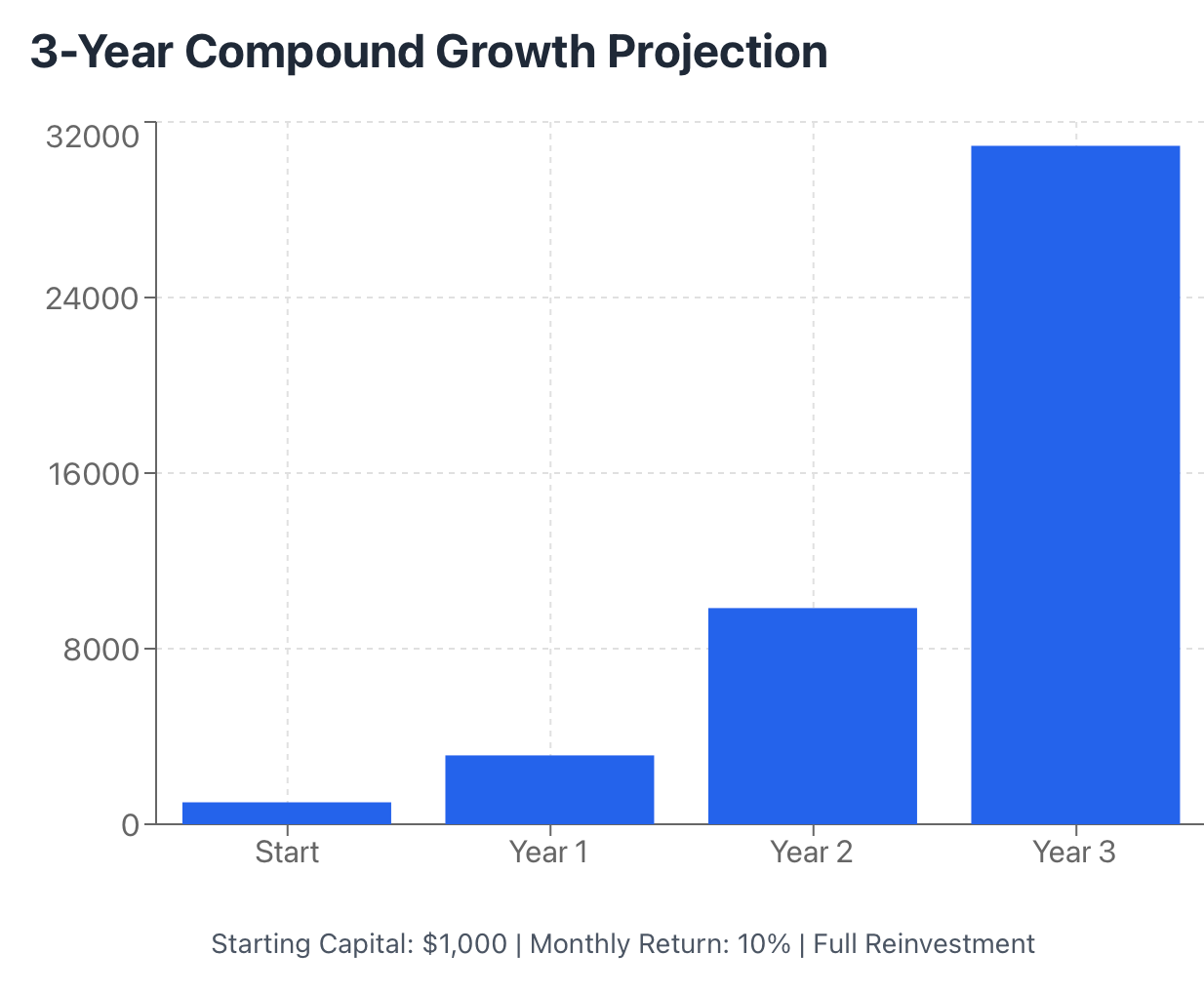
Through compounding, a person who is reinvesting their earnings will have a larger investment because of a greater number of reinvested earnings. Continuing to reinvest dividends allows for a continued increase in dividends earned, which also results in an increasing initial investment. Conversely, if no dividends were reinvested, the investor would not have the same level of return on their investment as the investor who reinvested all of their earnings through compound interest.
A visual representation of this is in the case of a snowball. As the snowball rolls down a hill, it gathers more speed and mass. The initial few revolutions of the snowball create the smallest amount of difference in the amount of snowballs that can be gathered, as compared to the first few revolutions, which were the most significant differences. By the third year of compounding, the compounded interest investor will have a larger snowball than the investor who took their dividends as cash.
In the real world, examples of long-term equities support this premise. For example, if someone invested $1,000 into the S&P 500 (a stock index) thirty years ago and continued to reinvest all of their earnings, their account would now be over $20,000, an estimate of the size of the investment based on past and current market conditions due to compound interest.
While trading shares some fundamental principles with investing, it offers much greater opportunity for flexibility in strategy, as well as much better options for managing risk. Therefore, if you are successful with your trading strategy, you should be able to earn compounded returns on your invested dollar much faster than a long-term investor.
Therefore, the upside of being patient when compounding an investment is that in the first year of the compounding process, you will experience a relatively slow rate of compound growth. However, once you have made it through the second year, you will see a significant increase in the rate of growth, and by year three, the rate of growth will be exponentially greater than it was in year one, making the time and effort put into compound investing worthwhile.
As a general rule, trading is not typically viewed as "instant gratification", i.e., it focuses on building a strong foundation that will continue to grow, but at increasingly higher rates.
Mistakes Made While Compounding in Trading and Suggestions to Help Avoid These Mistakes
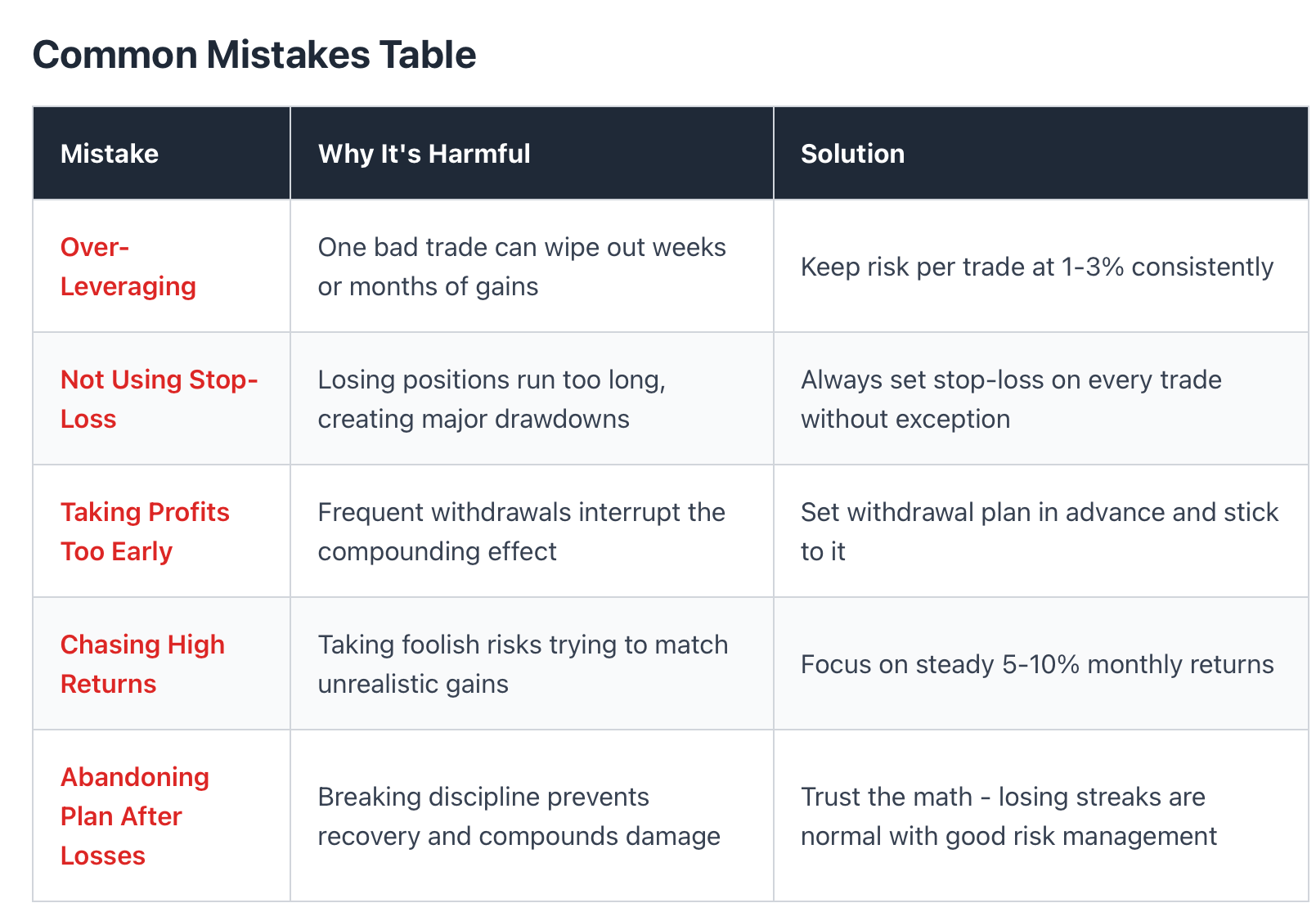
Even when following a great plan, traders can still make mistakes while compounding returns. The following are some of the most common mistakes and what to do to prevent them.
Mistake 1: Over-leveraging. You watch your account increase in size and think, "I can take bigger positions." You increase the amount of leverage you are using, and then one bad trade wipes out multiple weeks or months of growth. Solution: As long as you are consistently getting results, keep your risk per trade between 1-3%.
Mistake 2: Not managing losses. You let a losing position run longer than it should because, in the back of your mind, you are waiting for it to reverse direction. As a result, that trade becomes a major loss and puts you in a major hole on your compounding curve. Solution: Always use a stop-loss on every trade, without exception.
Mistake 3: Taking profits too frequently. You are either anxious to get your money or greedy to keep it all, so you make a constant stream of withdrawals. If you truly need the money, fine, but in doing so, you will have taken an important part of the compounding. Solution: Determine what you will or will not withdraw before you ever make a trade, and stick to that plan without fail.
Mistake 4: Chasing after large profits. You see someone making 50% a month and think you must do the same or fall far behind. You take foolish chances in trades, trying to catch up with them, and fail miserably. Solution: Concentrate on obtaining steady, sustainable profits. Even 5-10% a month will compound into very substantial amounts of money.
Mistake 5: You get discouraged after you have a string of bad trades, lose confidence in yourself, and stop using your original trading plan. Solution: Trust the Math. Losing streaks are part of the process, and if you have a solid risk-management plan in place, you will eventually get back on track. Consider this: A snowball will break if you roll it too hard or if you keep starting and stopping. What works best is a smooth and steady roll.
Compound trading is all about respect for the process, risk management, and keeping emotions in check while you trade. The traders who are lucky enough to be trading for a long time are those who do not make the mistakes mentioned and who have discipline through good times and bad times.
Now, let's take what you have learned above about Compound Trading on BTCDana and get started.
Your plan is as follows:
Step 1: Get Good at Risk Management. You should have a small amount of loss (1-3% of your total trading balance) for each trade, you must have a stop loss in place, and you should never leave so much of your account exposed to being leveraged. This is the foundation for everything you do.
Step 2: Have a Profit-Making and Reinvesting Plan. Decide beforehand how much (i.e., 50%, 75%, or 100%) of every gain you will reinvest back into your trading account consistently every time.
Step 3: Commit to the long run when investing in Compound Trading. Compounding takes a certain amount of time to be effective. Don't expect to see huge returns during your first month of investing. It usually takes around 12 months before you start seeing an exponential growth curve.
Step 4: Get started on BTCDana. BTCDana provides simulated Compound Trading accounts, which allow you to practice without using your own money. Once you feel comfortable with how Compound Trading works, you can experiment with different ratios for reinvesting your profits and figure out what works best for your trading style.
Lastly, avoid getting caught up in chasing after short-term profits! Compound Trading is not a way to become a millionaire overnight! It is a long-term investment and requires patience, consistency, and perseverance.
So if you are ready to watch your account grow exponentially, sign up for BTCDana today and get started on the journey to Compound Trading. Small, consistent profits today can lead to substantial profits in the long term!