



Introduction
The cryptocurrency market has changed immensely since Bitcoin was launched. Early on, there were centralized exchanges where most trading took place. Centralized exchanges have their advantages, but also serious downsides. Traders were continually faced with high transactional fees, regulatory limitations, and platform risk. So traders turned to look for alternatives - peer-to-peer (P2P) trading was born.
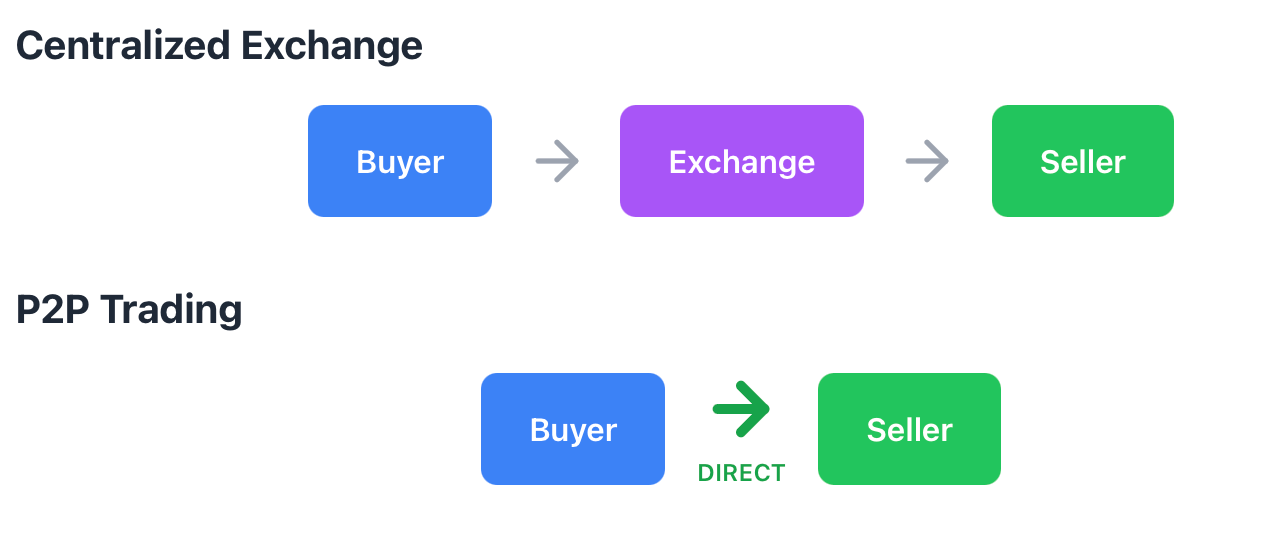
In a truly P2P cryptocurrency ecosystem, users can buy and sell digital assets directly to each other without any traditional intermediary in the middle of the transaction. In a centralized exchange, for example, if you bought a Bitcoin - the transaction would flow as such:
buyer <-> Exchange <-> Seller. P2P trading allows trading directly where the transaction flows as follows, buyer <-> seller. This takes the concept of decentralization and utilizes the value it was intended for.
P2P trading's highest perceived value is flexibility. Users can transact using several hundred payment methods, they can trade across borders, and a user has maxim-rate control of their hard assets. Locally, peer to peer platforms like LocalBitcoins and Paxful have provided demand-side peer trading with billions traded, especially driven from regions where traditional banking is limited or unobtainable.
Think of your friends trading Xbox or PlayStation Live points directly to each other without needing the teacher or school as an intermediary to facilitate the trade. It is simple, but the financial freedom advantages run deep. In this guide, we will show you everything you need to know about P2P from basic concepts to advanced security practices.
What Is P2P Trading?
P2P trading is a method where cryptocurrency buyers and sellers connect directly on a platform to complete transactions. The platform itself doesn't hold or control the assets. Instead, it serves as a marketplace where users can post offers and match with trading partners.
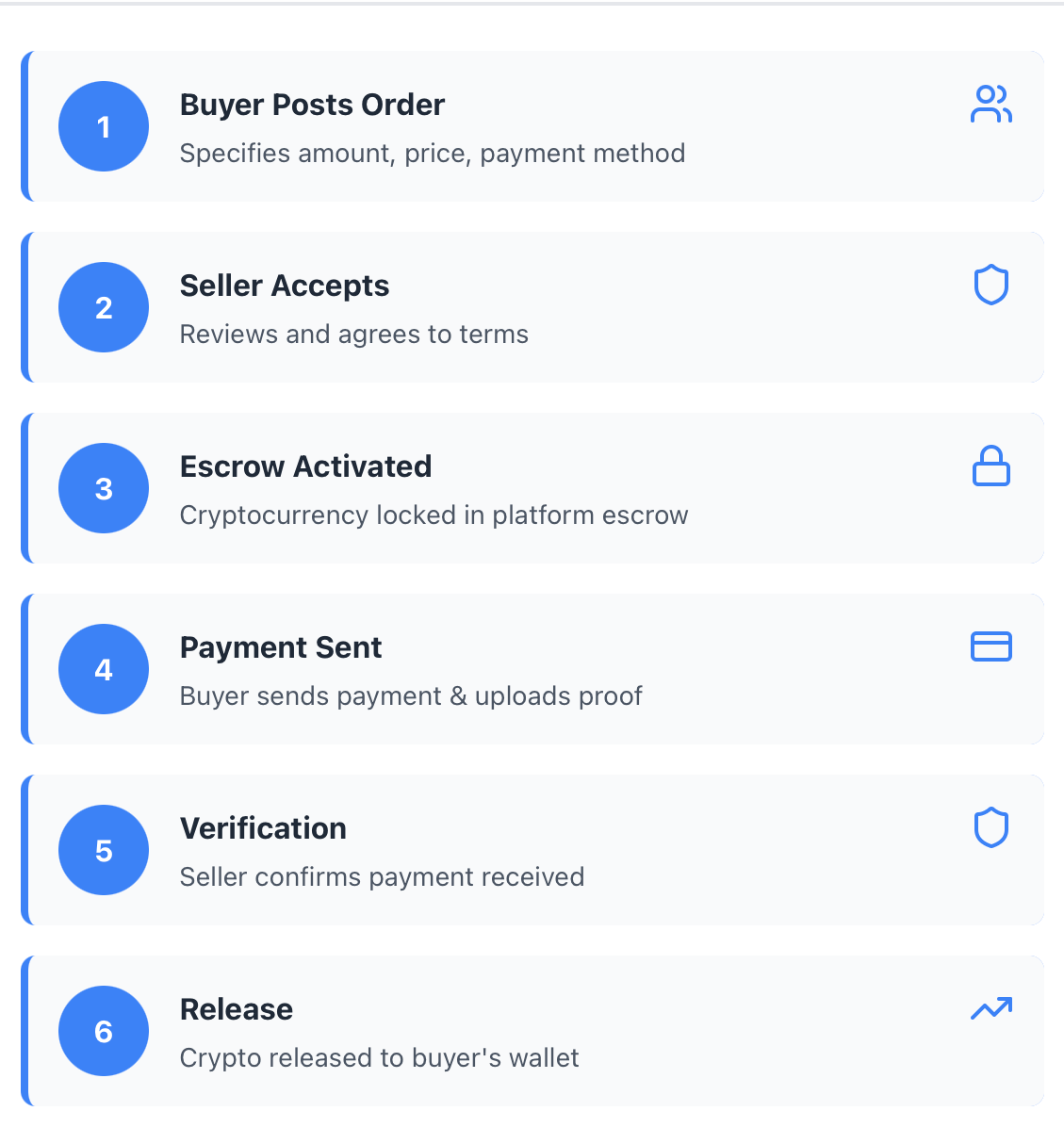
Here's how the mechanism works. A buyer creates an order specifying the amount of cryptocurrency they want, their preferred price, and payment method. Sellers browse these orders and choose ones that match their preferences. Once both parties agree, the platform activates its escrow service to secure the transaction. The cryptocurrency gets locked in escrow while the buyer sends payment through their chosen method.
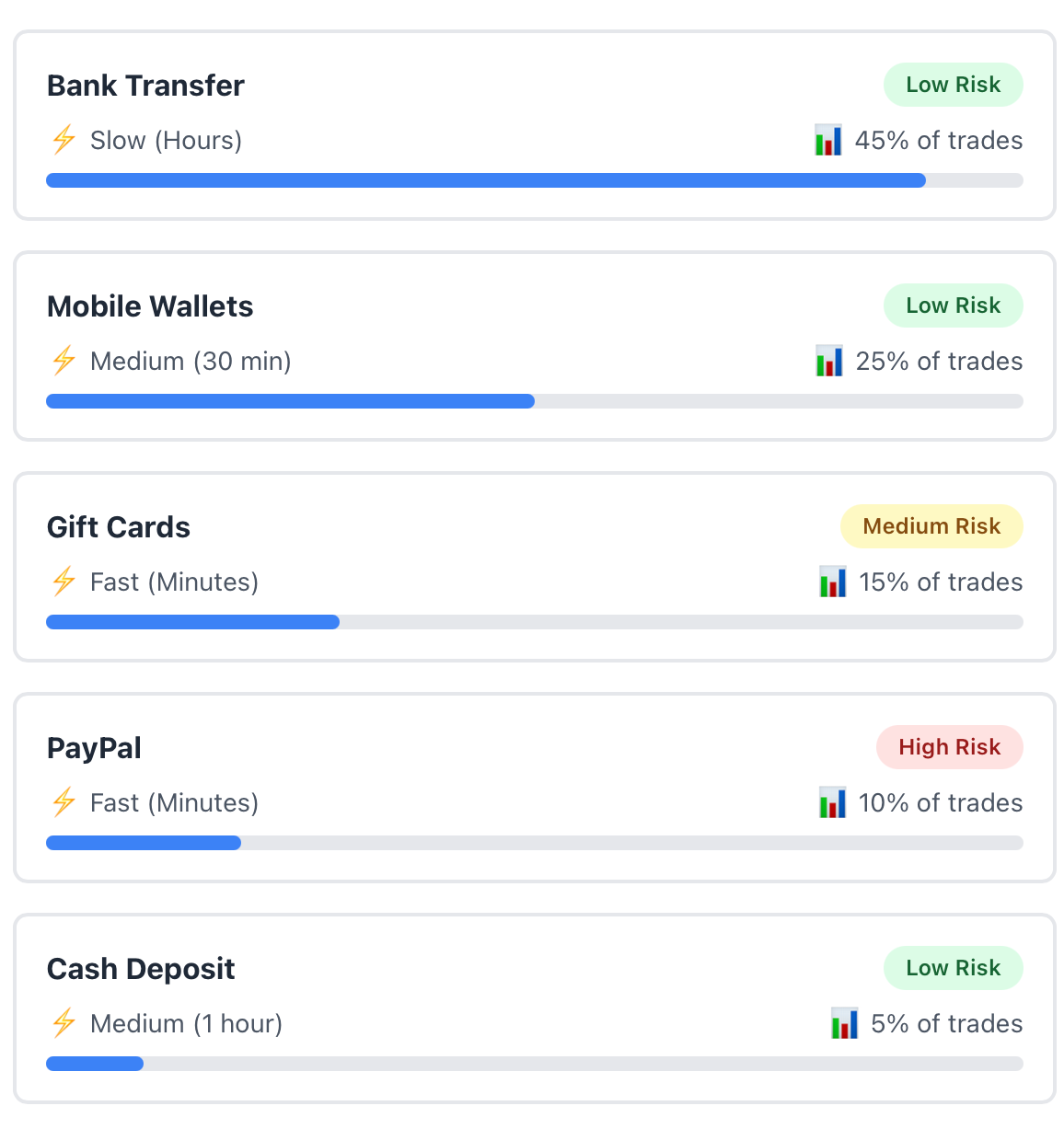
The beauty of P2P trading is payment flexibility. Platforms like Paxful support over 300 payment options, including bank transfers, PayPal, gift cards, mobile wallets, and even cash deposits. This versatility makes cryptocurrency accessible to people worldwide, regardless of their local banking infrastructure.
Every P2P platform contains security measures built in. The escrow feature makes cheating impossible because neither party can access the funds until the trade completes. If there is a dispute between the parties involved, the platform will help investigate and resolve the dispute. The user rating systems will help traders find reliable partners, and transaction limits allow inexperienced users to start small and slowly build confidence in their trading partners and the P2P model of trading.
P2P trading has independence from centralized exchanges. Traders are not reliant on the exchange's liquidity or pricing. Users will negotiate the amount, terms, and price directly with users and often find much better pricing. P2P trading is like using a second-hand marketplace, where buyers and sellers negotiate their own prices based on market conditions and individual desire for negotiating and prices.
How P2P Trading Works
Knowing the entire P2P trading process allows you to trade with confidence and security. This procedure follows a series of steps specifically designed to secure both buyers and sellers.
The first step is for the buyer to post an order. The buyer posts a request on the P2P platform, stating how much cryptocurrency they want to buy, their offer price, and what payment methods they can accept. The offer will then show up in the platform's marketplace for sellers to search. And, when the seller finds an offer they like, they select it and will reach out to communicate with the buyer.
Where both parties agree to the trade, the platform's escrow functionality is initialized and activated. This is where P2P security begins. The seller's crypto is locked into the P2P platform's escrow wallet. The seller cannot retrieve the locked funds, nor can the platform use the locked funds until the trade properly completes. This protects buyers against sellers who may take payment and not deliver the cryptocurrency.
After a successful payment is made, the buyer will then provide proof of payment to the seller. The buyer sends the payment in whatever payment method they agreed upon. This could be a bank transfer, a PayPal transaction, gift card code or whatever payment type they agreed to use. The buyer then uploads proof of payment, which could be a screenshot of the transaction receipt, or other transfer details. Lastly, the buyer will notify the platform that they have made full payment.
The seller then verifies with their payment service provider that the payment has actually settled. This step is very important. The seller never releases cryptocurrency until they verify that they actually have received the funds in their payment account. Once the seller confirms that the money is available in their payment account, they notify the platform; the platform then releases the cryptocurrency from escrow to the buyer's wallet.
The whole thing may take 15 minutes to an hour based upon the speed of the payment method used - bank transfer is a common method that may take some time, while gift card trades may happen in just a few minutes. Parties can communicate through messaging on the platform through a variable exchange process to coordinate the transaction and additional details while both buyers and sellers wait for the transaction to complete. There are also multiple testing and risk measures in place that are working during this entire period.
Every user has a rating based on past completed trades. Traders who have completed hundreds of successful trades with positive rating scores are generally more trustworthy. The platform monitors suspicious activity and can freeze user accounts showing signs of fraudulent activity. There are also limitations in place to restrict new users from trying to execute a large scam until they have a little bit of a reputation.
Visualize it in this manner. You purchase a used phone online. The platform retains the phone until payment is made. Once you indicate payment was made the seller indicates they received payment, then the platform ships the phone to you. Everyone is entitled to protect their money and valuable item while avoiding relying on trust, because the platform will hold that valuable item in neutral custody until both parties have satisfied their obligations to one another.
Consider that LocalBitcoins and similar escrow services process thousands of escrow transactions each day with a greater than 99% completion rate without any disputes. There are many good reasons there is this level of success, escrow transactions are effective for creating trust between two strangers.
Advantages of P2P Trading
Peer-to-peer (P2P) trading encompasses a number of advantages that contribute to its increasing rate of adoption internationally. These benefits resolve many of the pain points that traders face when using centralized exchanges.
First among them is decentralization. You are not dependent upon a single company or trading platform to hold your funds in custody. If one P2P platform is down due to technical issue or regulation, then you can simply go to another platform. In P2P trading, your cryptocurrency stays in your personal wallet until you choose to trade with someone. You significantly decrease the risk of having your funds stolen during an exchange hack or have the exchange go bankrupt while holding your funds.
Second is payment flexibility. Do I need to use a specific local payment app? Do I want to pay with a gift card that I received as a gift? Do I have cash that I would like to deposit into the bank or my account? All payment methods are typically accepted on a P2P platform. This can be particularly useful, especially in countries with poor access to banking, or limited capital controls. People can simply go through P2P to access whatever payment tools they have available to trade cryptocurrency.
Privacy is another major benefit. While all reputable sites require some verification, trading P2P can provide better privacy than centralized exchanges. You're trading with individual traders instead of institutions that could provide your information to governments or data brokers. Some sites make limited anonymous trading possible for small amounts, but this depends on your jurisdiction and the site agreement.
The barrier to entry is incredibly low as well. Unlike centralized exchanges, which may require sizable minimum deposits, you can trade on P2P exchanges with small amounts. You could even test it with as little as $10 to get the hang of it and build your reputation. This opens up cryptocurrency to entire populations in developing countries without much capital.
Cost benefits are interesting for regular traders. Generally speaking, P2P exchanges have lower fees than centralized exchanges. Some sites don't even charge fees, making money on premium features instead. Even the sites that do charge fees typically charge 1% or less - much lower than 2% to 5% in fees on some centralized exchanges.
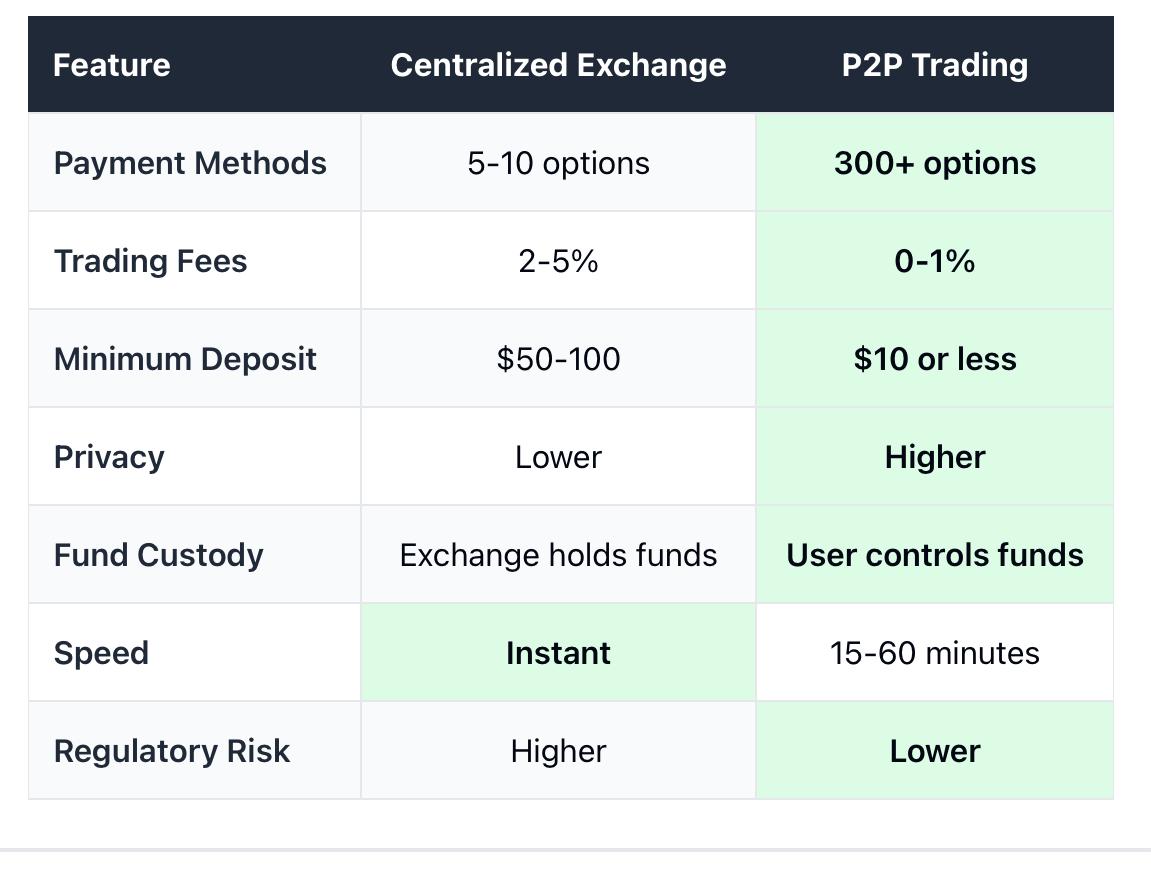
In areas with strict cryptocurrency regulation, users can use P2P trading as a legal way to access digital assets. P2P exchanges will often continue to operate when governments restrict centralized exchanges because P2P exchanges do not custody users' funds. For example, when Nigeria restricted cryptocurrency in 2021, many users turned to P2P exchanges to continue to buy cryptocurrency despite the ban.
For the uninitiated, imagine swapping gift cards directly for Bitcoin with someone halfway across the world without a bank or corporation in between. That is P2P trading; you hold the control, you set the terms and you trade when it works for you.
Risks and Challenges of P2P Trading
Even with its advantages to users, P2P trading still involves risks, and it is crucial for every trader to know and be prepared to deal with them. However, with awareness and some safety steps, these risks can be managed.
The most common risk is fraud. Scams have occurred involving the creation of fake payment confirmations, stolen payment accounts, or chargebacks after the buyer receives the cryptocurrency. In fact, fake screenshots of bank transfers happen often enough that traders should be careful. Scammers also create new accounts for the express purpose of scamming one or two traders and then disappearing. Or a seller using a service like Paypal accepts payment from a buyer and the payment backs out, as the buyer claims they did not authorize the payment.
Price volatility is a risk for P2P traders that does not affect centralized exchange traders nearly to the same degree. Often the time it takes to complete a trade using P2P causes volatility to happen while the buyer or seller waits to complete the trade. For example, if you agree to sell Bitcoin at $50,000 but the buyer takes an hour to pay, the price may now be $49,000 by the time the payment is confirmed. This affects both buyer and seller.
The quality and speed of resolving a dispute can vary greatly from platform to platform. If a trader has a dispute with a buyer or seller, it is up to the platform's support team to investigate and provide a fair resolution. Some platforms will resolve disputes in hours, while others could take a few days. During that time, the trader's funds and the buyer's funds are being held in escrow. This can wear on one's patients while waiting for investigation to be resolved, as well as miss out on potential trade because the funds are locked.
Validation procedures are critical for trade safety. Always conduct transactions using the escrow service provided by the platform - never, ever consent to a trade outside of escrow. Thoroughly research the history and ratings of your trading partner. The person with hundreds of completed trades is orders of magnitude more reliable than someone with a brand new account. Whether working with a new trading partner or trialing a payment method start small.
Verify every detail on your own. Do not trust screenshots or what a person says. Always check your bank account or payment service to confirm payment has actually arrived. Exercise extra caution when using payment methods that can be reversed. There are seasoned traders who won't accept a transaction funded with PayPal due to chargeback risk.
Though technical concerns are less likely to happen, they still exist. There is a minor chance that there may be a flaw in the platform being used that could be exploited by a hacker. Major P2P platforms invest tremendous resources into security, but there are no guarantees a platform won't be hacked. The safest option is keeping most of your cryptocurrency in a personal wallet instead of the platform wallet, limiting your exposure to technical issues.
The regulatory risk will differ from country to country. There are governments that either strictly regulate or surveil P2P trading. Using these services can possibly attract additional scrutiny of one’s financial transactions. In extreme cases, a government can completely ban a P2P platform, but users will usually just jump to a different platform and continue trading.
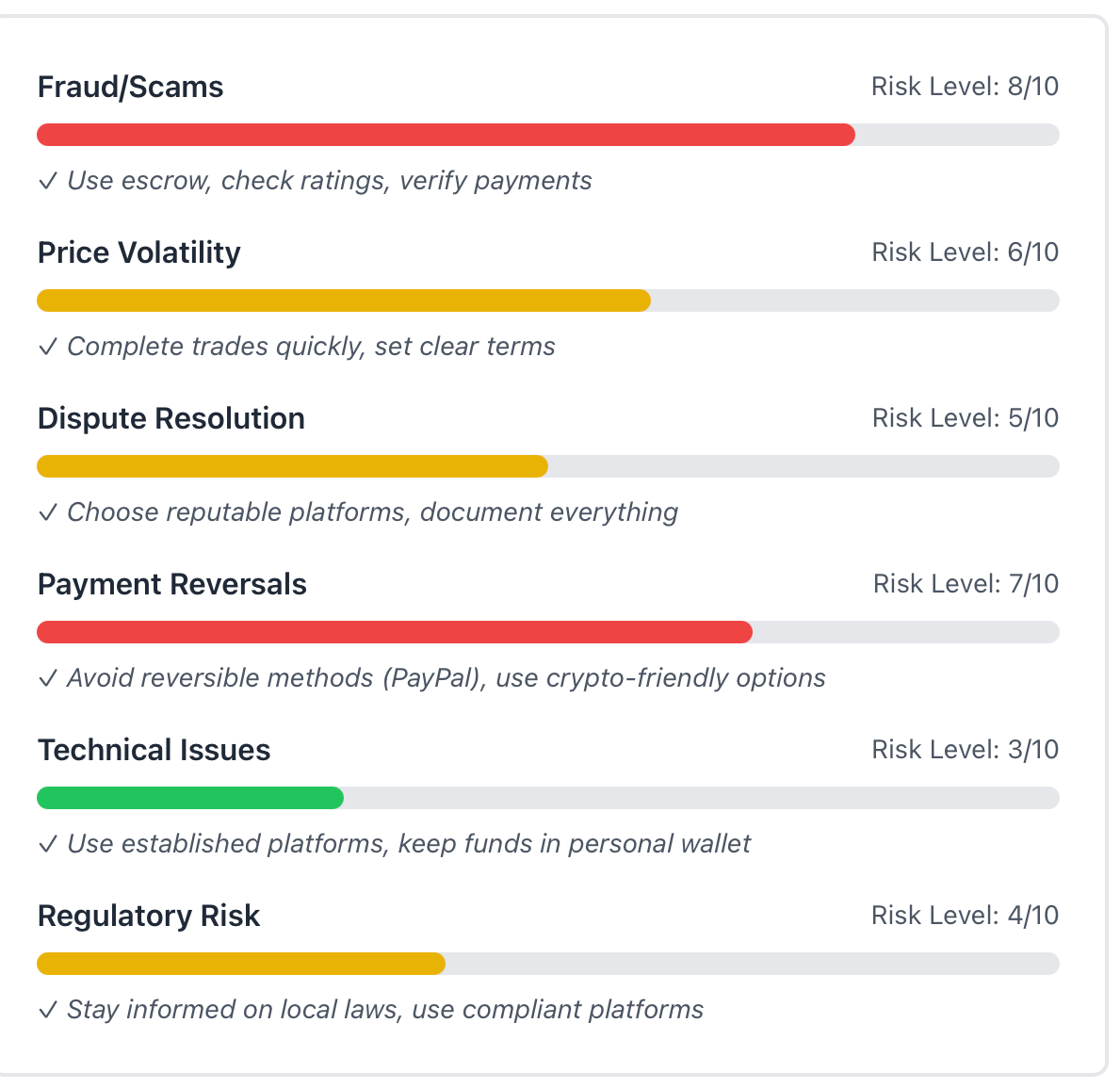
Local Bitcoins stated in 2022 that it saw numerous attempted scams but that users who adhered to the platform's guidelines never ended up losing funds. The main idea is to treat P2P trading the same way you treat all other online transactions with strangers: Trust the escrow process, verify especially on a first transaction, and don't let greed or scarcity dictate what you do.
Take second-hand marketplace transactions as an example - you wouldn't send payment before having seen the item or having checked the seller's feedback. P2P cryptocurrency trading operates with those same principles of caution and verification to protect you from nearly all risk.
Global Applications of P2P Trading
P2P cryptocurrency trading has grown especially popular in areas where traditional financial services are limited or unavailable. The worldwide trend of P2P activity also provides an interesting perspective into the real-world utility of cryptocurrencies.
Africa is leading in P2P trading growth. Countries such as Nigeria, Kenya, and South Africa exhibit explosive adoption patterns. In 2023, the volume of P2P trading in Africa soared over 40% compared to 2022! Many factors are driving this growth including limited access to banking services and/or currency instability, while affordability of remittances also contributes. When Nigeria's central bank restricted cryptocurrency exchanges in 2021, trading volume in P2P applications sharply increased as users sought alternative services.
Latin America is another major P2P market. Exchange activity in Venezuela, Argentina, and Brazil is particularly high. Hyperinflation and capital controls in these countries drive many citizens to store value in cryptocurrency. P2P platforms allow users to quickly and easily convert the local, unstable currency to Bitcoin (or stablecoins). The same workers who use remittance services to send cash home utilize peer-to-peer exchange or trading services to quickly and easily send bitcoin home, while avoiding exorbitant fees traditional remittance services apply.
Southeast Asia is seeing increasing P2P engagement as well. Countries such as Vietnam, Thailand, and the Philippines have vibrant P2P trading markets. Many utilize cryptocurrency for international business payments or invest in cryptocurrency overall, although the experience varies based on local jurisdictional regulation.
Use cases are typically outlined in various categories. Small remittances account for a large percentage of the P2P volume. A worker stationed abroad can send money home in cryptocurrency; the intended recipient can convert it to local currency via P2P trading. The amount paid usually is less than a traditional remittance service, and the transaction often settles faster as well.
Exceeding exchange controls sharply increases P2P activity. When centralized exchanges face regulatory challenges or face geographic restrictions, P2P trading provides a means to access these crypto assets. Customers in countries without a local exchange can still buy or sell cryptocurrency utilizing a P2P exchange.
Investment and arbitrage-like opportunities entice sophisticated traders. Price differences between different countries or platforms create the potential for profit. A trader might utilize a P2P engagement in one country to buy Bitcoin, and then could sell it at a higher price in another country, and earn the difference.
Trends in user growth underscore the expanding role of P2P. Platforms such as Paxful and LocalBitcoins indicate millions of users, and registration activity continues to rise in emerging markets. Monthly trading volumes globally regularly exceed hundreds of millions of dollars.
The true appeal of P2P trading is that it is grassroots. It is not a corporate or governmental imposition. People are choosing it because it solves daily problems for them. No doubt a Nigerian simply using P2P to preserve savings against currency devaluation has a drastically different need than a European investor, but they both derive utility from the same system.
Think of friends who want to exchange cryptocurrency, yet live in different countries and simply use mobile payment apps. That is what happens millions of times a day globally on P2P platforms. The technology allows inclusion on a scale that previous systems couldn't enable or achieve.
Future of P2P Trading
The advancement of P2P cryptocurrency trading progresses as technology and regulatory measures evolve. Multiple trends are defining the future of what P2P trading will look like in the short- to medium-term.
Technology advancements are increasing security and efficiency. Blockchain-based identity verification systems are in development to allow the user to provide proof of identity without needing to submit the same documents to every platform. Once an identity is verified on the blockchain, any P2P platform would be able to recognize this identity and provide access to the application process, maintaining security while still increasing efficiency.
Smart contract escrow would represent one of the greatest advancements in trustless P2P trading. Most traditional P2P platforms require some level of trust in the platform itself to properly hold escrowed funds without manipulation. Smart contracts can accomplish this with code on the blockchain, instead of the platform provider holding the cryptocurrency and only releasing it once certain conditions are met. This would completely remove the platform as a potential point of failure or manipulation.
Automated dispute resolution is another trend arising from AI and smart contracts. If a dispute arises, the user would not have to wait for manual support to respond and investigate. Systems could automatically confirm payment confirmations from blockchain records and external payment networks. As a result, most disputes would be resolved in minutes instead of hours or days.
Regulatory developments exert pressure in the direction of greater compliance. Nearly every P2P platform now operates some form of Know Your Customer (KYC) procedures and Anti-Money Laundering (AML) procedures. This may take some privacy benefits away, but it also lends regulatory legitimacy to P2P trading and reduces fraud. It’s fair to assume that the verification process will become more stringent, but platforms will also try to strike a balance between the user experience and compliance.
The trend of decentralization continues to strengthen. There are new P2P platforms starting to pop up that don’t even have to operate as a traditional company. P2P marketplaces could be fully decentralized autonomous organizations (DAOs) where users are in charge of the policies and the dispute resolution process. There would be no single point of failure whatsoever.
The interoperability of systems across the globe is improving. Right now, the majority of global P2P platforms exist in a completely independent manner. In the future, it is plausible that we could see one’s reputation or rating system become interoperable between platforms. If you earn a rating on one platform, that rating would likely carry over to other platforms. This would increase the ease for a user transitioning between platforms and establishing trust even when they don’t have a relationship with the new rating system.
Some of these innovations are already taking shape and being adopted by emerging decentralized P2P platforms. Companies like Bisq operate without a company, to enable trustless trading through the use of smart contracts and security deposits. Although the current liquidity is lower compared to centralized P2P platforms, they do demonstrate what is possible from a technical standpoint.
Layer 2 scaling solutions for Bitcoin and Ethereum will make peer-to-peer (P2P) trades faster and cheaper to complete. For example, the Lightning Network allows for instant transfers of Bitcoin at minimal fees. This alleviates a pain point of P2P trading, as functions based on blockchain technology might be delayed due to congestion on the blockchain.
Traditional financial integration is another frontier. Some P2P trading platform users are engaging payment processors and banks to make fiat currency conversion less cumbersome. This could even result in blurred lines between cryptocurrency and traditional money. P2P might eventually feel like using a payment app, with currency conversion taking place seamlessly behind the scenes.
This is like an auto escrow box that unlocks when the conditions are met by both parties, creating a P2P trading experience with no trust needed. That's where the technology for peer-to-peer trading is heading, progressing in a way that is safer, quicker, and more accessible; while still providing the decentralization that P2P assists with in the first place.
P2P trading has a bright future ahead of it. As technology continues to evolve and adoption becomes more widespread, it's likely to become the most commonly used mode for everyday trade in cryptocurrency; especially in markets that have been neglected by traditional financial systems.
Conclusion
Peer-to-peer (P2P) cryptocurrency trading is a return to the basics that inspired Bitcoin's creation: decentralization, user control, and the separation of financial intermediaries. By allowing individuals to trade directly with one another, P2P trading provides global access to cryptocurrency trading.
The value proposition remains strong for P2P. Users can trade with whichever payment method works for them, keep control of their assets until the time of exchange, and gain access to global cryptocurrency markets regardless of jurisdiction. P2P allows for everything from small remittances in Africa to investment activities in Latin America.
It is possible to be cautious, but with sufficient precautions, there are ways to manage risks. Escrow systems, user ratings, and verification practices can get you protected using proper precautions and best practices. As P2P platforms evolve, with the advent of smart contract protocol systems and better security, blockchain will evolve to offer protections.
For investors and traders, the P2P trading volume and trading activity offers important indicators of real adoption of cryptocurrency. P2P trading activity studies real-life people trying to solve issues using cryptocurrency, unlike speculative exchanges. P2P trading offers us perspectives on measuring demand within geographic locations in cryptocurrency trading trends.
The future holds the potential for even stronger accessibility and safety as technology continues to grow. With smart contracts, improved dispute resolution, and other verification methods, P2P trading will become much more seamless, while still being decentralized. Regulatory clarity will both encourage P2P trading and not do it at the expense of some potential benefits.
Whether you’re a novice making your first steps into cryptocurrency or a seasoned trader looking for better rates and more flexibility, P2P trading presents several good options. Start small, always use escrow, check the ratings, and grow from your experience. The global P2P trading community is large and vibrant, and is available for you to trade with at your pace.
Ready to explore the world of P2P cryptocurrency trading and discover how it can serve your financial goals? Visit btcdana.com for comprehensive guides, market insights, and expert strategies that will help you navigate the P2P landscape safely and profitably.