




What is SQQQ and How Does It Actually Work?
If you've ever observed the decline in tech stocks and said to yourself, "I wish I could profit from this," you're not alone. That's precisely why SQQQ exists.
ProShares UltraShort QQQ (ticker: SQQQ) is an inverse leveraged ETF that profits when the NASDAQ 100 declines. Just think of it as a financial mirror to tech stocks, but multiplied by three.
Here's the basic concept: If the NASDAQ 100 goes down 1%, SQQQ is expected to go up 3%. It is designed for traders who are looking to profit from declines or hedging against their existing tech holdings.
The math is not complicated. SQQQ uses derivatives (futures contracts and swaps typically) to create this inverse relationship. You are not shorting any stocks yourself. You're buying an ETF that is a vehicle for you.
During the 2022 tech crash, SQQQ had unprecedented gains of over 100% with the stocks of companies like Apple, Microsoft and Tesla being destroyed for example. Those traders in the right position made huge sums of money while everyone else was wondering how they could stop the bleeding on their tech stock portfolios.
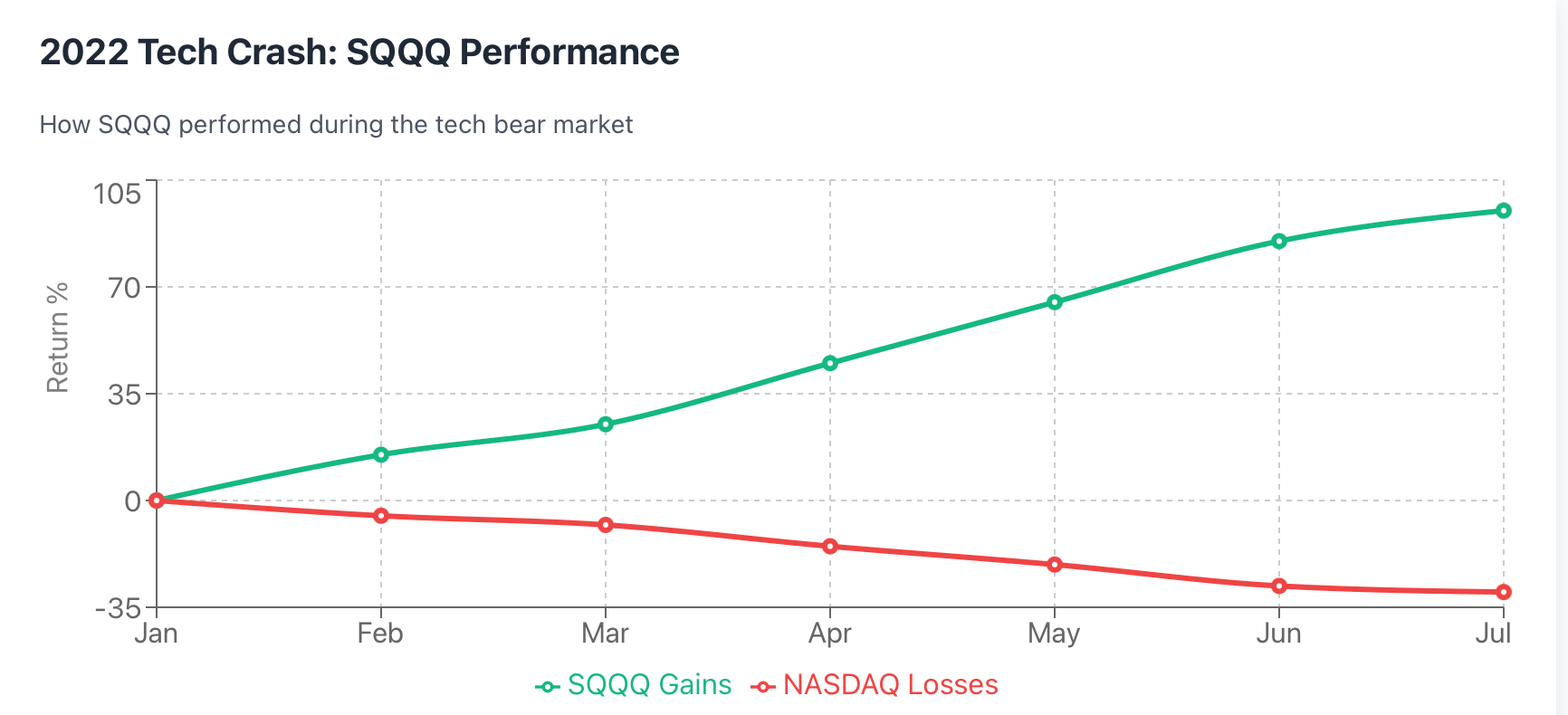
But here's the catch, SQQQ was built for speed and not endurance. It's a sprinter, not a marathon runner. The 3x leverage resets every day, which means holding SQQQ for a period of weeks or months can result in varying and unexpected results because of something like volatility decay (we will dive into that later).
So, who should use it?
Short-term traders who can monitor the market closely, investors looking to hedge their tech-heavy portfolios, and anyone who has full conviction that NASDAQ is ready to go down. This is not a buy-and-forget investment. It is a tactical weapon that requires attentiveness and discipline.
Decoding the 3x Inverse Leverage Mechanism
Let's break down the phrase "3x inverse" because this can confuse people.
Every single day, SQQQ seeks to post and deliver 3x the opposite return of the NASDAQ 100. If the NASDAQ goes down 2% today, then SQQQ should go up about 6%. If the NASDAQ goes up 1% today, then SQQQ should go down about 3%. That’s the contract!
The magic happens with derivatives. ProShares does not actually short every stock in the NASDAQ 100. Instead, they have several different types of financial instruments including index futures, swap agreements, and others, to create this leveraged inverse exposure. It is a lot cheaper, more efficient, and resets the leverage daily.
That daily reset is the important part. SQQQ resets every morning to deliver that -3x return for that day. This sounds technical, but it has enormous practical implications.
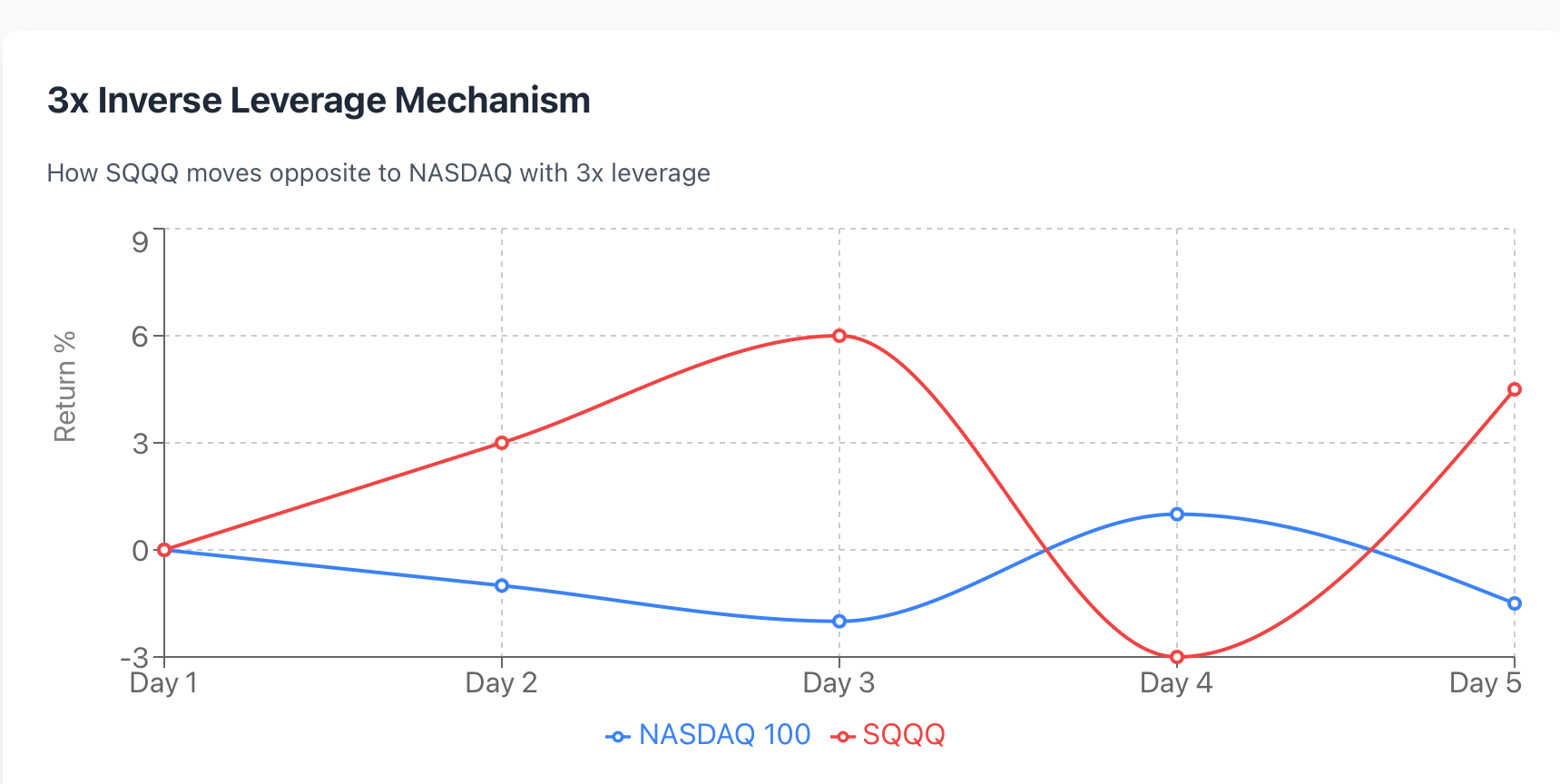
Let’s say on Monday the NASDAQ drops by 5% and SQQQ goes up by 15%. Great! But, then on Tuesday the NASDAQ bounces back-up by 5%, SQQQ does not simply give back the 15%. Even using math, the compounding is different and you may lose around 16-17%. Over the course of multiple days of volatile behavior, the compounding becomes what is known as decay.
Here is a real scenario from the year 2023 during a two week period of choppiness, the NASDAQ pretty much went nowhere (it was down only about 0.5% overall), but SQQQ was down 8% due to the whipsaw action. The daily reset and volatility worked against the holders.
Costs matter as well. SQQQ charges a fee of about 0.95% annually, which is expensive relative to a standard index fund. Add on that you will be charged the bid-ask spread and the cost of maintaining the derivative positions and there is a real friction to contend with which can eat into returns.
The leverage amplifies everything. Your gains get multiplied (of course!) and so do your losses. For example, a 10% wrong direction move on the NASDAQ will statistic a 30% loss to your SQQQ position. This type of volatility can wipe out accounts quickly and therefore prudent position sizing is critical.
When Should You Actually Use SQQQ?
SQQQ isn't applicable in every circumstance. Below are examples of when it does and does not make sense.
Protection in the event of a market crash. If you're long a portfolio of tech stocks and see the storm clouds evenly build (rising rates, stretched valuation, weakening earnings), SQQQ can provide insurance. While you won't sell your long-term position, you may buy some SQQQ to offset some potential loss along the way.
To think of it this way: if you own a house in a flood zone, you wouldn't sell the house every time it rains, but you might buy flood insurance if it does rain. SQQQ directly acts like the insurance policy that you have for your tech portfolio.
Short-term swing trading. Technical traders love SQQQ because of the volatility. If you spot a bearish pattern developing on the NASDAQ charts, a break below key support lines, or a non-confirmation start rising momentum indicators, buying SQQQ will help you capitalize on the short-term price movement with higher returns.
In Q1 of 2022, buying SQQQ during the bounces and selling during tech selloffs, was part of a common technique used by swing traders to repeatedly take profits. Many traders achieve 40-50% profits in just a few weeks.
Why holding long-term fails. Let's be clear, even if you are right in the direction of SQQQ, holding for months will lose money. The daily reset and compounding work against you. Additionally holding through side-ways markets will deteriorate SQQQ value.Even in a downward trend, the journey matters just as much as the destination.
Between 2020 and 2021, when the tech stocks blasted higher, SQQQ lost more than 90% of its value. Anyone who held SQQQ expecting "tech's gotta crash soon" was wrecked. The daily rebalancing and the time decay were unforgiving.
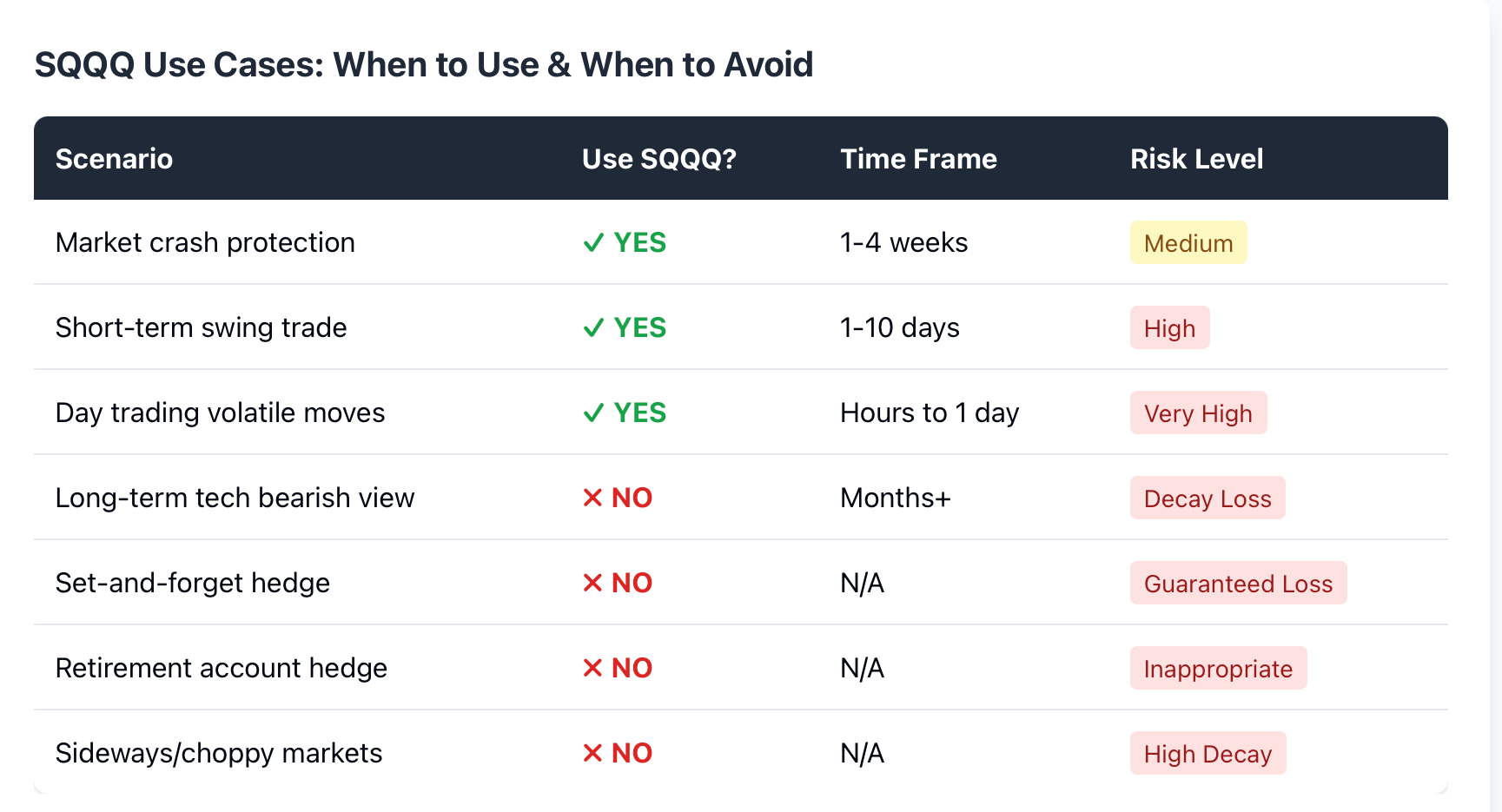
Who should avoid SQQQ? Long-term investors, anyone who isn't monitoring a position on a daily or at least every other day basis, someone who doesn't understand leverage and is a beginner, and anyone looking to set it and forget it as a hedge. If you cannot, at all, accept the idea of losing 20-30% in a week of bad trading, it simply is not the product for you.
Bottom line: SQQQ is a scalpel, not a hammer. Use it for a specific purpose in a short time frame if you have conviction in your near-term directional view.
The Risks Nobody Talks About
Every promotional document on inverse ETFs will show you trades that ended well. Again, let's talk about what can go wrong.
Volatility decay, which is real and brutal. Even if the NASDAQ trend down over the longer term, it could be a bumpy ride to get there and that volatility kills your returns. The NASDAQ could lose 20% in three months, but a bumpy ride getting there. So instead of being up 60%, SQQQ might only be up 30-35%. The daily resets and whipsaw price action took 25-30% of the upside off the table.
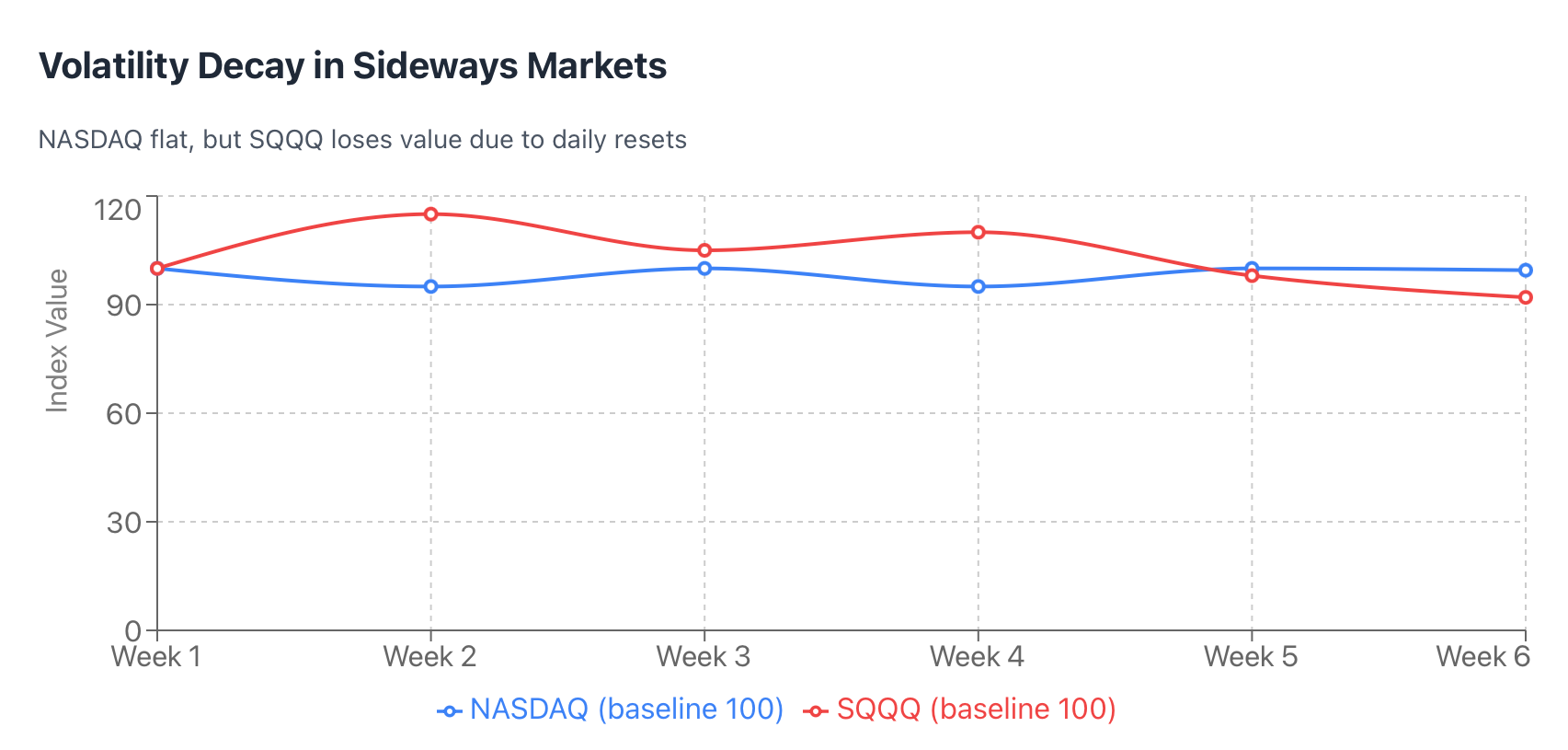
In March of 2020 during the pandemic crash, ironically, the NASDAQ lost a lot of value, but successful trading was about learning how to handle enormous intraday price swings. If a trader of SQQQ held during the sessions, only to wake up and then find that SQQQ had a big overnight gap-up, they were ruined. On any given day the NASDAQ might fall 5%, rally 4%, and fall 3%. When you get price action like that in your trade, it's going to blow up a leveraged product.
Leverage works both directions. On a day with a 5% rally in tech stocks using SQQQ, you could experience a 15% loss in SQQQ. Use leverage on top of that (trading SQQQ on margin for example) and you have lost your account! Watch how fast your account can blow up trading this way.
Tracking errors also happen. SQQQ does not always deliver the expected -3x returns. If you're SQQQ is supposed to deliver a 3:1 return, it may only return 1:2. Timing of rebalancing, slippage in loose market conditions, and other volatility attributes create separation between expected versus actual performance. On extreme volatility days, tracking can be off 10-20%.
Management fees and costs. That annual fee of 0.95% might not sound like a lot but for a product intended for short holdings, you're basically paying 3x per month to hold the product. If the average trading length is placed at one month, I have paid almost 0.08%, plus trading costs, plus the invite cost to the daily rebalancing.
Risk management rules of the road: If you plan to trade SQQQ you need stop-losses. Period. Most traders utilize a 15-20% stop-loss rule. If SQQQ goes 15-20% the wrong way against your position, that's the trade-exit. No exceptions, and no hoping for a pull-back.
Size becomes just as important as any other risk management component. Most pros won't put more than 5-10% of their portfolio in SQQQ personally. The risk is too asymmetric. Having a small position gives you decent market exposure without risking your account.
SQQQ vs TQQQ vs PSQ: Choosing Your Weapon
It helps to know what you’re getting yourself into.
SQQQ gives you -3x daily returns on the NASDAQ 100. It's intended for aggressive bears or hedgers that want max punch.
TQQQ is just the opposite: +3x daily returns on the NASDAQ 100. This is for bulls that believe technology, in particular, is going to rip higher. TQQQ returned over 150% in 2023 on the AI rally.
PSQ is -1x (a simple inverse) on the NASDAQ 100, which is the conservative exposure. Less leverage equals less risk and less decay.
If you want to hedge but don’t need to be aggressive, using PSQ makes sense.
The leverage ratio changes everything. 3x leverage gives you 3x the profit in a straight-line move, but during a choppy environment, that leverage means extra decay. While in sideways markets, PSQ holds up better.
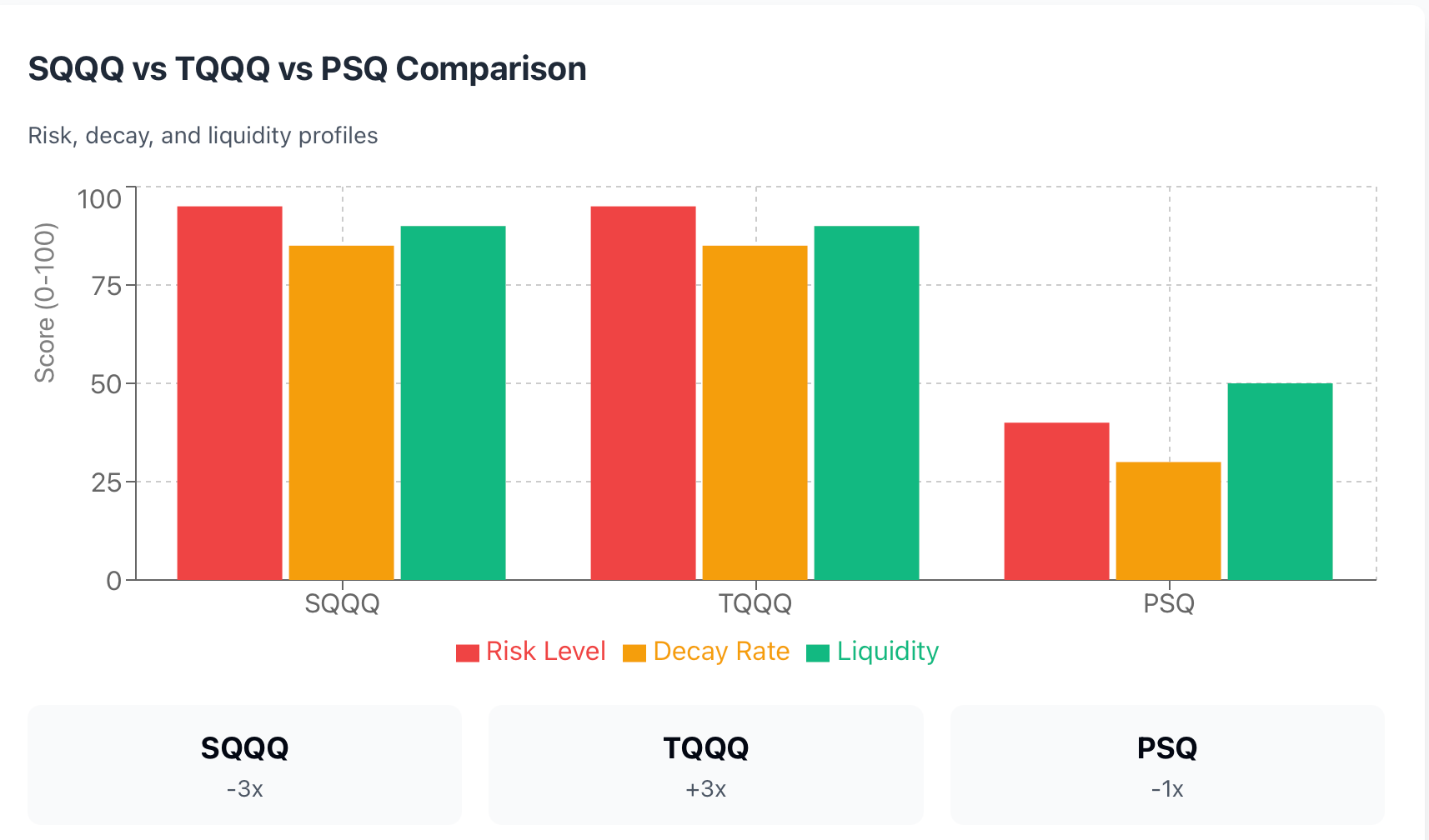
The use cases are pretty different.
Day traders like SQQQ and TQQQ for most action. Swing traders might use any of them depending on conviction level. Long-term hedgers (yes, those exist), prefer PSQ because of the manageable decay factor which they are prepared to bet against.
In fact, during the 2022 bear market SQQQ outperformed PSQ almost 2x which makes sense with the leverage ratio. However, during the choppy first half of 2023, SQQQ actually underperformed compared to PSQ on a risk-adjusted performance because the extra volatility created more decay.
The analogy here is as an accelerator vs brake.TQQQ is comparable to pushing the gas pedal all the way down to the floor while driving up a hill. SQQQ would be compared to hitting the brakes on a steep hill going down. PSQ is more simply application of brakes. It really just depends on how aggressive you would like to be in your trading and how much risk you are willing to accept.
One additional note I would make here is the liquidity of these ETFs. SQQQ and TQQQ are liquid with tight spreads while PSQ has fairly low volume leading to wider spreads and possibly worse executions on your trades.
Developing a Real Trade Plan for SQQQ
All the theories have steps for applying it practically. Here is how to actually start using SQQQ.
Develop a plan: Prior to buying a share, you must know the entry point, stop loss in case it reverses in price, take profits to exit. Give some thought. You may determine the market will top out at 16,000 for the NASDAQ index. Your entry plan has to include entering SQQQ should the NASDAQ break below 15,800, let’s also say you have a stop loss of 16,200, the profit area for approximating an entry would be 15,000.
Use technical analysis: Just like it was mentioned for entry, I know there are SQQQ traders that watch charts of the NASDAQ obsessively. Technical analysis will include resistance levels, support levels along with moving average levels (like 50-day and 200-day), and RSI and MACD. There is not a magic to trading and again technical analysis is a means to position at entry and exit points when the market indicates.
In February of 2024, the Nasdaq broke down below the 50-day moving average after a long rally period. Traders who immediately bought SQQQ into similar trade entries made 25% in two weeks as tech stocks corrected down.
Think of other hedging strategies as well. Some sophisticated traders actually use SQQQ combined with other hedging strategies, like having put options on the QQQ or just on individual tech stocks or both. The order of selling shares using either position but holding a put option gives broad exposure to moves in the market, but different types of risk to either position. Likewise, many traders use SQQQ in combination with calls on the VIX, since they fill the need to profit as volatility is going up and the market moves in one direction, are two different trades.
Demo trading is a must for beginner traders either licensed or not. If you do not have any experience trading a leveraged ETF like SQQQ, you should not try to learn trading that shares or back to trading real money in your account. I would suggest that you open a paper-trading account and watch how SQQQ trades for a month. See how the daily price action will put SQQQ up or down to follow, how to apply decay / effects of the reverse split, and become familiar with your own emotions by watching SQQQ essentially decay 10% a day.
Someone, a veteran trader, noted in passing also to watch the economic calendar. Just like someone veteran trader who's not to trade price movement around those events since they are covered by their own market risks.
The SQQQ moves violently around either economic or company data release events. Data releases for the FOMC meeting, CPI, GDP, tech earnings, etc may present major market risk conditions either the day before or day of the report. Many traders choose never to hold SQQQ to avoid dealing with the extreme overnight risks.
For example, in June of 2023, the Fed surprised the market when they cancelled it's hiking intention. On that day SQQQ dropped 18% because of the price moves up in tech stocks and options at once as the market reacted.
Position sizing: Position sizing as a courtesy ratio is just that. If you are hedging with SQQQ, be somewhat symmetrical in limiting your position exposure. I would typically suggest sizing exposure to essentially 1/3 of the leverage of using SQQQ related to your long trade position. For example, if you hold long positions of stock market or tech company stock worth 30,000, position hedge above 3000 or a lower size, just as example risk.
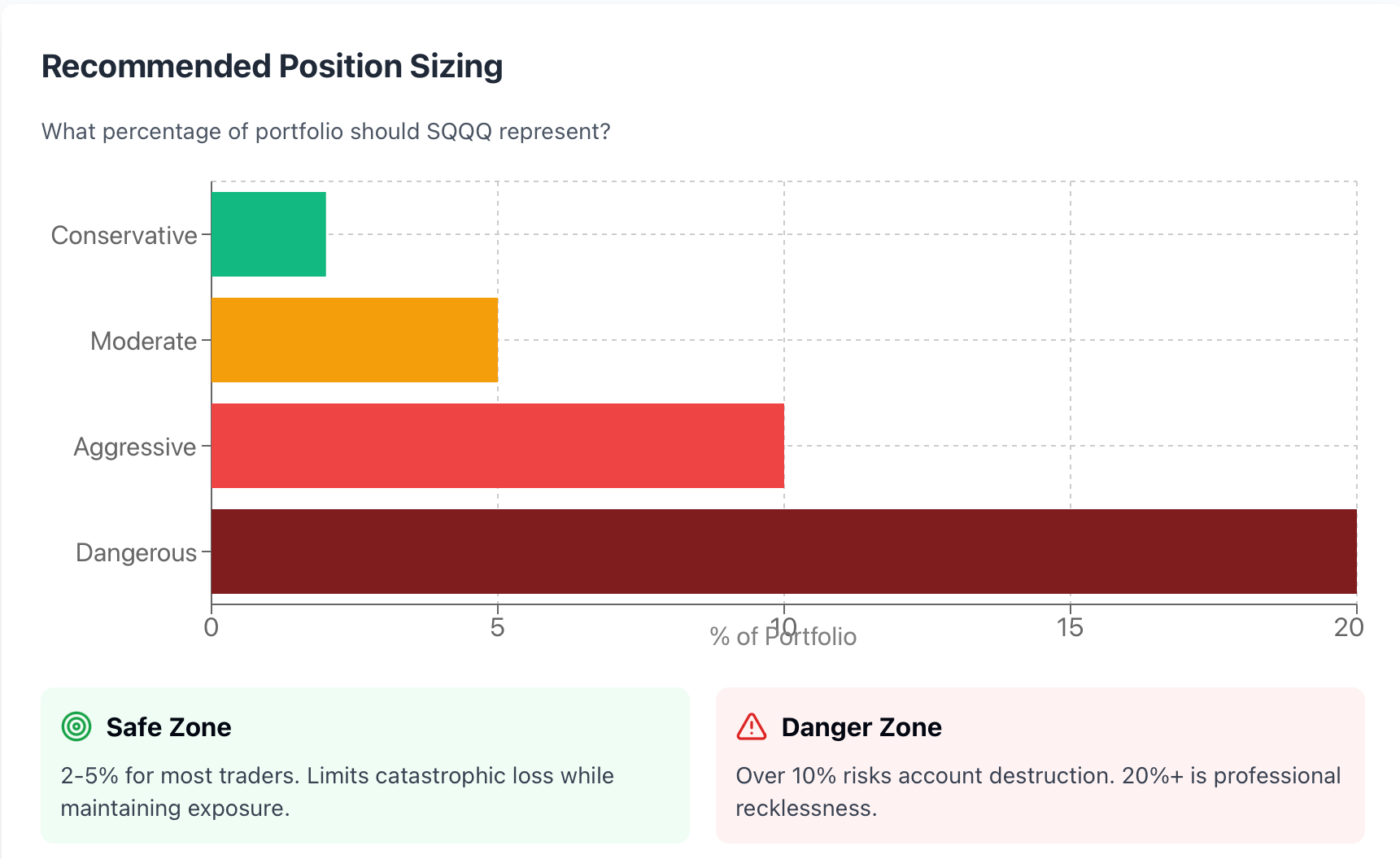
For speculated trades, typically no disciplined trader should ever trade at either risk because too much risk either around volatility or deviations needed-sized trading. Reasonable-sized trades would generally not risk more than 2-3% of your total trades and strategies in one position with SQQQ given the volatility.
What's Next for SQQQ? The 2025 Outlook
There are a few reasons to think that SQQQ may become relevant again.There are several reasons to suggest that SQQQ might matter again in the months ahead.
To begin, technology valuations are again stretched. As of late 2024, the NASDAQ 100 is again near peak multiple levels similar to previous bubbles. In particular, the hype around AI resulted in valuations in stocks that seem unsustainable. If the hype does not pan out, then SQQQ may have another explosive move to the upside.
Next, rates matter a lot. Tech is rate-sensitive assets because valuations depend on discounting future cash flows back to today. If the Fed keeps rates higher for longer, or if inflation forces the Fed back to hikes again tech will take it on the chin, allowing SQQQ to take advantage of it.
Most notably, the 2022 example is instructive: rates went from near-zero to 5% in 2022, causing tech to be crushed. As a result, SQQQ more than doubled. If the macroeconomic context evolves the same way again into aggressive rounds of monetary tightening, it would make sense that history could repeat itself.
There also runs the risk of rapid reversals. Herein lies the problem: markets can reverse volatility. If you are long-short SQQQ and the Fed pivots to cuts or a positive catalyst makes its way to the market, you are looking at 30-40% losses in a matter of days. This happened in 2020 post-COVID when the SQQQ longs were figuratively obliterated betting on continued economic weakness.
Timing is extremely important with SQQQ. It is not so much that you have the macro context correct but that you are timing the direction correctly in the moment.While it's possible to correctly forecast a 20% decline in tech over a six-month timeframe, it's also possible to lose money in SQQQ if your timing was early, forcing you to first endure a rally.
Intelligent industry players are watching credit spreads, the yield curve, and the underlying fundamentals of the technology space. Should the "cracks" appear in the tech space, which might consist of slowing revenue growth, margin contraction, layoffs - that's when SQQQ becomes appealing or a useful tool.
Is SQQQ for you or for your clients?
SQQQ is effective, dangerous, and potentially lucrative. I will mention again - SQQQ is not for everyone.
You may think about SQQQ if you: are an active trader and can watch your positions on virtually a daily basis; you appreciate and understand the concept of leverage or margin and the associated risks; you have developed a specific, short-term bearish view on technology; or you are looking for a tactical hedge for your portfolio.
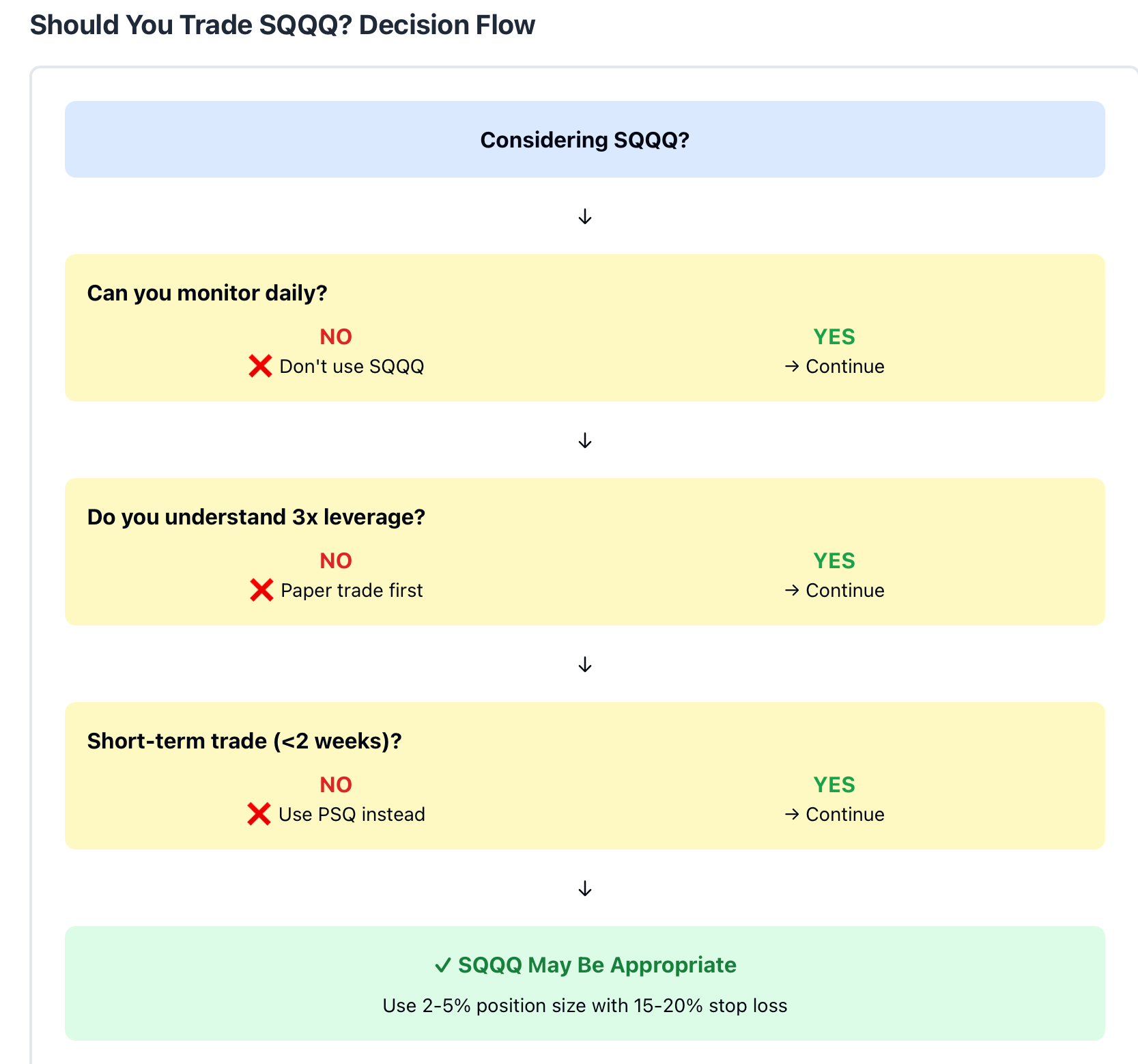
You should be wary of SQQQ if: you are an investor time horizon of long-term; you fear extreme volatility and its effects on your capital; you do not have the time required to ascertain and monitor an appropriate position for SQQQ; or you are hoping to find a simple and easy way to invest using SQQQ and set-it & forget it - essentially placing the investment as a hedge against your long-term technology investments.
For the cryptocurrency investors who do make money on SQQQ, however, they treat the product as a trader would, and in fact, a reminder of my demographic analysis of traders, they treat the investment with a trader's mindset. The trades that are successful due to the conditions of SQQQ, the traders treat the asset the same way as the traders profitability concerns - tight stop-losses, proper position scaling, and not falling in love with the position. They take profits when they trade "works" and cut the loss quickly when the trade does not work.
Remember: SQQQ is a tool, not an investment. If used appropriately, it can help you shield your portfolio or find tremendous short-term profit. If used carelessly, it will hand you painful losses.
The next major correction in technology will happen eventually. When it does, SQQQ will be one of the few pathways to make money from the chaos. The only question is if you will be ready and will you be able to use it prudently.
If you are ready to put theory into actual practice, please visit us at btcdana.com and take advantage of our entire library of ETF strategies, live market analysis, and CFD trading tutorials that will sharpen your edge with clever products. Don't just trade blind, trade is really informed.