




What is Proof of Work? | Understanding PoW in Cryptocurrency
If you've ever thought about how Bitcoin can function in the absence of a bank or a government in charge, you're about to learn why. Proof of Work (PoW) is what enables it all to take place.
Essentially, PoW enables a system of verifying transactions and generating new blocks of information on a blockchain through extensive computation. It is similar to a digital security guard that works not just during the day, but all of the time. Instead of trusting someone in a position of authority to approve the transaction, a PoW system expects computers (miners) to solve an expensive and complicated math problem in order to validate the transaction. The first miner to solve the mathematical puzzle correctly submits that block of transactions to the blockchain and receives a reward for their work.
To help you visualise it, think of a classroom scenario where the teacher presents the class with a challenging math problem. The student who completes the problem first and correctly now has proof that they put in the required effort and is rewarded with extra credit. In short, Proof of Work (PoW) is working in a globally distributed computer network, and extra credit is cryptocurrency.
Bitcoin exemplifies Proof of Work (PoW). When you send Bitcoin, it does not simply appear in another person's wallet. Meaning, the transaction needs to be verified on the blockchain. Miners compete to gather transactions into a block. Once a miner gathers enough transactions to create a block, miners race to find a valid hash, which is a unique string of characters that valid transactions must meet to be accepted on the blockchain, to add the block to the chain. In the case of Bitcoin, this happens approximately every ten minutes.
The order of operations is as follows: First, transactions are broadcast to the network. Second, miners collect transactions into a candidate block. Third, miners race to find a valid hash. Fourth, once a miner finds a valid hash, the miner adds the candidate block to the blockchain. Fifth, all full nodes re-verify the miners’ work. Sixth, miners will start the process again.
Why does any of this matter? Because PoW offers crypto security and decentralises the currency. No one is in charge of the network. Anyone with the correct hardware can participate in mining. The ability to vote is spread across thousands of computers globally, making it nearly impossible to be manipulated by a negative party.
The Bitcoin Genesis Block, created by Satoshi Nakamoto on January 3, 2009, was the origin of this revolution. Embedded in that block was a message about a newspaper headline related to bank bailouts, a clear criticism of the established financial system that PoW was creating challenges for.
How Proof of Work Actually Works | PoW Mechanism Explained
Now let's dive into the details of how PoW works under the hood.
The special ingredient in PoW is also called a hash function. A hash function, without being too technical, takes any input (say, a block of transactions) and produces an output comprising a string of letters and numbers of a fixed length. The secret? Even the tiniest change in the input will rearrange the output completely. Hash functions offer security since you cannot reverse-engineer the original data from the hash.
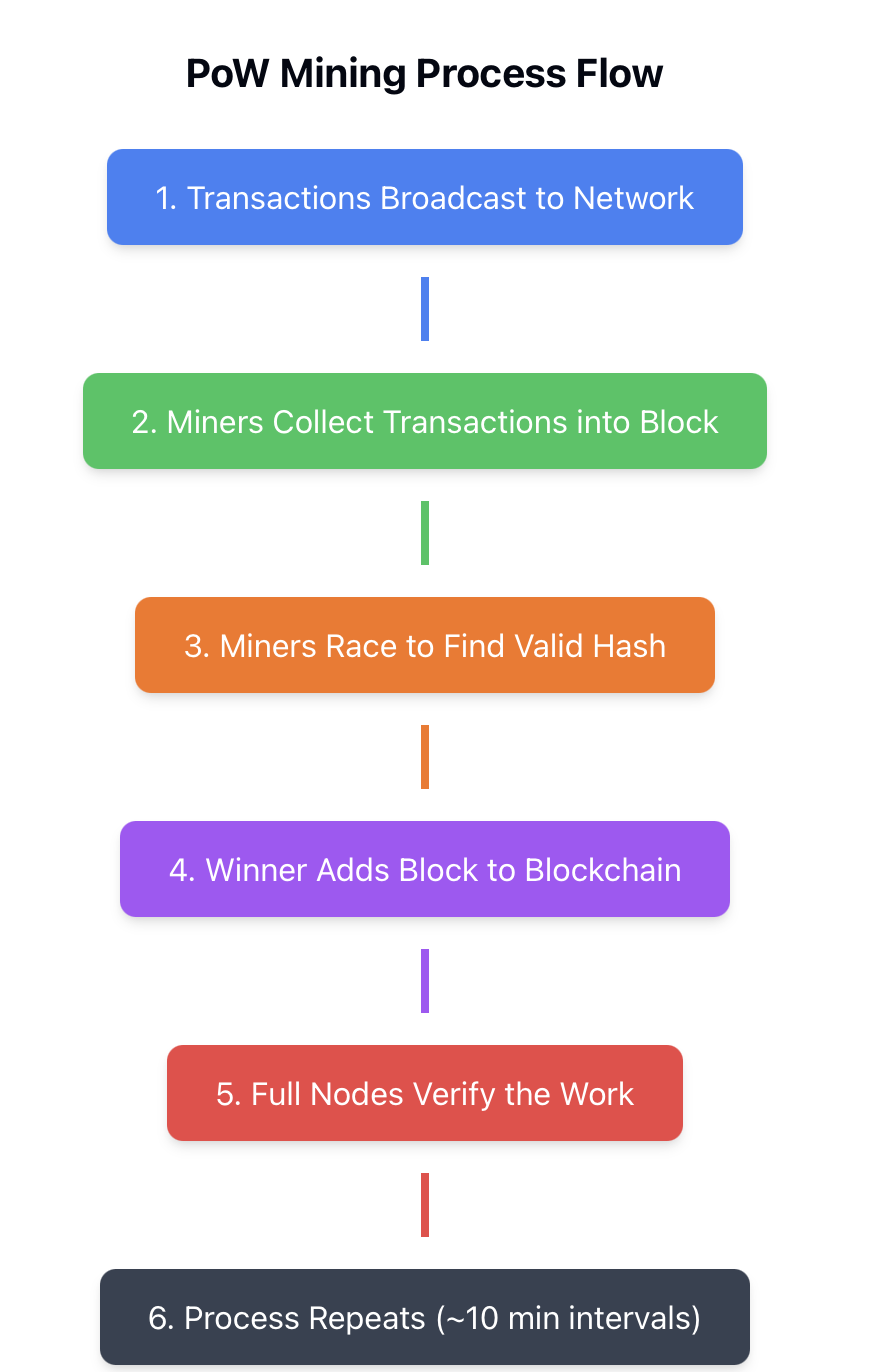
When miners create a new block, they take all the transactions in the mempool (accounts that have not been added to a mined block), along with a reference to the previous block. The next step is the difficult part: finding a hash that is valid under the current difficulty of the network. In the case of Bitcoin, for the hash to be valid, it must begin with a certain number of zeros, and the greater the number of zeros, the more difficult the mathematical puzzle becomes.
Miners don't figure this out using advanced algorithms; they just attempt a bunch of options. They use the data from the transaction, along with an additional piece of data called a nonce, and try guessing different inputs until they stumble across a valid hash. What brute force!
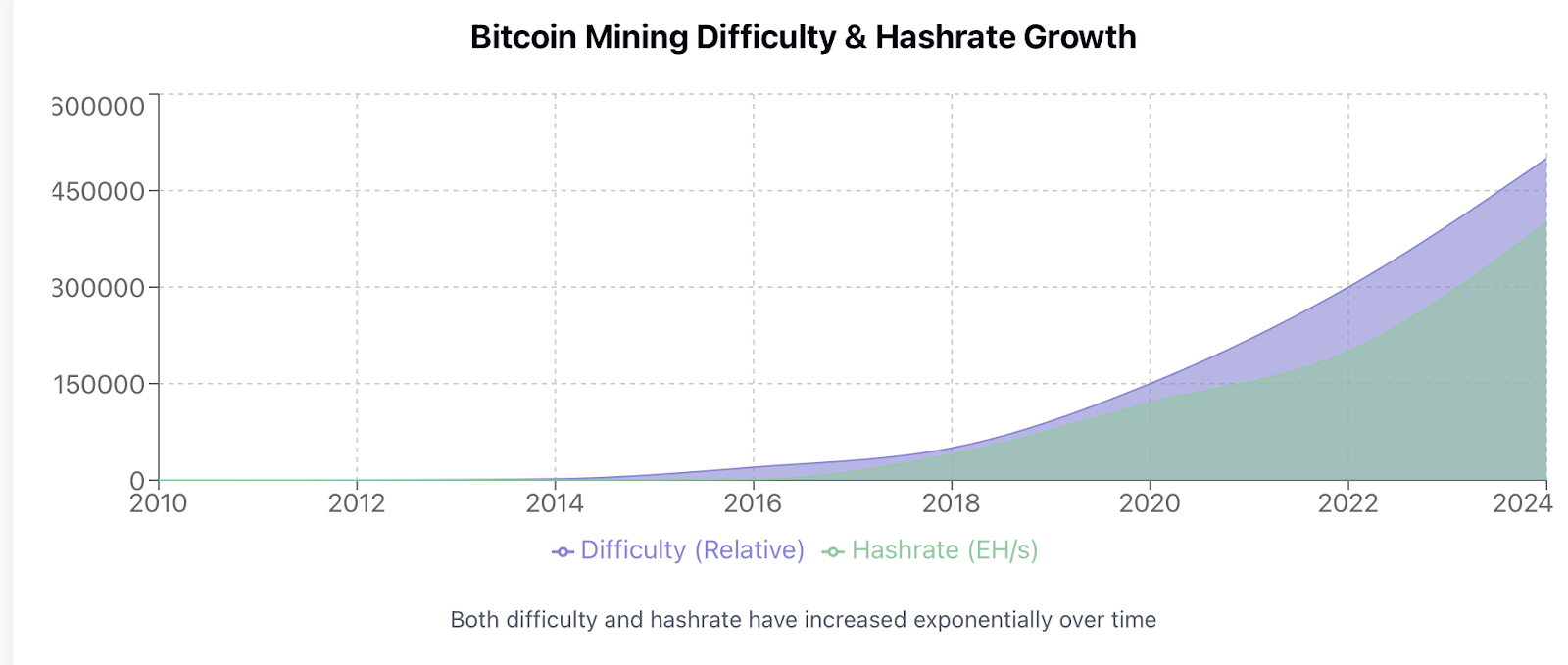
This is where it gets interesting. The network will adjust how hard those puzzles are based on the rate at which miners are solving them. Bitcoin adjusts its difficulty level every 2016 blocks, or roughly every 2 weeks. If miners are solving blocks too quickly, the network increases the difficulty. If miners are having a tougher time, the network decreases the difficulty. Either way, the objective is to keep the average between each block at 10 minutes.
It's similar to a video game. If you finish levels too quickly, the game will increase in difficulty. If you struggle to finish levels, the game becomes easier. Bitcoin does the same, maintaining a steady production of blocks.
This difficulty adjustment is also key to the security of the network. This makes it difficult for any one person to abuse the network to create blocks or alter transaction history. In order to rewrite a past transaction, an attacker would have to redo all the proof of work from every block since the block they wish to alter. This would require an enormous amount of computing resources, far more than any one entity could produce.
Proof of Work also addresses the double-spending concern. In the digital world, copying is trivial; you can duplicate a photo, a song, or a document with one click. However, money should not work that way. Proof of Work makes certain that once you have spent your Bitcoin, you cannot re-spend it. The blockchain becomes an unchangeable record of who owns what.
The cost of attacking this network represents an economic disincentive. Why spend millions on electricity and hardware to potentially steal from the blockchain? You can simply use those resources to mine honestly and earn Bitcoin rewards instead. The system is designed so that the incentives are built around a trustworthy system rather than an ineffective one.
Considering mining difficulty trends can indicate the health of a network. When the difficulty of mining Bitcoin consistently goes up, it indicates that more miners are entering the network, strengthening its security. Sudden drops can indicate miner exits (often related to profitability), making the network much more vulnerable for a short time.
PoW and Decentralised Network Security | How PoW Protects Blockchain
Decentralisation isn't just a catchphrase in crypto; it's literally the whole point. PoW is what makes true decentralisation feasible.
In traditional systems, someone needs to be trusted. You trust your bank to accurately maintain its records. You trust payment processors to handle your transactions accurately. You trust governments to keep your currency stable. PoW changes this because trust is distributed across an entire network.
No miner or group of miners can unilaterally deem what distinguishes a valid transaction. The longest chain (the chain with the most accumulated PoW) becomes the canonical version of truth. A consensus doesn't require cooperation between trusted parties; it emerges from competition.
The biggest threat to PoW blockchains is the 51% attack. If someone has control over more than half the mining power of a network of PoW nodes, it theoretically allows them to rewrite the last several blocks of transaction history or to simply stop new transactions from confirming altogether. By creating a competing version of the blockchain, that miner could double-spend the coins in the competing blockchain version and force the network to accept it.
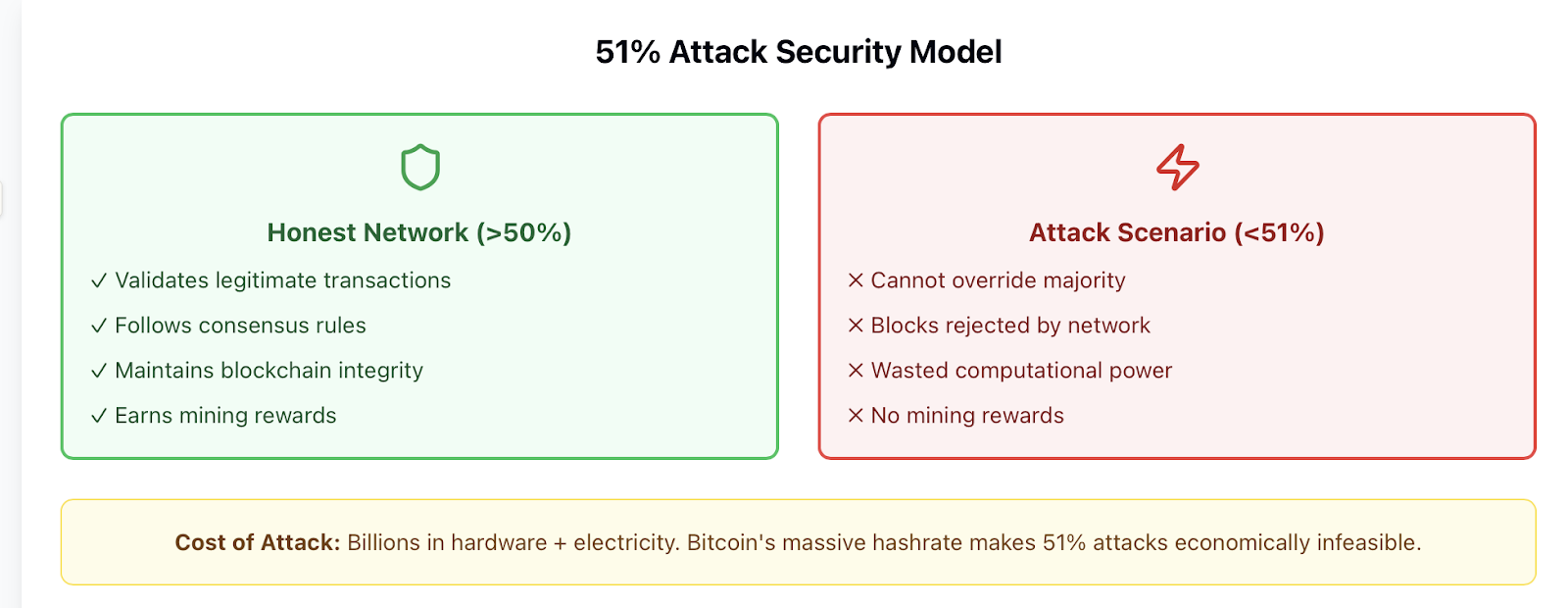
The enormous hashrate (the total amount of computational power that secures the network) of Bitcoin makes a 51% attack prohibitively costly. You would have to outspend all of the other miners combined, which could involve billions of dollars in hardware and electricity. On top of that, even if you could somehow pull off the attack, the price of Bitcoin would likely plummet as a result of your attack, making the success of the attack itself negligibly valuable.
Smaller Proof of Work cryptocurrencies do not have this advantage. They are fairly easy targets for an attack, simply because it costs less to rent enough hashrate to make an attack feasible. There have been several documented 51% attacks against smaller chains, when attackers were able to double-spend coins on exchanges and walk away with real money.
You can think of it like a group project where everyone in the group has to agree on the final presentation. If a single person did 51% of the work, however, that person could simply overcome everyone else's collective consensus, decisions, and suggestions. But if there were 10,000 people working collectively to put together that presentation, no one could unilaterally put their vote on how to proceed. That is the security model that PoW is designed to create.
As a Proof of Work (PoW) network grows in scale, the cost to attack it becomes more and more expensive. As the price of Bitcoin went up, mining became more profitable, which then brought more miners to the network, which in turn increased the hashrate, which then in turn decreased the possibility of an attack due to the increased economic cost of a 51% attack. As more and more security is integrated into the system, more attacks would ultimately be defeated, as the cost to attack Bitcoin has drastically raised economic concerns for attackers since Bitcoin has become a market. This is self-reinforcing.
This is why proponents of PoW argue it is the most battle-tested and secure consensus mechanism: Bitcoin itself has been running for over 15 years without a single successful 51% attack. That is an impressive track record for PoW's security merits.
Mining Economy and Incentives in PoW | How Miners Earn Rewards
Mining is not a charity. Miners mine for profit, and mining economics have to make sense for it to be a viable system.
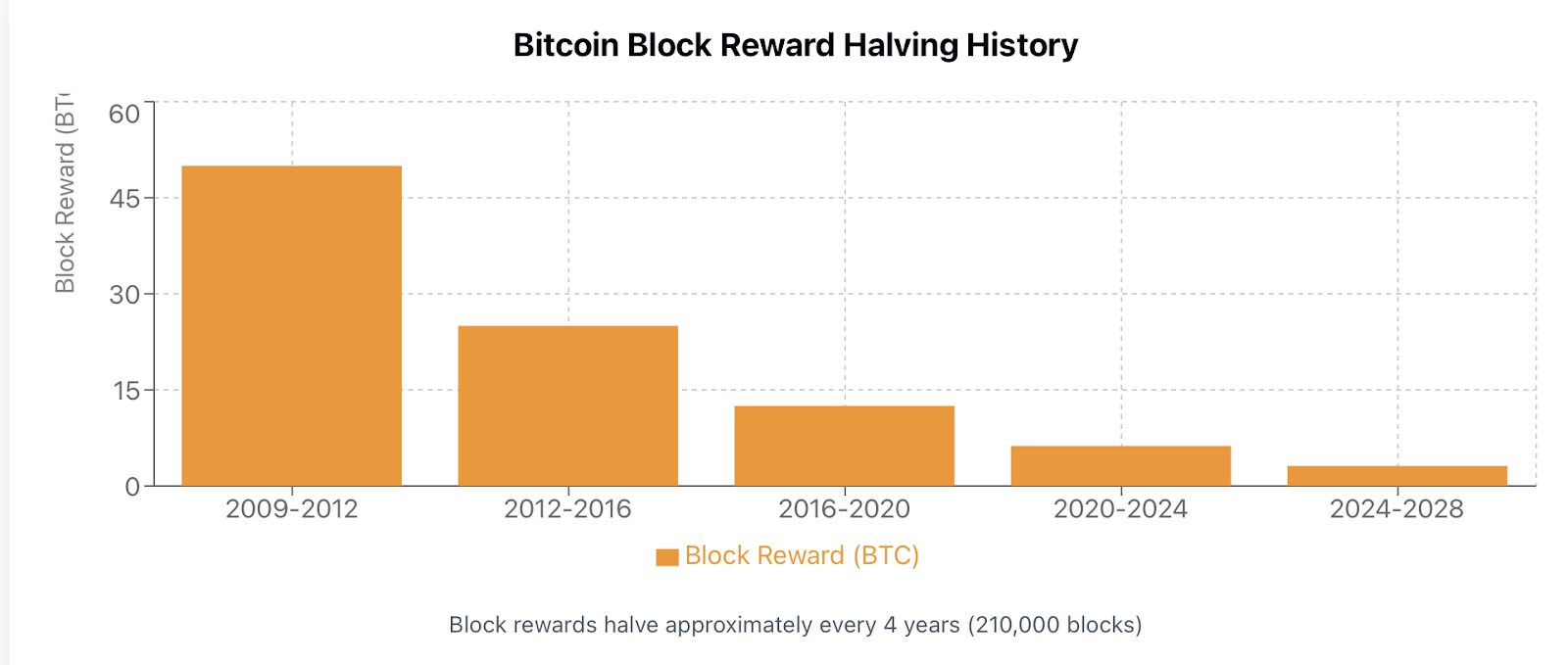
When a miner finds a new block, there are two different types of rewards for mining a block. First, there is the block reward. The block reward is a fixed amount of newly minted cryptocurrency. When Bitcoin was first introduced, the block reward was 50 BTC per block and was reduced by half every 210,000 blocks (approximately every four years). By 2024, that number will drop to 3.125 BTC. The second inherent reward will come from transaction fees that users pay in order to have their transactions included in a block.
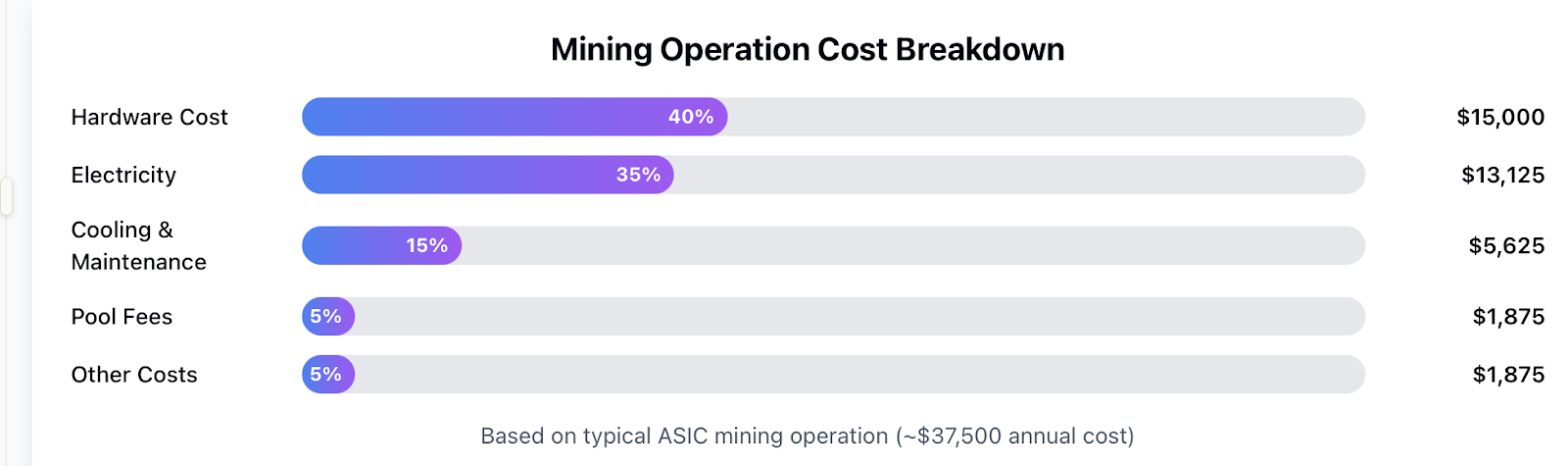
These rewards eventually create an interesting economic dance. For every block mined, the miner takes a cue and begins to calculate profitability from his or her costs (hardware, electricity, cooling, maintenance) and expected income (block reward, fees, etc). If the price of Bitcoin goes up, mining what those miners are making becomes more profitable, and lowers or eliminates miner out, the less efficient miners drop out first.
Now, let us look at some numbers. A contemporary ASIC (Application-Specific Integrated Circuit) mining rig for Bitcoin can cost anywhere from several thousand dollars to tens of thousands of dollars. These machines run around the clock, and they use a significant amount of electricity to compete as miners. In areas with inexpensive electricity (such as some areas in Texas, Kazakhstan, or China prior to the ban), mining can still generate positive returns. If mining in an area where electricity is expensive, the operation likely loses money.
You can think of mining like a small business. You have an equipment investment, you have an operating cost, and hope to make more revenue than expenses. The difference is that your operational costs are combined with thousands of competing miners around the world, and you will also obtain a win by luck (finding the next block), and your degree of success is affected by efficiency (running the cheapest operation).
Mining pools have changed the entire scenario. Miners no longer solely compete as individual miners. Instead, miners bring their hashrate (computational power) together and the pool finds to find blocks. When the pool is able to find a block, then the payment is made in equity compensation based on the contribution by individual miners. This diminished returns and risk, and made mining possible for smaller miners.
Significant proportions of Bitcoin's hashrate are managed by major pools like Foundry USA, AntPool, and F2Pool. Although this raises centralisation issues, miners are free to change pools at will, which limits the potential for any one pool to have too much power over Bitcoin mining.
Halving events cause supply shocks that have cascading effects on the mining economy. When the block reward is cut in half, the miners making the least money work at a loss, unless the Bitcoin price increases sufficiently. This eliminates miners on the lower end of the cost structure. Some supporters believe this strengthens the network as inefficient miners are eliminated, while others see this as an opportunity for industrial-scalepools pools to hold mining power.
Transaction fees are becoming more important as block rewards are cut. At some point in the future, around 2140, the block reward will go to zero, and miners will be required to rely on the fees. We do not know whether fees will ever be sufficient to provide the same level of security that mining block rewards have provided in the past.
Energy Consumption Concerns of PoW | Understanding Mining's Environmental Impact
This is where it gets tricky. PoW is based on security that requires an incredible amount of electricity consumption, which has a real environmental impact. Bitcoin alone consumes an estimated number of terawatt-hours per year that is greater than many countries. Depending on the estimate, needs to be somewhere between 100 and 150 terawatt-hours, which is similar to the annual electricity consumption of a country like Argentina or the Netherlands.
To put this another way, the electricity consumed for every single Bitcoin transaction is about the same as a West-to-average household in the U.S consumes in an entire month. So, why so much electricity? Because it is a kind of race among miners. Keeping up with newer, more efficient hardware means that difficulty is adjusted up as new hardware comes on the market, so mining requires even more hardware to be competitive. It's a treadmill that's never going to end, and it's expensive.
The mining farms that I have seen look like something from the future, out of a movie. Just warehouses full of computers that get incredibly hot and require these massive air conditioning systems. The noise level is shocking, and the power consumption can be related to the consumption of a very small city.
It is like if you had every single appliance in your house on all the time, 24/7, except multiplied out by several million. The net effects are totally overwhelming.
Carbon emissions are the focus of environmental critique. When mining operations use fossil fuel grids for power, they are accelerating climate change effects. For example, coal-fired plants in some parts of the world have powered Bitcoin mining and justifiably received criticism from environmentalists.
However, this is not the full story. Many mining operations are looking for the cheapest electricity cost, and more than ever before, this is derived from renewable energy. Hydro energy, solar, wind, and even using natural gas that is "flared" and would otherwise go to waste are common to each of these mines. Some suggest that Bitcoin advocates renewable energy because it provides a flexible load that can use the energy on-site rather than going to the grid, and that means excess energy production from renewable energy production can be absorbed when there is less electricity demand.
Countries like Iceland and Norway, which have plentiful geothermal and hydro energy, respectively, have increased the amount of Bitcoin mining. Miners in parts of Texas are buying the cheaper wind electricity, and they can resell that electricity back to the grid during peak demand times due to a deregulated grid.
The real-time application of these variables is captured by the Cambridge Bitcoin Electricity Consumption Index. It’s a stark reminder of the energy appetite of PoW, but it shows the nuance as well: energy consumption does not necessarily equate to carbon emissions if renewable energy is the source.
Critics point out that it is egregiously wasteful to use so much electricity for number-crunching, regardless of the energy source. Defenders argue it is a valid use case for energy consumption because it secures a financial network used by millions of people around the world. It is a philosophical argument with no easy answer.
PoW vs Other Consensus Mechanisms | Comparing PoW, PoS, and DPoS
Not all blockchain platforms rely on PoW. Different consensus algorithms have arisen with tradeoffs.
The main competitor is Proof of Stake (PoS). Instead of miners racing each other with work, validators lock up (stake) cryptocurrency as collateral. The network randomly chooses validators to produce blocks based on the size of their stake. Energy-intensive mining is not necessary. Ethereum transitioned from PoW to PoS in September 2022 with The Merge, the largest experiment in changing consensus mechanisms in-flight in blockchain history.
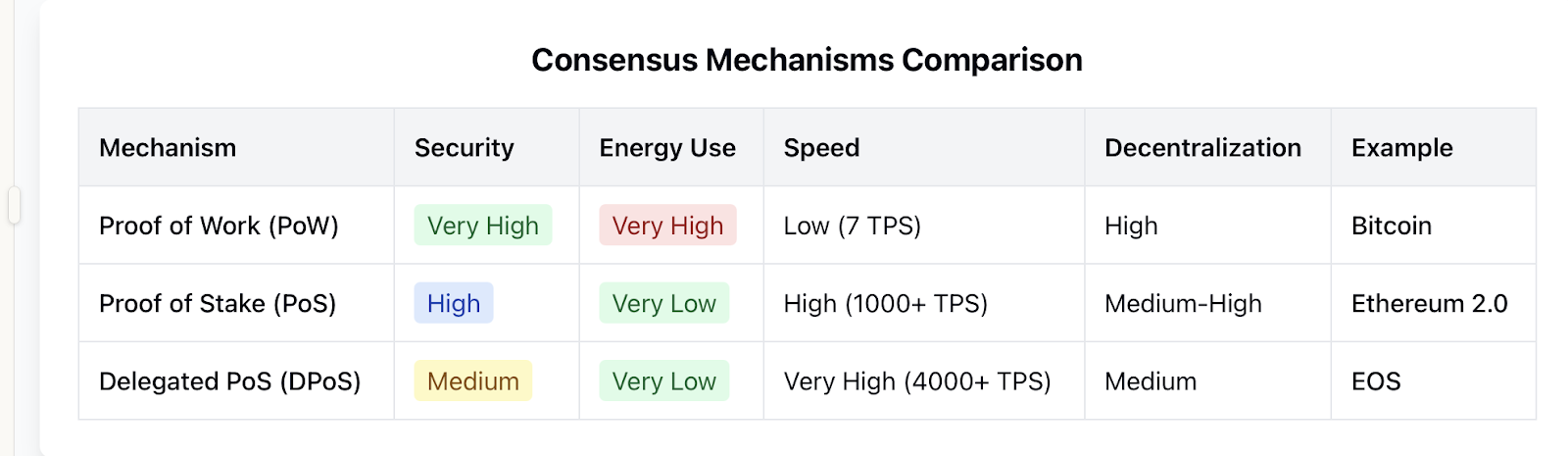
Delegated Proof of Stake (DPoS) takes this one step further. Token holders vote for a small group of delegates who validate transactions. This improves speed and energy efficiency but has the potential to be more centralised since the power is still within a group of elected validators.
Let's get into the comparison:
Security: PoW has the longest proven recipe for success. Bitcoin has survived prominence for over 15 years of attacks. PoS is newer, however, theoretically secure if the PoS is designed correctly. The form of attack changes from gaining control of hashrate to accumulating stake. Critics claim PoS leads to increased accumulation of wealth where the rich get richer (as providers of rewards, bonuses on staking, are compounded on bigger wallets). Defenders of PoW claim efficient mining turns into a concentrated position of power as well, only affordable to those who have the best and newest hardware configuration.
Decentralisation: Mining pools in PoW create some level of centralisation, although the barriers to entry to begin mining are in constant flux. PoS requires that stakers put up capital, but does not require specialised hardware to stake. DPoS gives up some decentralisation for speed through the use of a limited validator set.
Energy Efficiency: PoS and DPoS are clearly superior. In fact, Ethereum's energy consumption dropped by over 99% after The Merge. No, you're not imagining things. There is little computational work on validated blocks in PoS compared to mining PoW.
Speed: PoW has a lower speed. Bitcoin has 10-minute block times and has limited throughput (7 or so transactions per second). A PoS chain can process hundreds or thousands of transactions per second. Regardless, speed has required some tradeoffs in security or degrees of decentralisation.
To put it another way, using an analogy, completing a puzzle (PoW) little by little may take quite a while, and while you have proven that you completed the work, it has taken time, and you did all the work. Voting for your trusted friend to complete the puzzle (DPoS) is quick, but you have just trusted your delegate; you did not even try to work on the puzzle yourself. Or even better, do a small part–your own smaller task (PoS) that splits part of the responsibility between you and a third party.
Ethereum's shift to PoS significantly cut its energy footprint, while providing a large, decentralised validator set (hundreds of thousands of validators). Cardano developed PoS from scratch with a research-focused model. Both Ethereum and Cardano claim their methods provide security and decentralisation without PoW's energy requirements.
PoW maximalists argue that you cannot build the same security guarantees from PoW in PoS, stating that the costs of purchasing hardware and paying for electricity create real, tangible costs that tie a portion of the digital system to the physical realm, whereas PoS occurs entirely within the digital realm, which could be seen as less secure by those focused on PoW maximalism. Others consider this thinking outdated.
Ultimately, the question is, what is your priority? If you value security and decentralisation most, and feel you can afford the energy costs, your method should be PoW. If you value efficiency, speed, or care about the environment, there is more justification for PoS or DPoS.
How Investors Use PoW Knowledge | PoW Insights for Crypto Trading
Being knowledgeable about PoW isn't just for the tech heads. This is interesting information for anyone who is or plans to trade or invest in cryptocurrency.
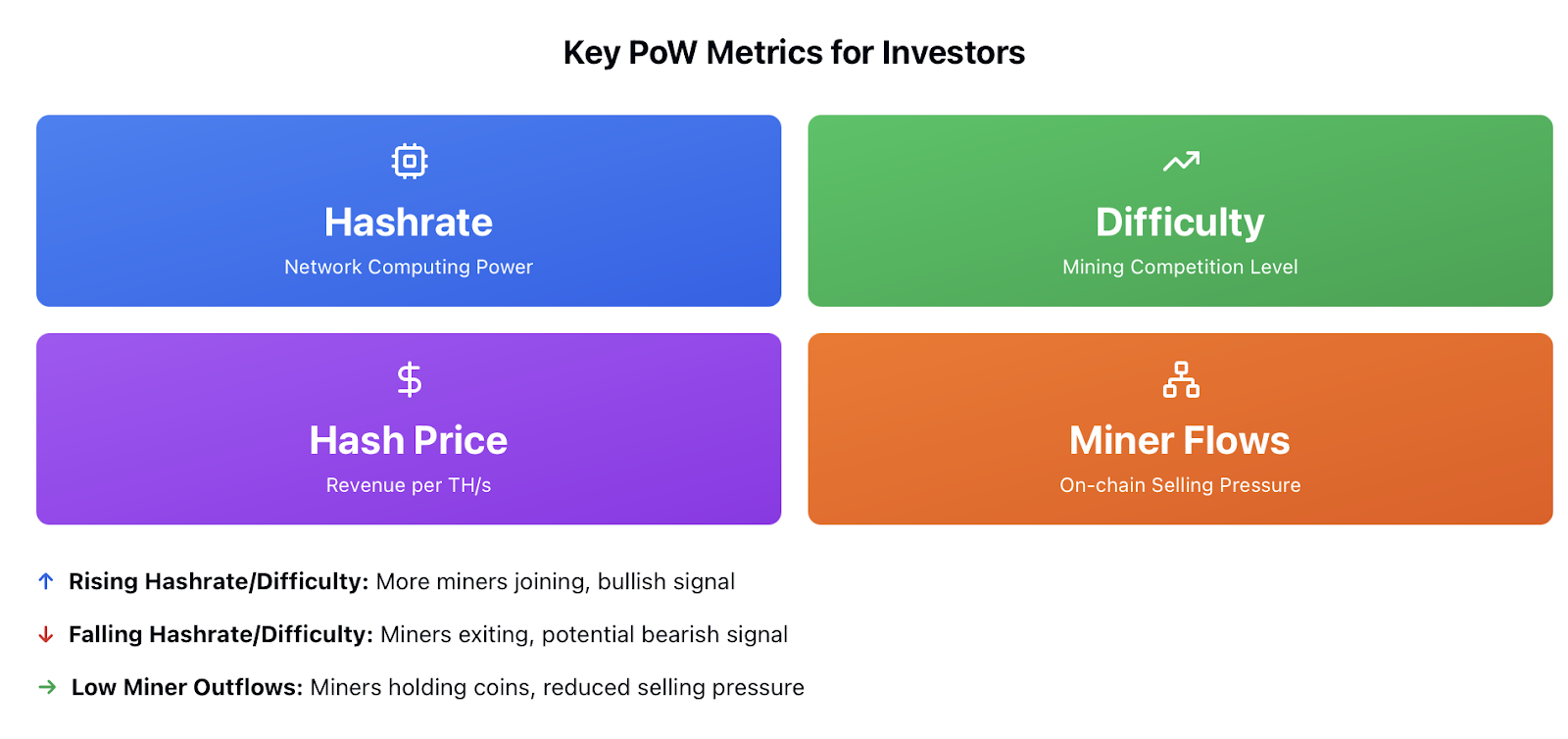
Mining difficulty is one of the most important metrics that savvy investors pay attention to. When mining difficulty increases, it is indicative of the miners having more confidence. They are going to invest in more equipment, which means they expect more profit down the road. Typically, an increase in mining difficulty corresponds with a price increase. Conversely, a decrease in difficulty signals that miners are leaving (probably selling their Bitcoin to cover their energy costs), and it can often be an indicator of future price decreases.
Bitcoin adjusts for mining difficulty every two weeks. Traders observe these adjustments because they can increase volatility. A larger-than-expected increase could trigger some buying activity because it shows strength in the overall network. Conversely, a decrease in difficulty could trigger some selling off as it suggests the fundamental indicators may be weakening.
Bitcoin's price will often react to halving events, which reduce block reward payouts. Historically, Bitcoin has had significant gains following halving events (no guarantee it will happen again). The reasoning follows basic supply and demand theory: cut the supply of new Bitcoin in half, and assuming demand stays the same, prices should rise. After the upcoming halving, miners need prices to push higher than $10,000 to remain profitable, and that is an interesting dynamic.
Here's a strategy that certain traders may apply: track miner actions by utilising on-chain analytics. When miners begin to transfer or sell Bitcoin in large quantities to exchanges, they are usually getting ready to sell or to cover their operational costs. This selling pressure often results in short-term depressed prices. When miner outflows decrease, it implies that miners may be holding coins, which is bullish.
Picture it like watching a basketball game where one team spontaneously changes the way they are playing and starts hoarding the ball. If all miners change to play more of a defensive strategy (or start hoarding their Bitcoin), then it is likely the market is starting to set up for upside penetration. Alternatively, it will likely be tough to manage a market if they go to an offensive scheme (or in this conversation aggressively sell).
Long-term holders (generally called "HODLers" in the crypto community) generally assert their conviction by the fundamentals, regardless of the type of money the investment suggests; for example, the total energy expended in securing the network proves value in the real world. Some investors take the increasing hashrate growth (the amount of hashing used to secure Bitcoin) as a signal that institutional adoption is strengthening and that the Bitcoin network is becoming anti-fragile.
The profitability of miners can also be analysed by asking the question, "Is Bitcoin mining profitable?" The hash price (revenue per unit of hashing power) in and of itself is another way of looking at mining profitability. When the hash price is high, it means mining can be profitable and will attract more network participants. Conversely, when the hash price crashes, only the most efficient miners survive, which may cause short-term instability of the network but is more sustainable for the foundational value proposition.
Traders will use outlooks on trends in difficulty and hashrate to guide their volatility strategies. Whenever there is a significant difficulty adjustment, this can lead to a price action that allows market participants to execute trades associated with straddles or strangles (trading strategies associated with volatility).
The nugget of knowledge is that PoW is more than simply the underlying infrastructure. It is a dynamic system whose fluctuations can signal important information regarding miner expectations, health of the network, and potential price action. Investors who can read these signals have a unique advantage.
Historical PoW Case Studies | Learning from PoW in Action
Nothing beats real-life examples. Let's revisit a few of the key moments in the History of PoW. Block 0, the Genesis Block, was mined by Satoshi on January 3, 2009, and has 50 BTC that cannot be spent, due to how the code was designed. It has a headline from The Times embedded in it that reads "Chancellor on brink of second bailout for banks." Hence, it was the timestamp of the inception of the blockchain and a mission statement about what Bitcoin was designed to do.
The mining of Bitcoin was trivial in the early days of Bitcoin’s launch. Back then, people were mining Bitcoin on laptops. Mining the coin was so easy that Satoshi and just a few other early adopters accrued thousands of BTC. As word of Bitcoin spread, the difficulty increased as more miners entered the market.
The first real event in PoW occurred in 2010 when a user exploited a bug to produce 184 billion Bitcoin out of thin air. The community decided to hard-fork the blockchain to remove the user's false transaction, rolling back the blockchain before the event of the exploit. Although the hard-fork decision was controversial, the decision was necessary and underlined that PoW is not sufficient alone without good protocol design.
In 2013, the emergence of ASIC miners launched a rapid arms race, making GPU mining (using graphics cards) for Bitcoin essentially obsolete overnight. As industrial-scale mining operations supplanted hobbyist miners, difficulty skyrocketed. This marked the shift of Bitcoin from an experimental engine for innovation lab technophiles to a serious financial infrastructure.
The 2017 bull run drove Bitcoin to nearly $20,000, and the difficulty adjusted upwards to the price. But when the inevitable 2018 crash happened, difficulty actually increased for a bit, since miners who had ordered machines during the boom found their machines in operation somewhere now instead of suffering from passive "Doomocaust" chatter. Eventually, reality set in, and unprofitable miners shut down. Difficulty was adjusted downwards eventually. It was a stunning example of how difficulty and mining respond to price cycles, but with a lag.
China's mining ban in 2021 was likely seismic. Roughly half of Bitcoin's hashrate disappeared practically overnight as Chinese miners ceased operations. Difficulty dropped dramatically. To compound uncertainty, a "Doomocaust" blitz of negative headlines and hot-takes filled social media and mainstream media alike. But within months, miners had relocated to other nations (the US, Kazakhstan, etc.), and hashrate continued to recover. Bitcoin was resilient. Its network difficulty adjustment mechanism worked exactly "as designed", maintaining a 10-minute block time in the face of rapid and substantial upheaval.
The halving that took place in April 2024 reduced the reward for each block to 3.125 BTC. The result was some erosion of mining profitability, which caused some less efficient operations to cease mining. The mining difficulty had declined a little but was still very close to all-time highs, indicating that miners left in the network were confident enough to maintain their operations despite lower rewards.
The patterns you have observed around these scenarios are worthy of note. PoW networks adjust to shocks by calibrating difficulty. The behaviour of miners is driven by economic incentives rather than any sense of ideology. Over the longer run, the rising required difficulty indicates a growing security in the network, and the network is enjoying increased adoption. In the short term, volatility creates an arbitrage opportunity for those paying attention.
Bitcoin miners at the beginning who held their Bitcoins made an extraordinary amount of money. For example, a miner who started during the 2010 or 2011 period could amass thousands of BTC with minimal hardware. Today that Bitcoin is worth several tens of millions or a hundred million dollars. Of course, looking back, many will look at that opportunity through hindsight bias, but in the early days, Bitcoin was an ongoing experiment that truly could have failed.
The lessons to be taken from this are not limited to the price appreciation of Bitcoin, especially. The lesson is how PoW networks create a game-theoretic, equilibrium system where self-interested rational actors, in their own self-interest, form the collective, and the individuals develop the security of the network. That group of alignment has proven to be volatile through market cycles and interest groups, regulation, and technology advancements.
Ready to turn PoW insights into trading profits? Don't just understand the blockchain—use it to spot opportunities before the market catches on. Your next winning position might be hiding in the difficulty adjustment data.