




Think about putting together $500 and having it control the same upside as a $10,000 stock position; it is not a dream; it is what you are able to do with a long call option.
For small investors who have limited capital, the question is always the same: how do you obtain an economically meaningful exposure to stock growth without placing thousands of dollars in one trade? Long call options offer the best way for most retail traders to economically obtain this exposure to accelerated stock growth.
A long call option allows you to purchase an asset or option at a predetermined exercise price before a predetermined expiration date. Your maximum loss would be the premium paid for the option itself. Your upside potential is potentially endless.
In fact, this asymmetry is the entire premise behind long options. It is like placing a $50 wager on a sporting event, and if you call it correctly, your payout would be $1,000. Your risk has a hard ceiling; your Payout does not.
This guide will provide information on the mechanics of how to properly use Call options and their Greeks, selecting the best contract, trading around Earnings Reports, managing risk without gambling your entire account, and understanding how long Call options are fundamentally less risky than Futures or Leverage Tokens.
What is a Long Call Option?
When you buy a long call option, you enter into an agreement where you can purchase 100 shares of stock at a chosen price called the "strike price" before the expiration date of the option. In order to obtain that right, you must pay an upfront cost known as the premium.
If the stock price rises above the strike price, your option will have increased in value. If, however, the stock price does not rise above the strike price, your loss will only equal the amount you paid for the option – the premium you paid.
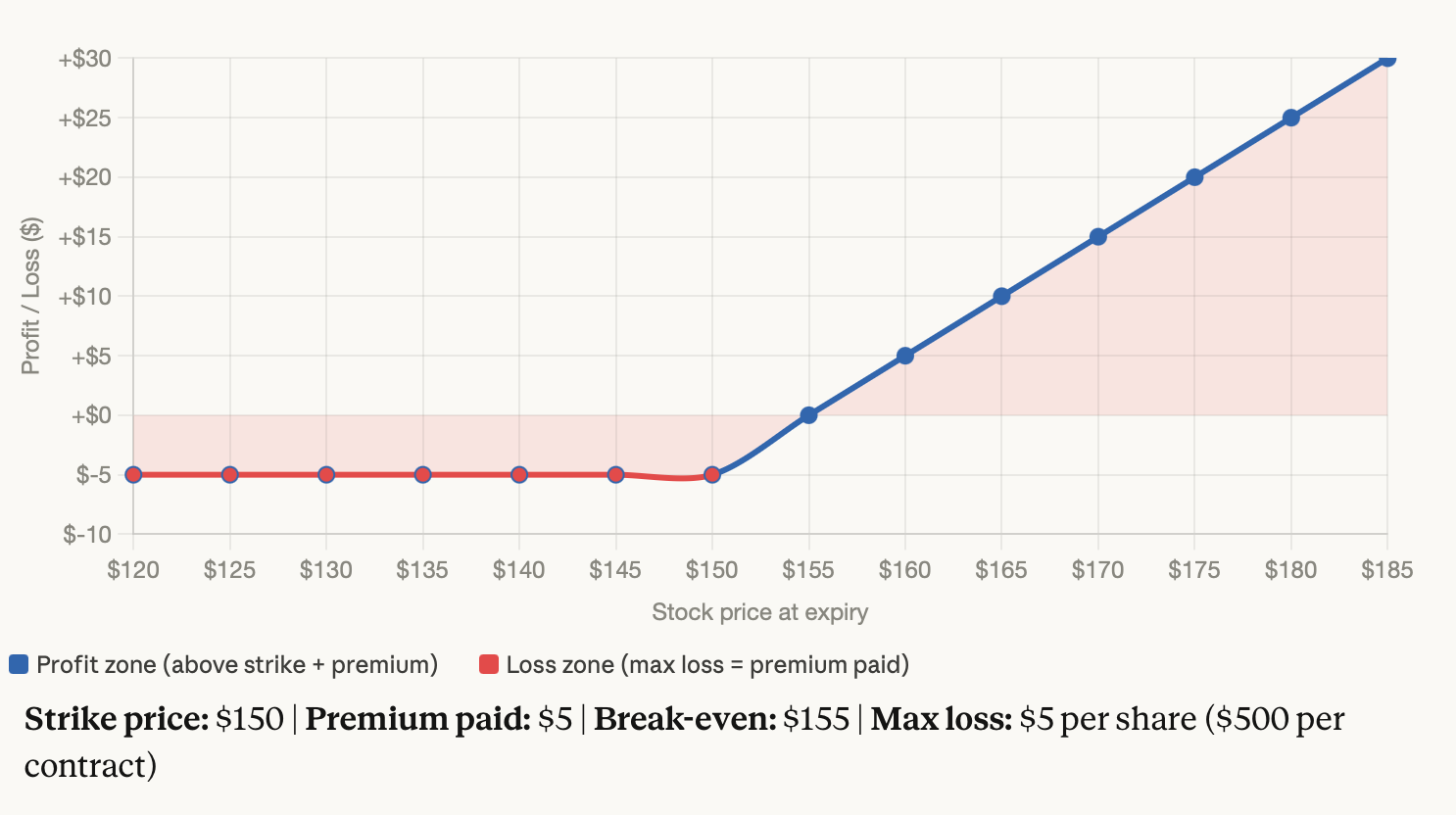
The attractiveness of long call options comes from the payoff structure. Before the strike price, your total loss is guaranteed and equal to the premium you paid; after the strike price, your total profit increases in proportion to the stock price increase. The ending profit from a long call option has a "curved" payoff profile, which is very difficult for most small investors to create in any other way.
 Long Call Options Explained
So now we've got the mechanics down. When you are buying a long call, you are purchasing a contract representing 100 shares of the underlying stock and are paying a premium or the option price per share for that contract. The total premium you are paying is your maximum total risk, meaning that it is the maximum loss you could incur from your trade.
On the other side, the seller of the call option has an obligation to deliver those shares at the strike price if you decide to exercise your option to buy the underlying stock (i.e. the right to buy). In this instance, you have all of the optionality; you aren't obligated to buy anything unless it makes sense to do so before the option expires.
An ideal scenario for a long call option is one where you have a moderately or strongly bullish view of the underlying stock and expect it to increase noticeably in price before expiration.
You would like to use a long call option because you believe the stock could go up in value, but you don't want to risk buying the stock at an outlay of hundreds or even thousands of dollars; therefore, you would like to use the leverage associated with a long call.
Consider NVIDIA Corporation's (NVDA) stock price. If you believe that NVDA's stock will increase in price significantly in the next sixty days, the purchase of one long call option on NVDA could cost anywhere from $500 to $900, depending on the current implied volatility of the underlying stock and where the strike price is located. If you were to buy 100 shares of NVDA currently, that investment would cost you at least $12,000-$15,000. Just check out that leverage!
Long Call vs Buying Stocks: Why Leverage Wins
This is where the capital efficiency argument gets concrete. Consider two investors, both bullish on NVIDIA. Investor A buys 100 shares at $120 per share, committing $12,000. Investor B buys one call option at the $125 strike for a $600 premium. If NVDA moves to $140 by expiration, here's what each outcome looks like:
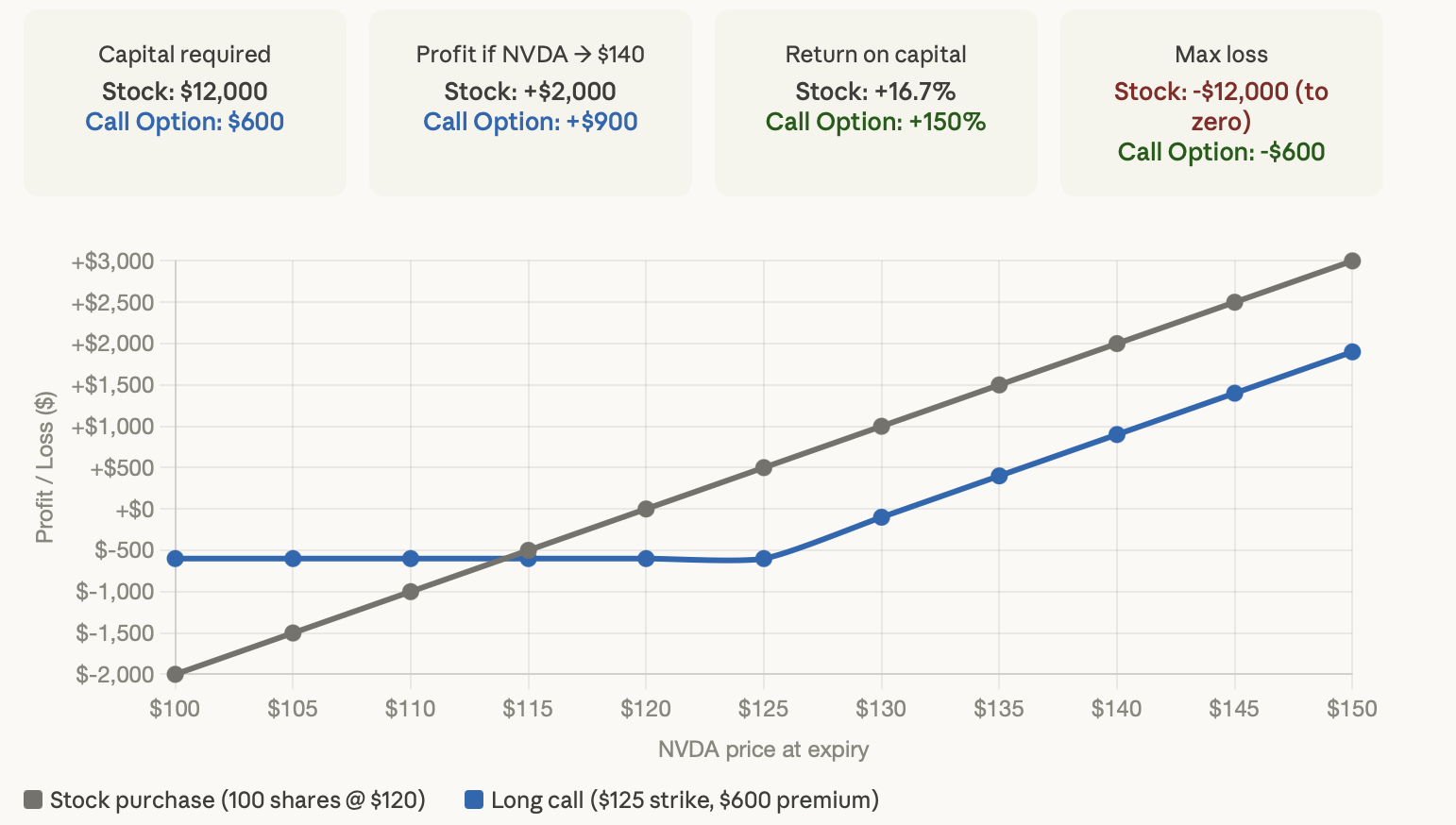
The difference in return on capital is clear. The stock investor has $12,000 invested and will earn a 16.7% return on that money. The option buyer will earn 150% on the $600 put into an option. Both of these investments experienced the same $20 price movement in NVDA.
Another consideration is the psychological aspects: when you put up a smaller amount of money, you can make decisions with less regard to emotion. This is especially true where the entire account is at risk due to owning one company’s stock; panic selling and revenge trading are much more prevalent in these types of situations.
Mastering the Greeks for Long Call Selection
Choosing the right option contract isn't just about picking a direction. Delta, Theta, and Implied Volatility shape every cent of your option's value, and ignoring them is how traders turn a correct market call into a losing trade.
Delta is used to represent the change in an option's price against $1 changes in the stock. An in-the-money (ITM) call option with a delta of .80 will move upward by $0.80 for every $1 rise in the stock. Conversely, an out-of-the-money (OTM) call option with a delta of .20 will only move upward by $0.20 for every $1 increase in the stock price.
Therefore, for highly directional trades you have conviction on, you are better served by ITM options because they tend to make more predictable profits; however, they will cost you more money to purchase. If your trade is more speculative in nature and you are relying on a very large move in stock price, you would be better served by utilising OTM options due to less capital needed to utilise them.
Theta calls for a continuing expense on every option buyer’s account. It represents value loss for an option each day from expiration until the stock moves in price by at least an established amount. The shorter the time before options expire, relative to longer times, the faster an option will decay due to theta.
Implied Volatility (IV) is the market's estimate of how much the stock will move going forward. High implied volatility will typically create an expensive option. Other common mistakes with options trading occur when buying long call positions immediately before earnings announcements when IV is high. Although you may benefit depending upon how the stock moves, the subsequent IV collapse or crush after the event has transpired can entirely consume your profits.
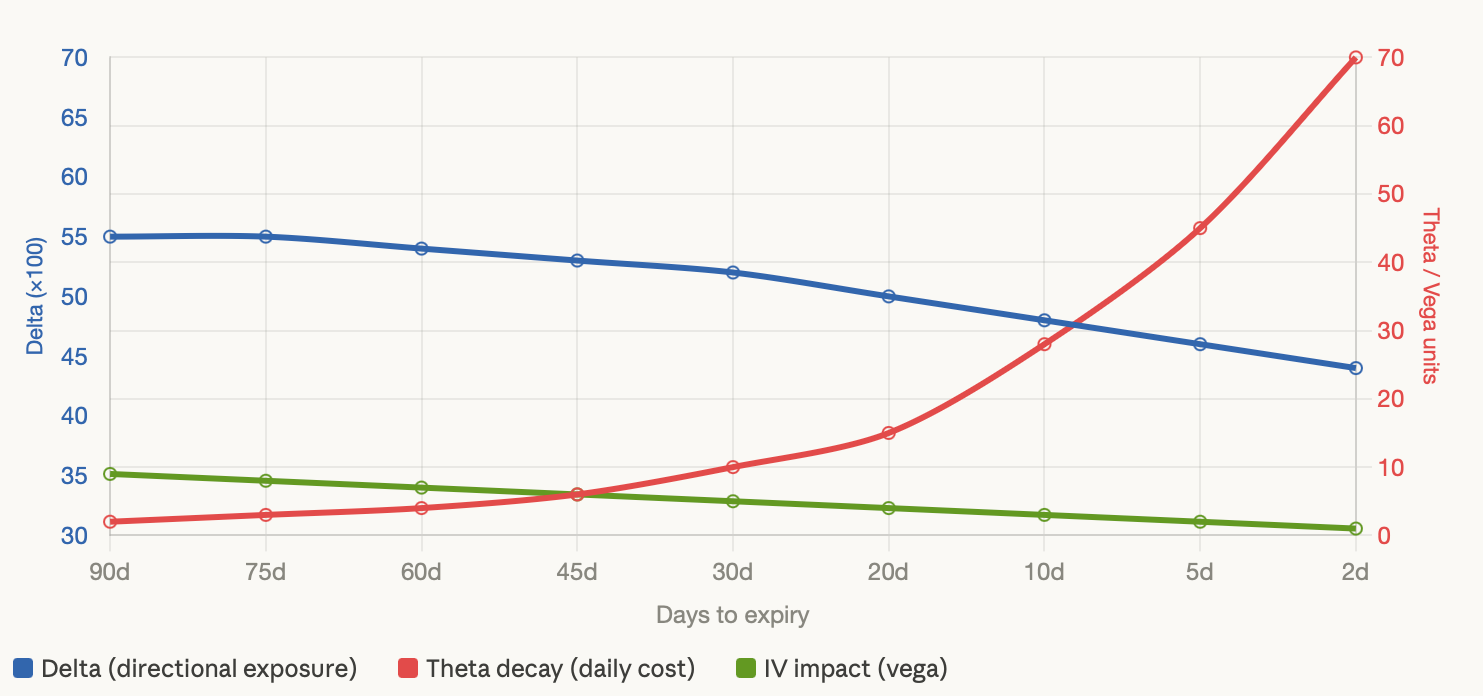
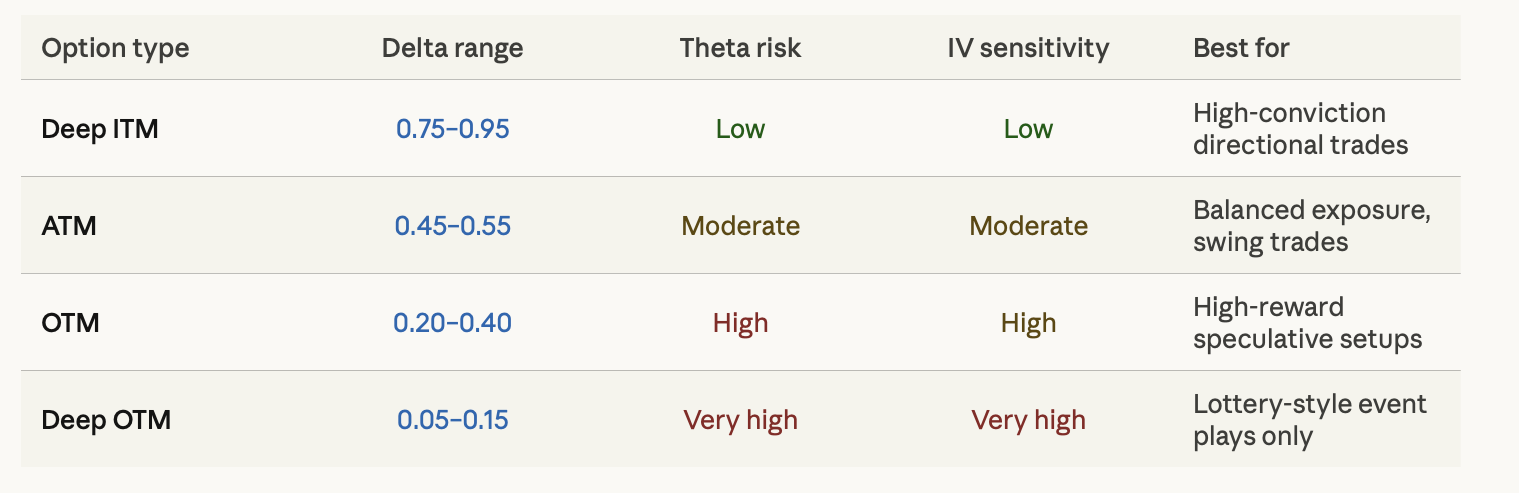
The key takeaway: never fight theta on a short timeline. Give your trades at least 45 to 60 days of runway, and avoid buying calls when IV is already running at elevated levels relative to its recent historical range.
Event-Driven Trading: Earnings and High-Volatility Plays
The earnings season is when long call strategies either excel or fail. The reasoning for this is simple; the timing of the earnings announcements causes large and sudden directional price movements, creating opportunities for options to capitalise on the directional price movements that occur as a result of the per-share earnings. Executing the trade properly around earnings releases can require high precision.
When deciding to act on an earnings release, one must decide whether to be involved before or after the release. Buying your call option before the earnings release will cost more due to the high implied volatility and will most likely crash immediately after the announcement, regardless of which direction the stock moves.
From a trader’s perspective,e the best option is to enter the long call position after the earnings announcement and its volatility has stabilised, and after the price of the underlying company shares has established a new direction.
For traders who have a high conviction trade going into the earnings report, you can buy an out-of-the-money strike price call option as a low-cost way to bet on the outcome of the upcoming earnings report.
For example, if the TSLA opening price was $250, with a substantial, positive earnings surprise, it would help push the stock up past the $300 level, then you could potentially find a call strike at the $280 level with a reasonable option premium. The worst that would happen is that you lose your option premium most of the time, but if your prediction is correct, you will have an incredible return on your investment.
When you are executing a long call buying an option for an event-driven strategy, you can use a three-step process. The first step is to select an expiration date that is at least two weeks past the event to recover form the impact of the initial volatility; the second step is to select a strike price that is within reason but not too conservative; the last step is to size your position so that in the event you lose 100% of your premium it will not result in a catastrophic loss to your trading account.
Risk Management: From Gambler to Strategic Trader
Long call options have a lower rate of success in comparison to other strategies; this is not a flaw in long call options, but rather it is simply a misunderstood characteristic of this strategy.
The entire logic behind long calls assumes that you only risk a small, fixed amount of money when you lose; when you win, you can win hundreds or thousands of times what you risked. By treating this as a slot machine, you will destroy your edge; by managing it as a probability-weighted business, you will retain your edge.
The most important control lever is position sizing. Professional options traders commonly use this rule of thumb:- never allocate more than 2% to 5% of total capital to a single long call position.
By using this rule of thumb, one may lose many rounds of trades without jeopardising their entire account; furthermore, by having smaller positions, it is easier for one to hold through temporary drawdowns without closing the trade prematurely and missing the entry point of a trade.
The importance of the rolling strategy cannot be understated. If your call is close to expiring and the underlying stock has not moved as you anticipated, but your overall thesis remains intact, you can unwind the expiring contract and purchase a new long call with a later expiration, thereby extending your time horizon.
Although this will typically cost you some amount of money, it will usually be significantly less expensive than simply watching the original premium depreciate to zero with time.
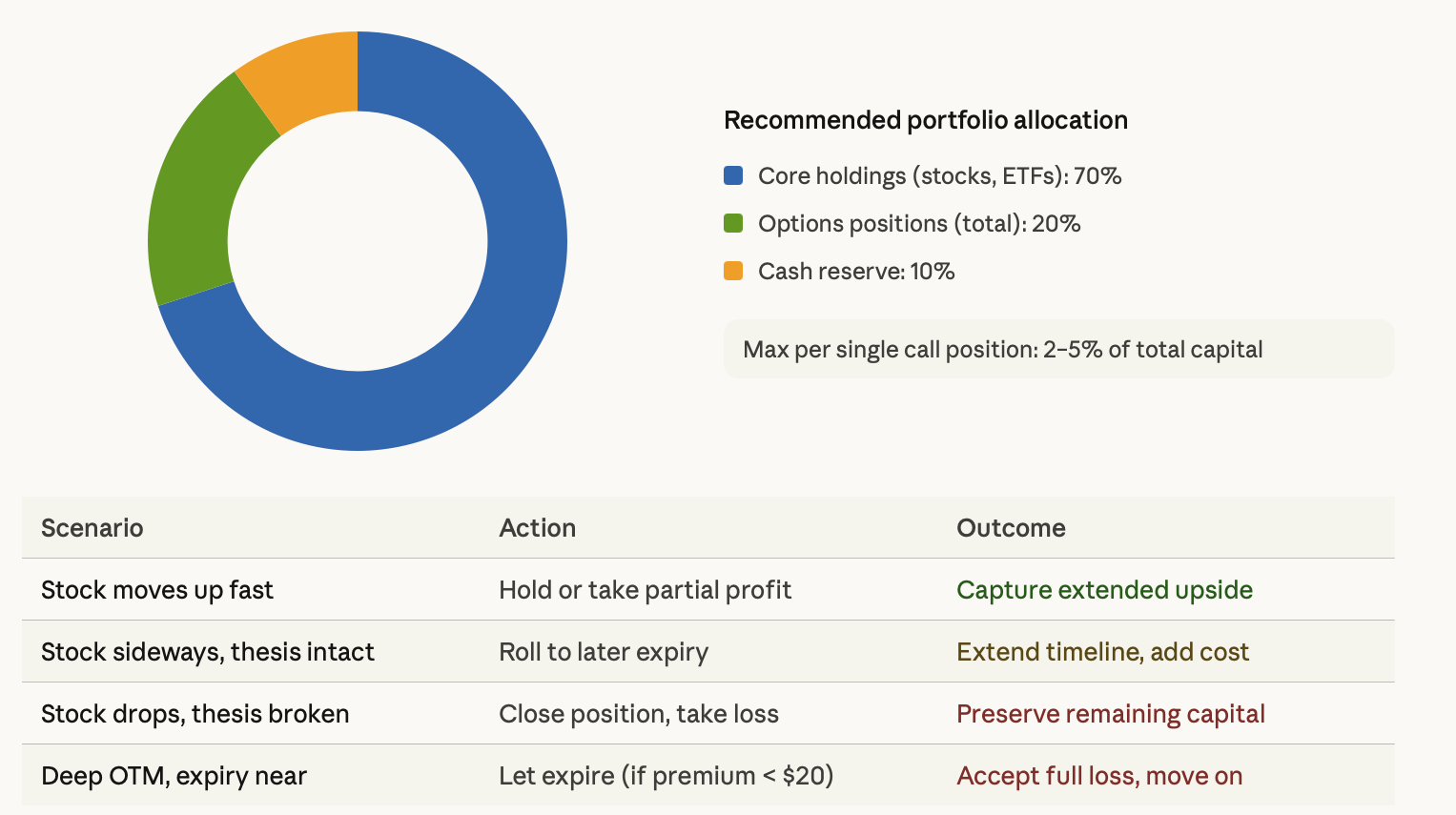
The importance of stop loss discipline is equal to that of entry. Experienced traders often use a rule to stop their long call positions if they lose 50% of their premium at any time, regardless of how much time is left. This helps them avoid the very common mistake of hanging onto a dying position and hoping for a rebound from an equity position that has fallen below zero.
Break-Even Analysis: Factoring in Implied Volatility
A long call's break-even point is easy to identify as a simple formula
Strike Price + Premium
An example is: if you buy a call for the $150 strike at $5, then your stock will need to be at or above $155 at expiration to be profitable.
However, this information is only part of the equation, and more seasoned traders realise that the real point of importance is the dynamic break-even during the duration of the trade.
Both the dynamic break-even and the changes in implied volatility will really affect the chances of an option trade being profitable. For example, when IV spikes, the value of your option increases even if the underlying security has not yet reached the strike, allowing you to frequently sell a long call for a profit long before it gets to the break-even level. A trader purchasing an NVDA call for a $5 premium and seeing IV increase from 40% to 70% before an earnings announcement may have an option that's worth $9, despite the motion of the stock only being a couple of dollars.
Vega indicates how much the option's price will change for each 1% change in implied volatility. An option that has a vega of 0.15 will receive $0.15 of premium for every 1% increase in implied volatility.
In a 100-share contract, a 1% move in IV is worth $15. That's why being conscious of when you buy options based on low-IV environments is extremely important, because you are receiving a great deal on the option, and when the implied volatility expands, it will work in your favour, even before the underlying makes a substantial price change.
Long Call vs Leveraged Tokens and Futures
One of the most compelling arguments in favour of long call options vs. all other leverage instruments is that there is no risk associated with being forced out of your position due to a margin call.
If you were trading futures and the market moved rapidly against you, your position could get wiped out if you received a margin call before that movement settled down. Leveraged tokens also run into issues of compounding and are negatively impacted by constant rebalancing drag during periods of extreme volatility with little directional movement in either direction.
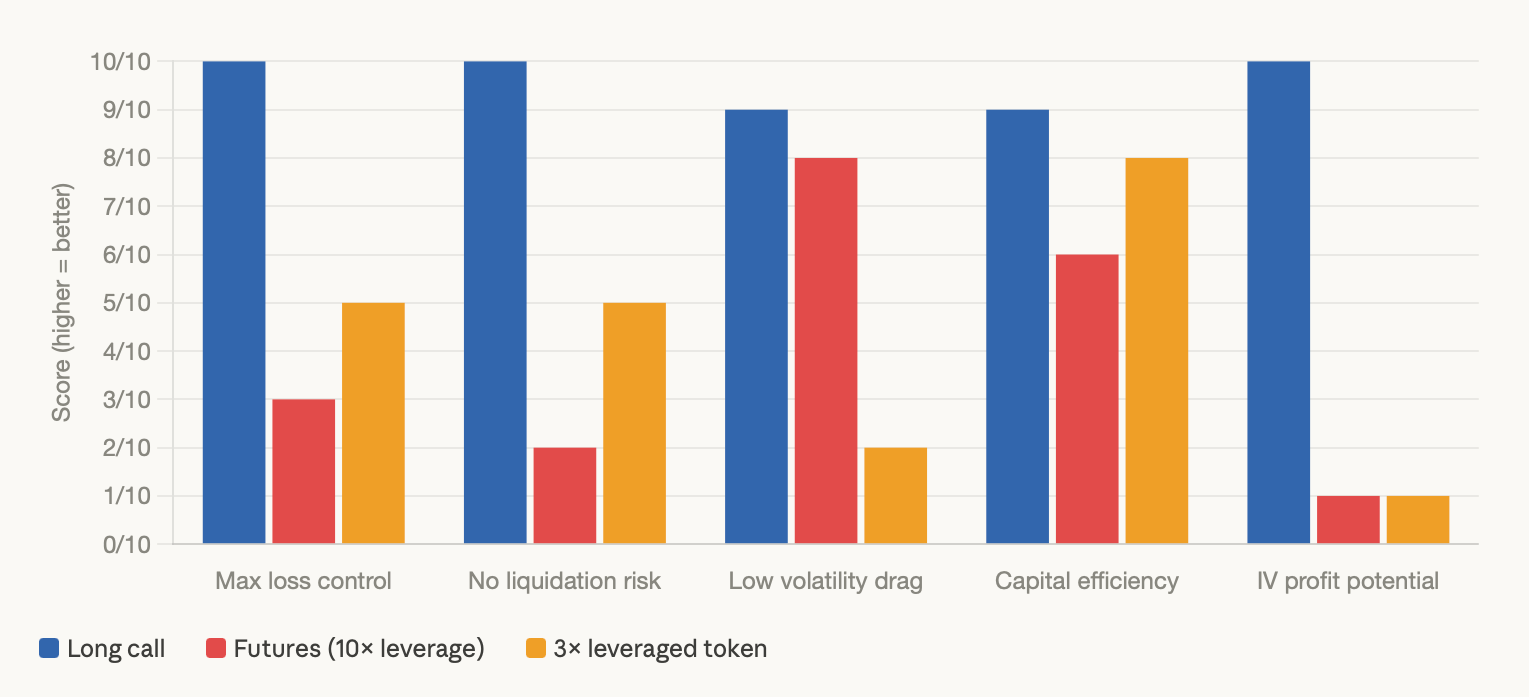
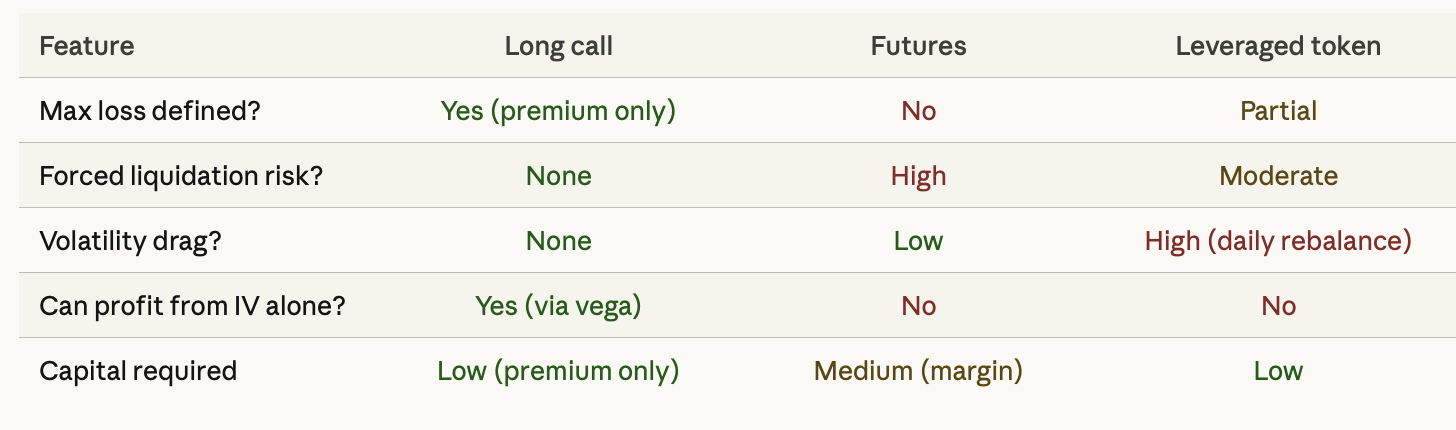
The maximum loss with a long call will be defined up front, because you will not experience more loss than the premium paid for that call, no matter which way the underlying moves against you. At 3 AM, margin calls are not going to be able to convert your controlled wager into a debt-building catastrophe, and you will never be able to convert your controlled wager into a debt-building catastrophe as the result of a flash crash. The established limit on loss is critical for traders who trade unpredictably volatile asset classes such as cryptocurrency and biotech stocks.
FAQ
How much capital do I need to start trading long calls? Most retail brokers allow single call contracts with premiums starting at a few hundred dollars. As a rule, allocate 5% to 10% of the equivalent stock cost as your maximum option budget per trade.
Can I lose more than my premium? No. This is a fundamental feature of buying options rather than selling them. Your maximum possible loss is exactly the premium you paid, nothing beyond that.
When is the best entry point for a long call? The ideal setup combines a bullish technical structure on the stock, implied volatility that's near the lower end of its recent historical range, and an expiration date at least 45 days out to give the trade room to develop.
How do I manage a losing position? Close the trade if it loses 50% of its premium value, and your original thesis no longer holds. If the thesis is intact but the stock hasn't moved yet, consider rolling to a later expiry rather than holding to worthless expiration.
Can a long call be profitable before the stock hits the strike price? Yes, and this happens more often than beginners expect. An IV spike can push your option's market value significantly higher even when the stock is still trading below the strike. This is why monitoring implied volatility alongside price is essential for active options traders.