




Quick Market Insights: Adam Smith in 60 Seconds
Adam Smith, the Scottish philosopher who lived in the 1700s, is considered the father of modern economics and wrote the book "The Wealth of Nations" in 1776. His major contribution to economics was his discovery of the law of supply and demand, which explains how self-interested people work together to create a smoothly-functioning, self-regulating economy.
His concept of the invisible hand is not just an abstract philosophical thought; it is a description of the underlying forces causing every price movement and fluctuation in financial markets, including the daily price movements of Apple Computer stocks, the fluctuations in the price of gold, and the volatility of bitcoin.
Every serious trader should not be focused on whether Smith’s ideas are still relevant to today’s financial markets but instead how his theories fit with how derivatives and crypto currencies are traded in an era dominated by algorithmic traders, the influence of central bank monetary policy, and the irrational behaviour of traders.
In this article, we examine whether Adam Smith’s theories are applicable today, highlighting classical economic theories, applying today’s market realities, and providing actionable strategies for traders to implement in their trading activities.
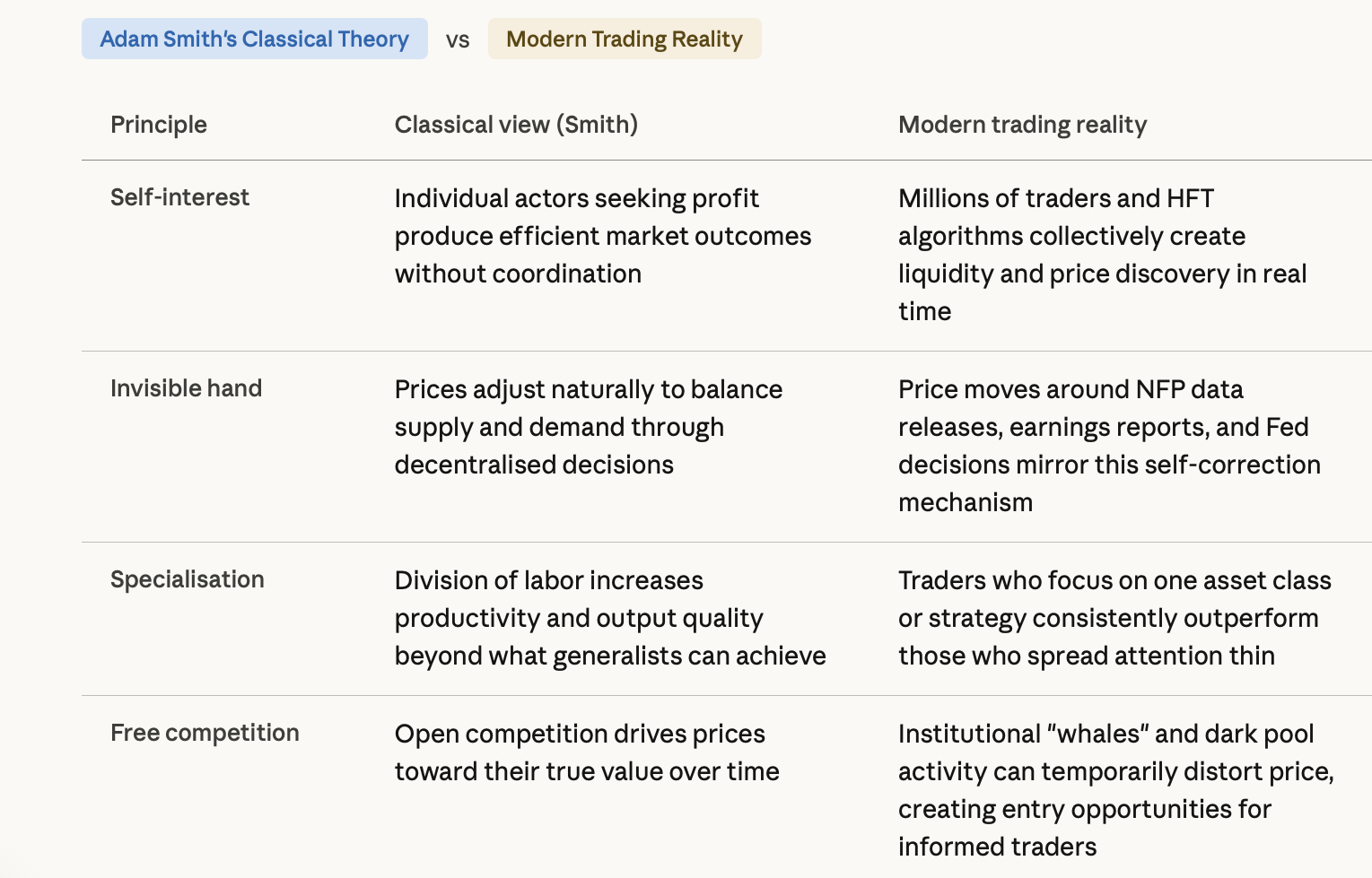
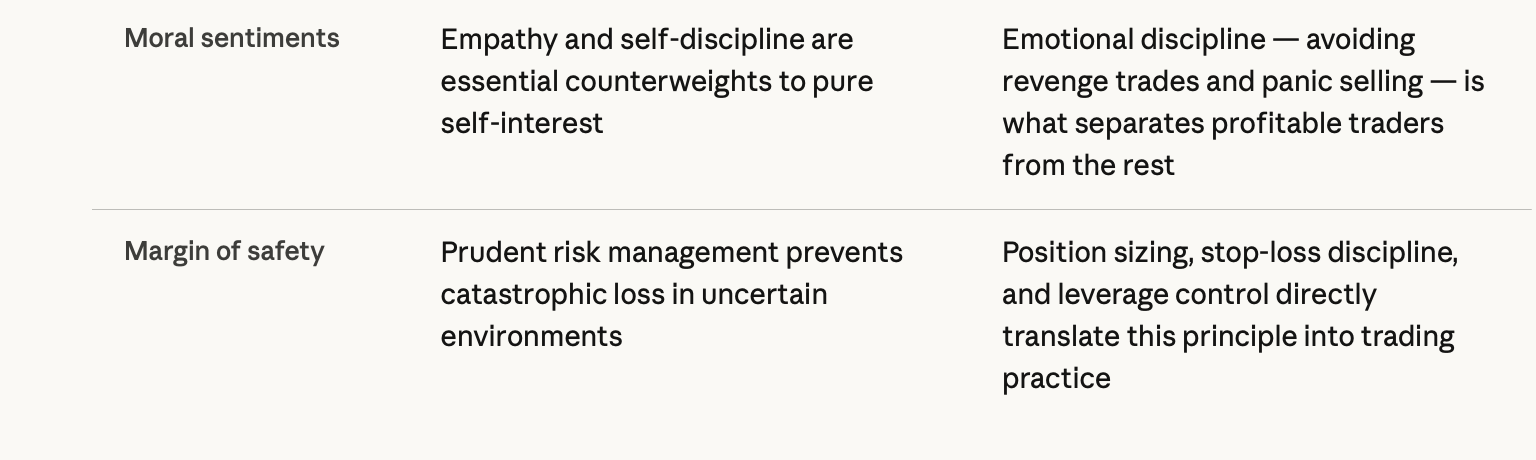
Why Adam Smith's Wisdom Still Matters for Modern Traders
Most traders first become acquainted with Adam Smith in an economics course rather than while trading. This is a missed opportunity. Smith’s framework was not meant solely for the long-term buy-and-hold investor.
He made specific observations regarding the self-organizing capabilities of markets, how prices serve as an informative vehicle for transmitting information, and how efficiencies are compounded through specialization. All three areas can be applied directly to short-term CFD markets, crypto pairs, and commodity derivatives.
Smith's philosophy is built on three structures that can easily be converted into trading principles. The first premise is that free-market systems create prices that aggregate all participants' knowledge, thereby providing informative value in price action.
Asserts that specialization creates more efficiency while reducing error rates; therefore, when you trade from a very narrow subset of instruments or strategies, you will have a greater advantage than if you spread your efforts among multiple markets.
There are distortions in price caused by events such as panic, manipulation, or macro shocks, the invisible hand will ensure that these distortions will gradually move toward correction over time, thus giving patient traders the advantage of structuring an edge.
The important point that Smith fully understood is that all three principles identify tendencies rather than certainties. There will always be movement in markets towards establishing equilibrium, although attaining equilibrium will take longer than one would desire.
The amount of volatility in the market can provide evidence against Smith's theory that the mechanism of self-correction is continually working as the market progresses toward equilibrium; that is, as volatility exists, self-correction continues.
For CFD traders and crypto day-traders, the essential distinguishing factor between reactionary noise and trade execution based on principle and theory lies in understanding this important distinction.
Market Fundamentals: The Invisible Hand and Price Logic
The invisible hand is not just an idea. It actually works to produce results, and once you understand this, you will have a different understanding of price movement on charts.
Each time a trader makes an order to buy an option, or to buy a future or place a stop-loss, they do so based on a combination of private information and public information, as well as their feelings about the situation.
The millions of people, making their own decisions are determining the price of a security, and it is a demonstration of how successful the invisible hand is, as it produces price information which is unattainable by central planners.
When a Non-Farm Payrolls report is released and is better than expected, there will be a large jump in USD relative to other currencies and a sell-off in gold. These moves occur when thousands of traders reinterpret the potential outcome the Federal Reserve’s interest rate decision, with each trader looking at the same data but interpreting that data slightly differently, with different position sizes and risk tolerances. This will result in a large movement in the underlying, which is an example of the invisible hand producing a total price information output.
Traders can read three dimensions of information on price: the first dimension is the relative balance of supply and demand, which is reflected in the bid and the ask and depth of orders; the second dimension is momentum, which is the momentum of volume and trend.
Whether the market is moving in the same direction or whether it is holding; the third dimension is volatility and represents the uncertainty or divergence of opinions about what the value of that underlying should be, or what Smith would describe as the market continuing to create an equilibrium price for that underlying.
Bitcoin provides a really good example of the plot working to produce an outcome. Because of the 24/7 nature of the crypto market versus the lack of institutional support and the limitations that are present in the equity markets as a result of circuit breakers, the invisible hand creates price movement much more violently and more visibly than in the equities markets.
An example of this is when a rumor is circulated regarding regulatory involvement that causes the price of bitcoin to drop 15% in one hour; when the price recovers, it is the result of individuals buying bitcoin at a discount to its intrinsic value, and is an example of the type of corrective action that Smith described in 1776.
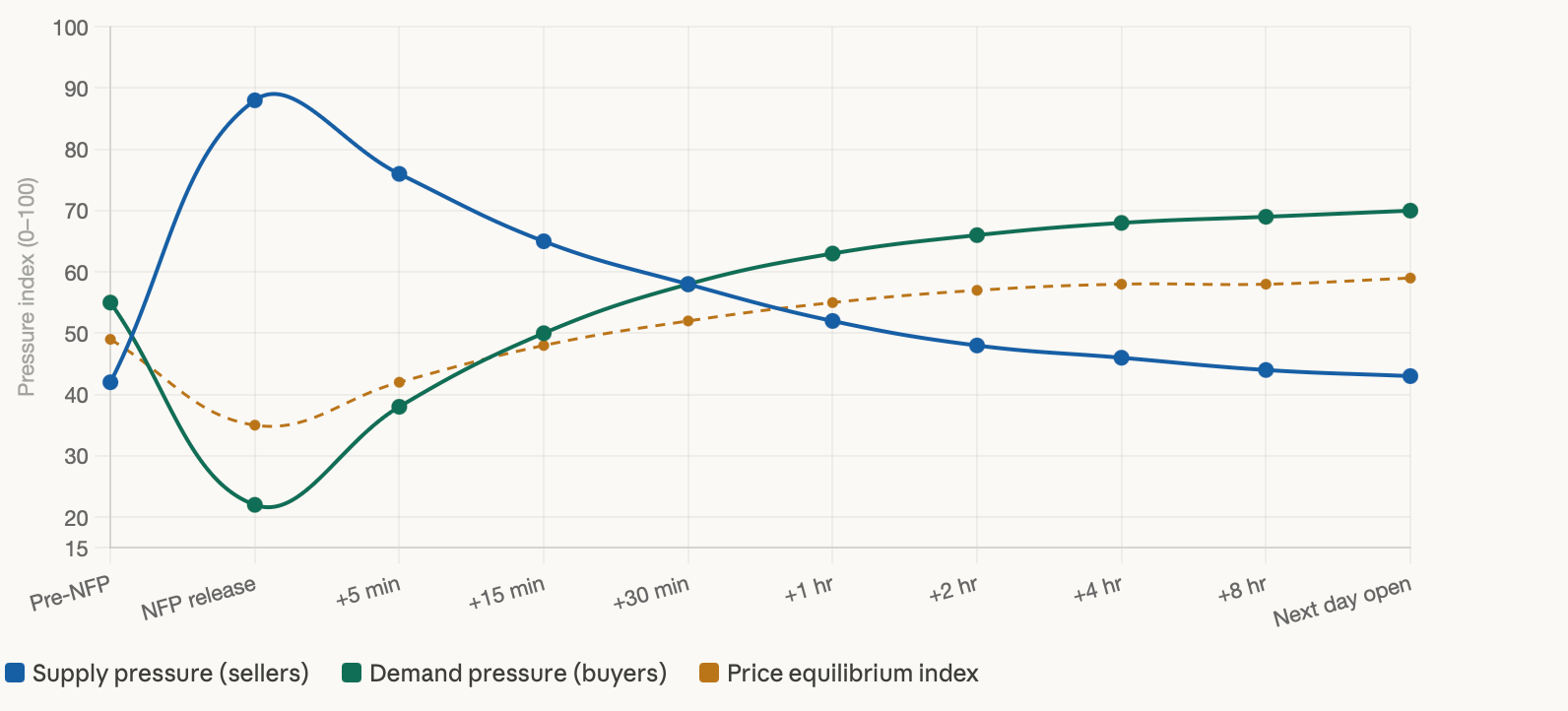
The chart above illustrates how supply and demand pressures interact around a major data release. Notice that the equilibrium index doesn't spike with the initial shock. It trends gradually toward a new balance as more participants absorb the information and re-enter the market, which is Smith's invisible hand playing out across a compressed time frame.
Practical Application: Division of Labor for Traders
The best ideas that practically can be found in The Wealth of Nations come in the form of the division of labor. The well-known example Smith uses to illustrate this is the pin factory: when ten workers create pins each working on only one step of the pin-making.
The production capacity is 48,000 pins per day compared to a few hundred when each of the ten create their own pins start-to-finish. The improved production is due not to an increase in the output of effort, but rather, having an increase in the depth of focus that results in a compounding level of expertise.
The principle of the benefits of division of labor also applies to traders who are successful in competing with other traders. Traders do not continuously beat the competition because they monitor all 40 instruments across 6 different asset classes.
They do so because they have enough understanding of one market to know what each market typically does and when the market is behaving outside of its normal parameters. Therefore, a trader will have an advantage over the generalist because he has spent the past 3 years monitoring how the Gold CFD reacts to changes in the US dollar, changes in inflation expectations and changes in geopolitical events.
The benefits of automating trading systems further ensures the advantage that traders who apply the principles of the division of labor will continue to have. Algorithmic trading strategies that focus on a single asset such as a BTC/USD momentum trading system or a gold mean-reversion trading system have the same principles that are used in Smith's pin factory.
A trading system does not monitor 40 instruments; however, it does automate the execution of one edge, at a level of consistency, precision and speed that is impossible to match using human judgement alone at scale.
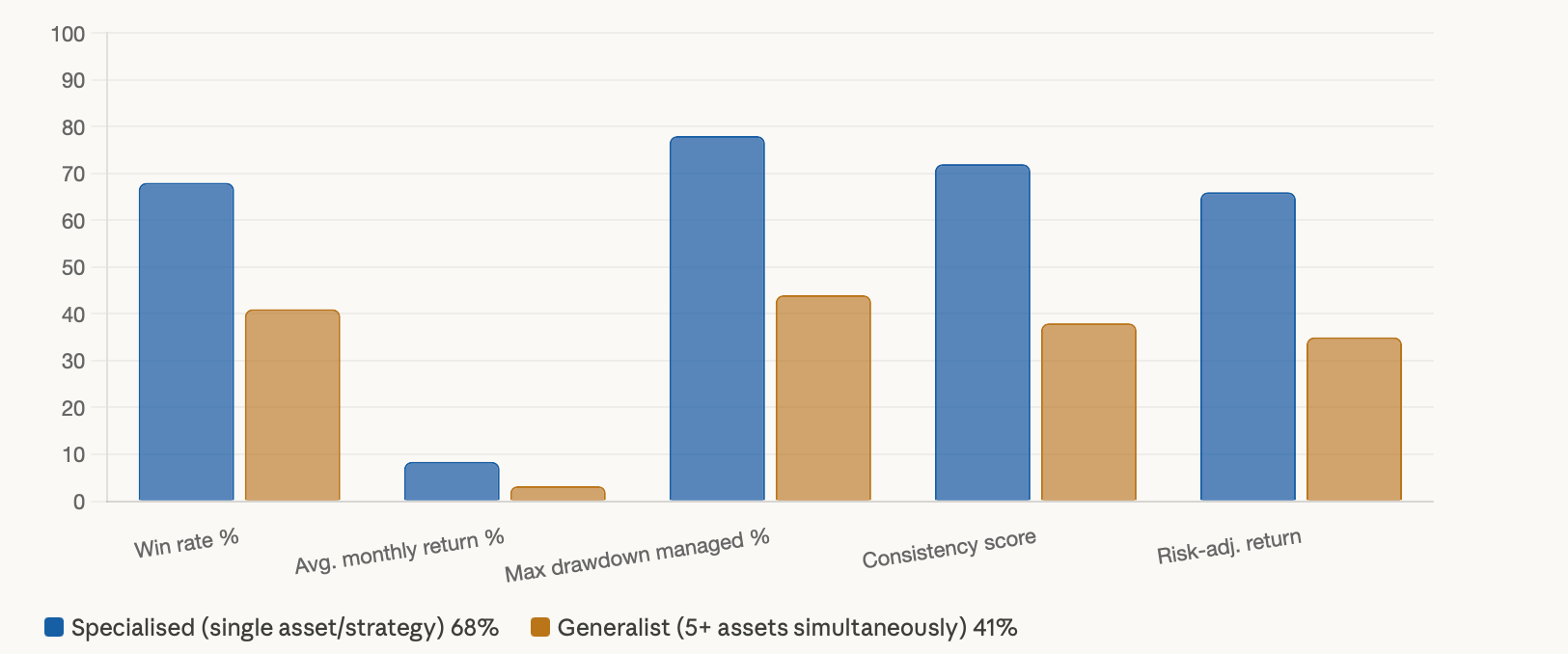
The data in the chart mirrors what seasoned traders say from their experiences. Not only does developing a specialty enhance win rates, it reduces draw downs, enhances reliability, and ultimately results in greater risk adjusted return ratios based on whatever metrics you utilize. This is the application of pin factory theory by Smith within an environment relating to financial markets.
New traders simply cannot go wrong by choosing one market instrument, time frame, and trading method and focusing on it for 90 days to begin developing their trading skills. Likewise, all experienced traders that utilize automated systems will benefit from this pin factory logic applied at a strategy level: a well defined trading method with strong edges will consistently have much more significant returns than one that tries to utilize many different strategies.
Classical Theory vs Modern Markets: Where Behavioral Finance Complicates the Picture
Smith theorized that market behavior flows from a rational self-interested search for an efficient market outcome. Behavioral finance has demonstrated over the past 40 years many reasons why this premise does not always hold and how understanding these instances allows for the identification of actual trading opportunities.
The existence of institutional players large enough to cause price fluctuations without regard to fundamental value presents the biggest challenge to Smith's theory of market behavior in the current marketplace. A hedge fund that is liquidating a gold position worth 1 billion dollars does not do so due to changes in the fundamental value of gold.
The price fluctuation is a mechanical by-product of order imbalances and is not caused by the invisible hand, as far as the trader is concerned; the outcome is likely to be poorly timed entry onto a position that will eventually shoot back up after the institution completes its liquidation of the gold position.
Smith also commented on the impact of individual rational self-interest in his treatise, The Theory of Moral Sentiments, where he suggested that genuine economic efficiency requires not only rational self-interest but also self-discipline and the capacity to empathize with the rational self-interest of others. In trading terms, these concepts directly translate to customers developing the ability to regulate their emotions.
The panic that may occur during an extreme sell-down of crypto currency, the fear of missing out that drives bubbles to exorbitantly high valuations, and the revenge trading that leads a customer with a manageable loss into entering a trade that eventually wipes out the entire customer's trading account, feature all demonstrate the failure of the self-regulation that Smith argued was necessary for the existence of an efficient trading environment.
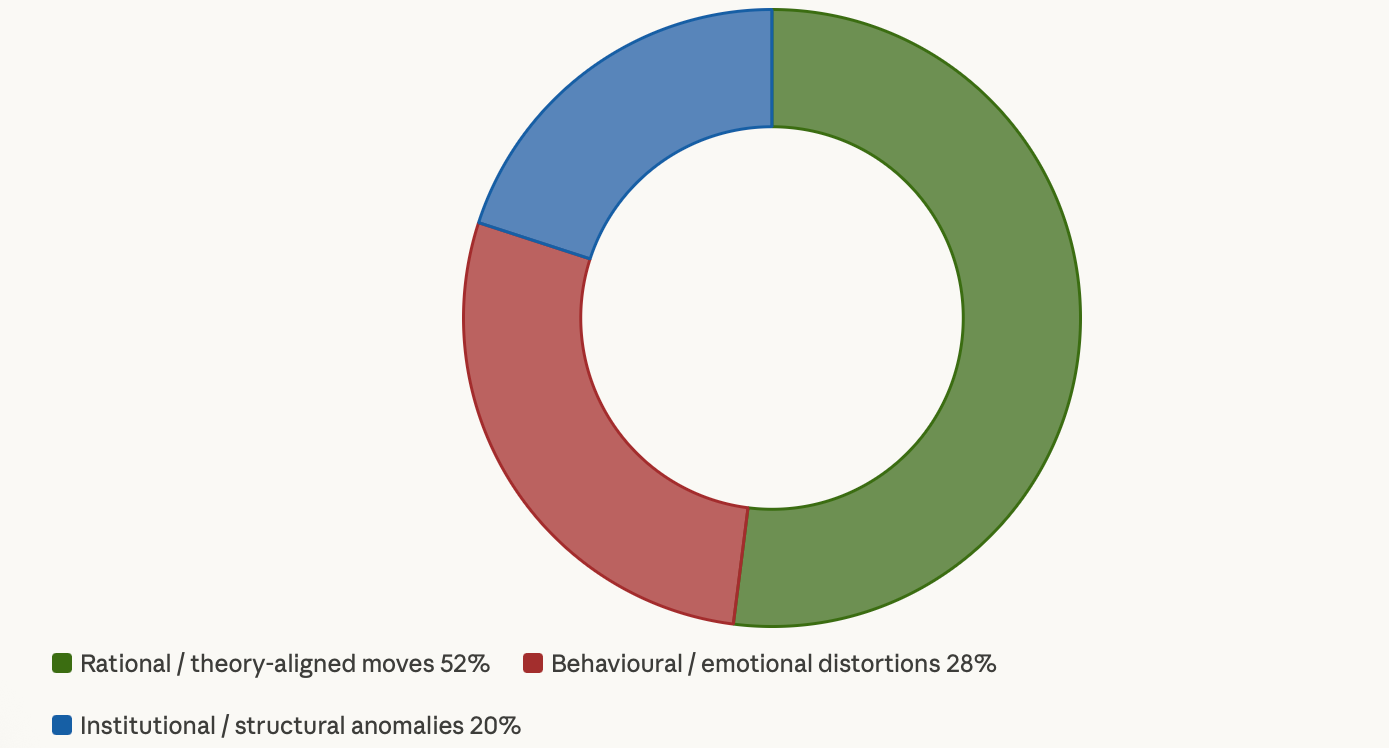
The evidence provided suggests that the truth about how much of the price moves happen in any liquid market is more related to psychological and structural anomalies than it is to purely economic supply/demand fundamentals. These anomalies are also the areas where Smith's framework can be augmented with modern behavioral finance tools; they also provide disciplined traders an opportunity to get an edge over the emotionally driven majority.
Building Your Knowledge Brand: How Economic Theory Shapes Wealth Over Time
Adam Smith was not alone in his economic thinking; he was part of a long chain of economists. It is important for today's traders to learn about other economists, especially those whose ideas were based on or provided alternatives to Smith's, to help provide broader context and a deeper understanding of how current macro expectations will affect world equities.
John Maynard Keynes disagreed with Smith in his belief that free markets are able to quickly restore themselves and stop long-term damage to the economy. He proposed that governments must sometimes step in with fiscal policy in order to encourage spending and thus restore demand.
Modern traders see these ideas in action every time a central bank lowers interest rates in an effort to stimulate growth or a government announces an infrastructure package that will increase demand for construction and raw materials.
Friedrich Hayek also disagreed with Keynes; however, he was much closer to Smith in his interpretation of how the market works. Hayek stated that the way price signals indicate the value of a product is a type of knowledge that cannot be replicated by a central planner.
Therefore, traders understand that when government puts its hands in the marketplace, even when it is for a "good" reason (e.g. fiscal stimulus), it creates a distortion that will be corrected at some point. In other words, the time-frame of the consolidation rally will end after the government ceases an effort to manipulate an asset and the true price signal resumes.
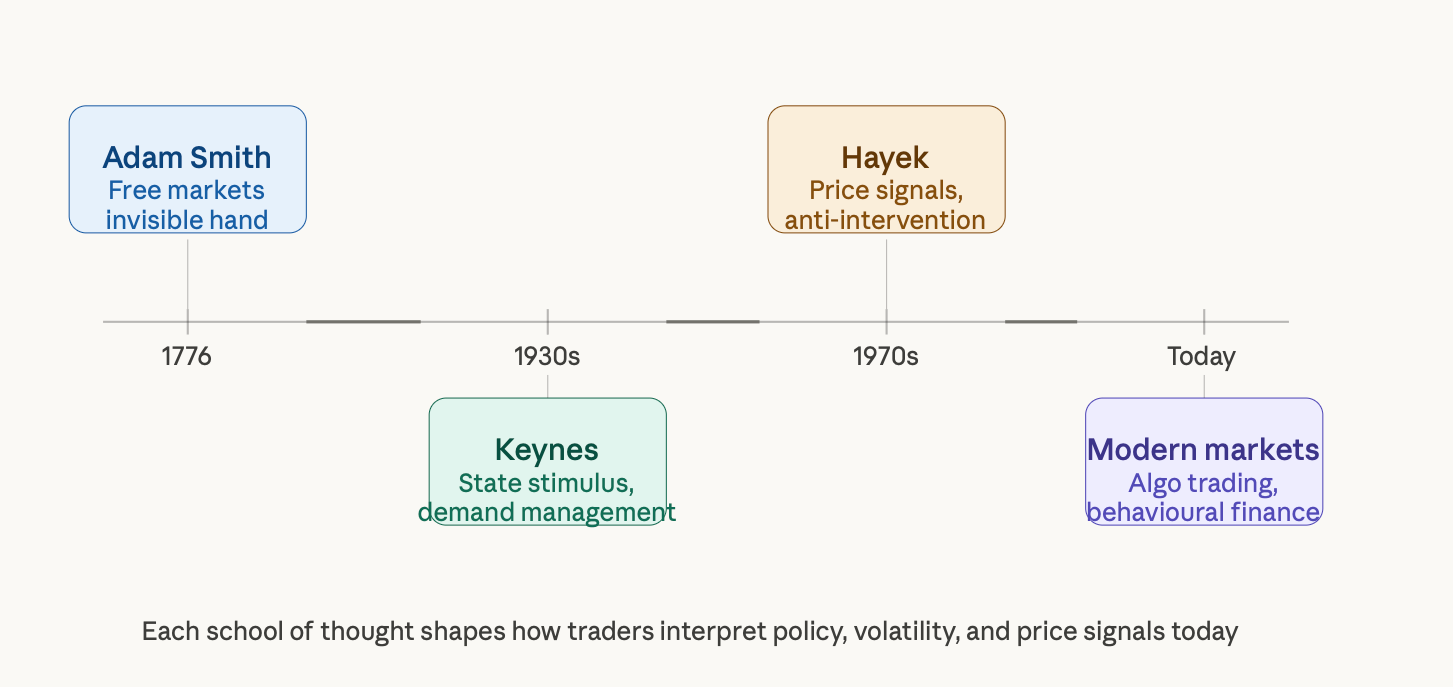
For traders building a serious intellectual foundation, three books belong on the shelf alongside a good technical analysis course: The Wealth of Nations by Adam Smith for the foundational framework, The General Theory of Employment, Interest and Money by Keynes for understanding how policy decisions move macro markets, and Prices and Productionby Hayek for understanding why those interventions eventually unwind.
Deep Dive: Free Trade Principles and Global Commodity Markets
Smith didn't just argue that free trade should be practiced, but also predicted that if traded freely across borders due to differences in price; due to the natural flow of products from one area to another will provide an equalisation of those price differences, and therefore provide stability within markets based upon the consideration of actual supply and demand globally.
Tariffs imposed on imports into the United States, sanctions imposed on exports, or the restriction of exports all create price dislocation due to artificial constraints upon the free distribution of produced goods becoming available globally. Once those restrictions end, the price of the restricted items will return to a state of equilibrium based upon Smith's concept of free trade.
The market for crude oil is one of the best examples of this mechanism, perhaps the only better asset is gold because of its relative lack of trade barriers and export controls. The result of OPEC's reduction of crude oil production causes the price to increase, and when this increased price results in a decrease in the demand for crude oil, or an increase in production from non-OPEC countries, the price of crude oil will return to an equivalent value.
When sanctions against crude oil producers take effect, for example, the price of crude oil will increase; once the intermediate markets have arranged for the crude oil to be provided to buyers outside of the country imposing sanctions against those producers, the price of crude oil will return to a level closer to what it was before the imposition of the sanctions. In both of these situations the economics of free trade as stated by Smith will still hold, and the trader understands how to price in the effects of a trade distortion due to trading restrictions and when to price out that distortion.
This will be done through the use of classical price signal analysis to value gold because of its relative lack of trade barriers or export controls and because the price reflects current global supply and demand as well as other financial requirements such as cash reserves held by central banks or similar institutions.
Because gold is a cross-border store of value it provides the trader with an opportunity for significantly greater transparency than any other asset for purposes of applying classical price signal analysis.
FAQ
Is Adam Smith's theory suitable for short-term trading?
Smith's principles operate at a level of abstraction above individual candles or intraday setups, but they provide the explanatory framework that makes short-term patterns meaningful rather than arbitrary. Understanding why a price move is happening, whether it's a supply-demand imbalance correcting, behavioral irrationality creating a temporary distortion, or institutional order flow overwhelming fundamentals, makes you a better short-term trader even if you're not making macro bets.
How can free market principles guide CFD day trading strategies?
The core implication for day traders is that price distortions caused by emotional or mechanical factors, rather than genuine supply-demand shifts, tend to revert. Identifying when a move is driven by panic selling or forced liquidation rather than a change in fundamental value gives you a probabilistic edge on the mean-reversion side of the trade.
How do you apply division of labor to crypto trading?
Pick one crypto pair, one time frame, and one strategy type. Spend 60 to 90 days developing deep familiarity with how that pair behaves around specific market conditions: exchange-specific order flow patterns, the relationship between BTC dominance and altcoin volatility, how a particular pair responds to on-chain data. That depth of specialization is what compounds into a genuine edge over time.
Start Trading with Theory-Backed Confidence
If this framework has changed how you think about price movements, TradeWill.com gives you the infrastructure to put it into practice, with tools built for traders who want more than chart patterns and gut instinct.