



What Is a Blockchain Fork?
A blockchain fork occurs when developers modify a blockchain's protocol or rules. Imagine it as an upgrade of the software that governs the whole network. Sometimes updates work without a hitch. Other times, the result is a chain split.
There are two main types of forks: hard forks and soft forks. Both serve different purposes and cause different effects for your crypto holdings.
Let’s use a basic example. Suppose there is a class of students that manages a ledger together, where they all follow set rules to record transactions. One day, half of the class wants to start recording the transactions based on new rules, while the other half prefers to continue using the previous rules. This means there will now be two separate ledgers, each with their own set of rules. This is pretty much how a blockchain fork works.
Bitcoin Cash serves as a well-known example of a hard fork. A portion of the Bitcoin community wanted to increase block sizes to enable greater transaction throughput in 2017. The rest of the community could not agree. Bitcoin ended up separating into two chains: Bitcoin (BTC) and Bitcoin Cash (BCH).
There are several reasons for forks. Teams must upgrade their protocols to handle increased users. They need to fix security bugs that would put funds at risk. Occasionally, communities disagree on the direction of their project. Disagreements lead to a formal breakup.
Another major example is the Ethereum Classic fork. After a hacker stole millions of dollars from a smart contract project called The DAO, the Ethereum community voted to unwind the theft. Not everyone in the community agreed to unwind transactions. They continued to operate their chain as Ethereum Classic (ETC).
Hard Fork vs Soft Fork
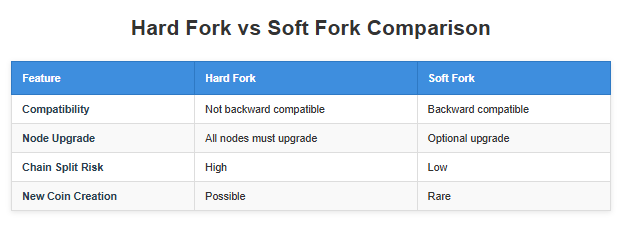
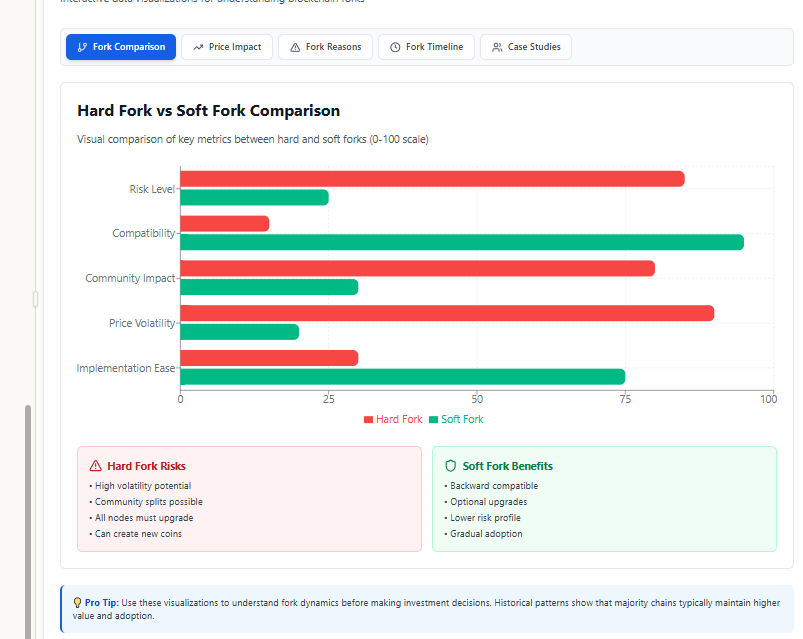
Hard forks create permanent divisions in the Blockchain. They are not backward compatible. This means those running old software will not be able to confirm new blocks. Everyone needs to upgrade if they want to stay on the new chain. If some people don't upgrade, there could be two separate chains.
Soft forks work differently. They are backward compatible. The nodes running old software can still validate transactions on the network. They just won't recognize the new features or the new data structure. Because the old nodes can still validate blocks, this makes soft forks less risky than hard forks.
Bitcoin's segmentation witness (SegWit) was a soft fork. It changed the way transaction data is structured and aggregated, which allows more transactions to be stored within each block. Old nodes can still validate blocks, they just don't know about the new data structure. The old nodes now work together with the new nodes to validate and confirm transactions in a single unified transaction history.
You can think of it as online multiplayer. A hard fork is like when the game releases a completely new version where the old players can no longer play the new players. A soft fork is more like a game update where the old players can still join games, they just won't be allowed to use the new game features.
Hard fork carries more risk because it could split the community. When Bitcoin Cash forked from Bitcoin, anyone who had coins on the Bitcoin forked chain suddenly had coins on both chains. Exchanges were forced to choose which chain to support. Miners had to choose where to point their computer power. This all created mass confusion and price volatility.
Soft forks avoid all of this. Since the network is not split, neither is the community split. Prices remain more or less stable. People have a chance to upgrade at their own pace and time. This is why many developers prefer soft forks if they are able to.
Why Blockchain Forks Happen
Technical upgrades are the most common reason for forks. Blockchains need to scale as more people use them. Bitcoin can handle approximately 7 transactions per second. Credit card processing companies can handle up to thousands per second. Developers decide to fork to gain larger capacity and speed.
Security fixes are another reason for forks. Hackers continue to be on the lookout for bugs in the blockchain code that they can exploit. Developers will need to fix a serious security bug rapidly once they have determined one. A fork allows developers to patch the vulnerability across the network through an update.
There are also performance optimizations to be had. There are problems that are a result of old blockchains as they weren't built to support the demands of today; forks can help limit transaction fees, speed confirmations to the user, and satisfy overall needs.
Community disagreements can lead to controversy with a fork. There may be two different points of view from two different groups in the community in regard to where they want to go with a project or technology. One group may want to maintain decentralization at any cost, while another may find that faster transactions may be superior even though that means there will have to be greater centralization due to the position of a centralized entity willing to solve problems for transaction throughput. Refusing to joint agreement on a direction typically results in a fork.
The Ethereum DAO fork is an example of technical and a community disagreement if you will. The DAO smart contract had a hacker exploit the problem of a bug. The hacker stole nearly $60 million worth of ETH as a result. At this point, the community agreed they were going to have a choice, agree to reverse the theft or agree to let the stolen assets stand. In reversing the theft, the community would essentially be changing the transaction history, which under the code is law principal . No person or entity should change, which is part of the ethos for several blockchains today.
The majority of the community voted for a hard fork to reverse the theft. A minority maintained the original chain as Ethereum Classic. They thought changing the transaction history set a terrible precedent. This occurred because of competing values regarding blockchain immutability.
Market-driven needs can also drive forks. Individuals may create forks for projects to maintain competitive relevance. For example, projects may want to implement privacy tools, smart contract capabilities, and improved token distribution models. An example of this is Bitcoin Cash, which increased the block size in an attempt to drive down fees to compete with payment networks.
Here's a breakdown of fork motivations:
Technical Reasons:
-
Scalability improvements
-
Security patches
-
Performance upgrades
-
New feature implementation
Community Reasons:
-
Governance disagreements
-
Philosophical differences
-
Development direction disputes
-
Economic model changes
Impact of Blockchain Forks on Crypto Ecosystems
Forks influence more than only the value of coins. They also influence any application going on top of that blockchain including DeFi platforms, NFT marketplaces, and decentralized applications.
DeFi platforms can face a complicated process dealing with forks. After a hard fork is completed, it is possible that liquidity pools exist on both chains. Smart contracts must potentially be compatible with both forks. Trading platforms will need to determine which chain to support.
Decentralized exchanges witnessed this process after Ethereum forked following the DAO attack. These exchanges were faced with needing to manage liquidity on two separate chains, as users now held both ETH and ETC. Exchanges like Uniswap needed to ensure their smart contracts were still working properly on both chains.
NFT platforms face additional challenges with forks. Digital art and collectibles exist in the form of tokens on the blockchain. When a fork occurs, these tokens may also exist on the forked chain and it is uncertain which token is the "real" one. This creates ownership disputes, and issues with valuation of NFTs.
Platforms like Opensea needed to determine strict policies in regards to which chain would be considered legitimate. Most chose to follow the majority chain, meaning that NFTs held on the Ethereum Classic chain were worthless in relation to their Ethereum counterpart, creating even more uncertainty for creators and collectors looking for clarity on which chain was legitimate for their NFT collections.
Developers must plan in advance for forks. They must have contingency plans for both possible outcomes. Smart contacts should be audited for compatibility issues, and teams must have a plan to continue services on both chains if necessary.
Investors also face difficult decisions. Should they hold coins through the fork to receive both coins? Or should they sell the coins before the fork to avoid periods of high volatility? Again this depends primarily on their risk tolerance and understanding of the fork purpose.
Some exchanges will allow customers to access both chains after the fork has been completed, even crediting users with coins on both chains. Other exchanges will choose to support one of the chains, ignoring the other chain completely. Investors should be aware of an exchange's policy before the fork occurs.
The same ripple effects extend to mining operations as well. Miners will have to choose which chain to secure with their computing power. This, too, has implications regarding security on both chains. In general, miners will choose the chain that is more profitable, but some may even have ideological reasons for supporting one chain over another.
How to Handle a Blockchain Fork: Investor and Trader Guide
If you want to receive forked coins, you have to plan ahead. Most exchanges make a snapshot of your holdings at a given block height, and if you hold coins at that time, you’ll get the forked version. Each exchange’s snapshot will happen at a different time.
The first step is to move your coins to an exchange that will support both chains before the fork. A major component of any fork announcement will always be the exchange’s pledge to distribute the forked coins. However, some exchanges only support the majority chain, and you will risk not getting forked coins if you use those exchanges.
If you instead hold your coins in a hardware wallet (self-custody), you are even more in control— you will have coins on both chains, regardless of what the exchanges do, and will only need to input into a wallet on the forked chain in the future (which obviously requires some technical knowledge). By being self-custody, you won’t miss out on potential value.
Controlling risk starts with the research you do yourself. Understand why there is a fork in the first place. Read the technical proposals. Read commentary by the community. If there is a contentious fork with no clear winner, that creates a different set of risks than if the fork is simply an upgrade.
If you are worried about loss due to price drops, stop loss orders can help protect your value against sudden price evaluations. Forks can create uncertainty, which in turn can create extreme volatility in price. Prices can go up, down and up again in seconds in both directions. By setting price exit points beforehand, you can limit your loss if you are going against the trend of the markets.
Do not begin trading instantly after a fork. Prices are very volatile in the first hours and days. Without much liquidity, it is easy to take bad prices on buys or sells. Wait for the dust to settle and have a decent price discovery.
You can think about it as a bank giving new coins. If you have an account when they make the announcement of the new coins, they just drop the new currency into your existing account. Your existing account balance stays where it is, and you just obtain new coins. That's basically how fork coins work.
Here's a step-by-step guide:
Before the Fork:
-
Investigate the details of the fork and rationale
-
Select an exchange that will support both forks
-
Make sure your coins are in a wallet prior to the snapshot
-
Set price alerts to monitor any volatility in either asset
-
Determine how you plan to either hold or sell both new assets
During the Fork:
-
Do not panic sell or panic buy
-
Make sure to monitor both chains to see which remains stable
-
Check the exchange to see if they have made an announcement on the fork
-
Confirm that you will receive coins on either of the forks during the snapshot
After the Fork:
-
Verify the balance of your new forked coins
-
Ensure that the price is stabilizing before trading
-
Assess both measures of the forked chains as a long-term holding
-
Most importantly, make sure the decision is based off fundamentals
Risk will always fluctuate based on the fork details. Contentious hard forks usually have the most risk. Network upgrades as soft forks have little risk. Coordinated hard forks that align with community consensus will be at medium risk.
Tools and Monitoring for Blockchain Fork Events
Blockchain explorers are your go-to source for information. With Etherscan for Ethereum, Blockchain.com for Bitcoin, and similar platforms tracking real-time data about the status of the network, you will be able to track when the nodes have upgraded and what version they are on.
Before fork, check the distribution of the versions held by the nodes. Greater than 90% nodes upgraded will cause the success of the new chain. If near 50-50 expect a flustered mess and two separate chains to survive.
Exchange announcements provide critical detail around this time-frame. They tell you when the snapshot is taken, when the forked coins will be credited into your account, and what chain they are going to support. Subscribe to email alerts from exchanges. Watch their social media for news about their announcements.
Set reminders on your calendar for the fork date, and mark the date of the snapshot. This way you will guarantee you have coins in the right place at the right time. If you forget the snapshot, it means you will not get your forked coins for free.
Price alert tools help track volatility. Establish alerts at significant price points on both chains. This allows for a quick reaction when prices are moving without the need to watch charts constantly. If you would like to implement customizable alerts, check out CoinMarketCap or TradingView, both of which have this nice feature available.
Social media monitoring gives you community sentiment. Everybody is tweeting, Redditing or Discording about forks. In these social channels, you'll learn about potential issues, ongoing developer updates, and market reactions. Although sentimental data is not hard evidence, it is a qualitative measure that asset managers can layer alongside technical analysis.
GitHub repositories can provide insight into the development activity of forks. You can check in on a GitHub repo to get an idea of commits, developer discussions, or code review. If you observe active development in both chains after a fork, it's likely both will continue. If one chain has little to no development activity, it may not have a future.
Here are essential monitoring tools:
Blockchain explorers include:
-
Etherscan (Ethereum)
-
Blockchain.com (Bitcoin)
-
BscScan (Binance Smart Chain)
Exchange resources include:
-
Official announcements
-
Support documents
-
EMA notifications
Price monitoring includes:
-
CoinMarketCap alerts
-
TradingView charts
-
Notifications from exchanges whenever price changes on the platform
Community channels include:
-
Project Discord servers
-
Reddit communities
-
Twitter accounts for developers from a project on Twitter
The Ethereum Constantinople upgrade demonstrates effective monitoring practices:
The developers announced the upgrade months before it happened. They also ran test networks to mitigate bugs. Community members monitored the upgrade of nodes with data from the blockchain explorer. Exchanges announced their support and the particular times for their snap-shots weeks in advance. All this preparation led to a successful upgrade.
Famous Blockchain Fork Case Studies
In 2017, the Bitcoin Cash fork emerged from years of discussion. Bitcoin's block is restricted to 1MB and can handle about 7 transactions per second (TPS). As user transactions began to rise, fees and times began to increase as well. Some in the community tried to increase the block size, while others worked on off-chain scaling solutions such as the Lightning Network.
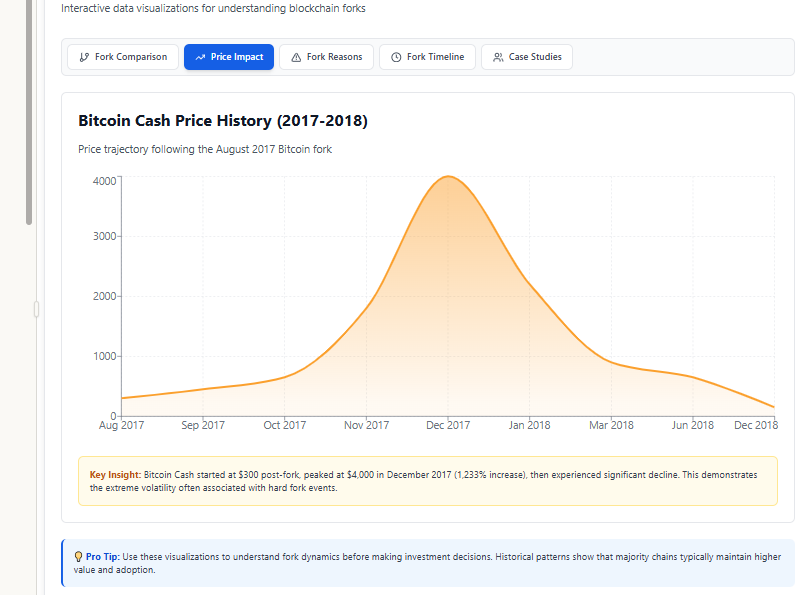
There was no community consensus. On August 1, 2017, Bitcoin Cash hard forked off of Bitcoin and offered 8MB blocks. Bitcoin holders, after the fork, received the same amount of BCH as they held in BTC. The price action of BCH was swift. The price started around $300, reached a high of up to $4,000 in December 2017, and has since collapsed. Mining power was divided between the two chains, with Bitcoin keeping the overwhelming majority of both hashrate and network security. BCH had enough miners to continue after the fork in 2017, but it was always smaller than Bitcoin. Both chains are still up and running, each developing their respective communities and use cases.
The Ethereum DAO fork happened faster and received more push back. In June of 2016, a hacker compromised the The DAO smart contract and drained around $60 million in ETH. The hack posed development issues and credibility issues with the Ethereum ecosystem.
Developers proposed a hard fork that would change the transaction history of the blockchain. About 85% of the community voted for the proposal. The fork happened on July 20, 2016, with the "main" chain operating under the name Ethereum (ETH) and the original chain still maintaining the name Ethereum Classic (ETC).
The price charts tell the story. ETH maintained most of its value. It started at about $12 before the fork and peaked at more than $4,000. ETC began at around $1, peaked at around $50 but never reached ETH's market cap. The market chose the majority chain.
Chain activity metrics provide an indication of the gap between usage patterns. Ethereum hosts thousands of DeFi projects, NFT marketplaces, and decentralized apps. Ethereum Classic has practically no development activity, as most developers followed the main chain. In this case, the community's choice to support the hard fork was validated.
The Bitcoin SegWit soft fork went in a different direction. Activated in August 2017, it increased transaction capacity but did not implement a hard fork. It modified how transaction data was recorded so there was more room in each block and nodes-compliant members could still validate blocks. It staved off the disintegration of the Bitcoin community.
SegWit was adopted slowly. Many wallets and exchanges took months to use. Users saw reduced fees and increased capacity as usage grew. SegWit caused no price collapses or disintegration of the community unlike hard forks. SegWit demonstrated that a soft fork can be a peaceful upgrade.
Legal and Regulatory Implications of Blockchain Forks
Forked coins complicate taxes. The IRS views them as new assets. They may cause you to owe taxes at the time that you receive them, even if you do not sell them. The fair-market value at the time you gain control of the new asset is the basis to use for calculating gains or losses later. This notion makes things complicated, as forked coins may have no market price at the moment of the fork.
All taxes are different. The IRS considers forked coins taxable income. In the UK, they would be considered a capital asset, and there is no immediate tax obligation. In Australia, the reporting provision for coins would apply, but they are merely taxed as profit after sale. You have to understand the laws in your local jurisdiction before you hold forked coins.
Claiming forked coins as income can also create issues. If you were holding Bitcoin when the coin forked to Bitcoin Cash, for example, you would have received BCH. However, exchanges often took weeks to distribute BCH to validated BTC holders. Do you owe taxes on the day of the fork, or when you actually received the coins? Tax authorities, in most cases, have not provided clear guidance.
You will also have to keep records. It is a good idea to keep good records of when the fork happened, when the coins appeared in your account, and the value of the coins at that time. It is also prudent to keep records of which exchange held the coins, as it provides evidence in the event there is tax filing or an audit.
The SEC has done some analysis on some forks. The agency did not designate most forked coins as securities. For example, Bitcoin Cash was not determined to be a security as it was a fork from community conflict and not due to a fundraising event. Each forked coin will be assessed for security status via the Howey Test.
Complications arise when forks solicit development pledges. If a fork happens because a developer team is raising funds or promises a return based on the team's effort, it may be a security. The designation for a forked coin does have implications for exchange listing and who may transact the coin.
Compliance suggestions for investors:
Documentation:
- Document the date and time of the forks
- Document the coin amounts you received
- Document the market value (price) of the coin at the time you received it
- Document all communications with the exchange
Tax Planning:
- Speak to a crypto tax advisor
- Report income earned on the forked coins
- Ensure your cost basis is correct
- Optimize the timing of your sales for tax efficiency
Legal Protection:
- Know your country’s laws and regulations
- Use exchanges that abide by your country’s laws and regulations
- Report all cryptocurrency income
- Maintain comprehensive documentation for all transactions
Changes to the regulatory landscape will continue and could change overnight. What is true today may be meaningless tomorrow. Be aware of changes in your part of the world. Join chat rooms to discuss taxes and regulations on crypto. If your holdings are significant, consider obtaining professional assistance.
Future Trends in Blockchain Forks
Soft forks are becoming the upgrade method of choice. They generate little community disruption and little price volatility. Developers learned a lesson from professionals - do not create controversial hard forks. The response of creating upgrades that are backward compliant has become the normal development practice whenever possible.
On-chain governance is reducing the need for forks. Projects like Tezos and Cardano feature built-in upgrading mechanisms. Token holders are able to vote on proposed changes when they are presented. Changes that receive approval are then automatically updated without further interference from developers. This democratic process takes care of disagreement and promotes innovation that is supervised to avoid splits.
Ethereum 2.0 represents the future of upgrades for larger projects. Their upgrade from proof-of-work to proof-of-stake was achieved due to a series of consensual hard forks over time. Specific update proposals were provided over a long period to ensure extensive testing and community involvement. Ethereum 2.0 represents a blueprint to follow when it comes to preparing your community for relatively large upgrades
Because there are layer 2 solutions that the community can utilize, there is less pressure for forks on a base layer. Both Bitcoin and Ethereum have introduced layer 2 solutions to be more scalable with their networks without having to update the main chain. This helps limit fork opportunities as a scalable solution is found, while the base layer continues to be a stable network for other people to build on.
The frequency of forks is decreasing, at least for the major chains. Between 2017 and mid 2019, bitcoin forked several times due to community disputes. Since 2019, development has been a lot less adversarial. Ethereum has built a fork resistant upgrade path that has defined proposals for future updates. Newer chains launching today have upgraded mechanisms in place to accommodate new proposals and community buy-in mechanisms to safely onboard changes to their systems.
DeFi and NFTs make forks more complicated. Projects built on a blockchain do need to consider forks. Cross-chain bridges, wrapped tokens, and convoluted protocols add a layer of coordination complexity. Complexity often serves as a deterrent for additional forks.
Less forks is good for investors. Less volatility is less risk. Clear upgrades gave people a better ability to plan their holdings. Institutionally, investors can assess the fundamentals of a project instead of suffocating the rumor of forks.
Monitoring will improve - new data analytics will better predict the success of forks and improve governance tracking to show which proposals are likely to pass, allowing investors to better decide whether to hold their investments through a fork.
Fork probabilities for major chains:
Bitcoin: Low probability for contentious forks. Strong social consensus around a development path forward. Likely to see soft forks for gradual improvements.
Ethereum: Planned upgrades through coordinated hard forks. The roadmap is public and well supported. No likelihood of unexpected contentious forks.
Cardano: Formal on-chain governance helps reduce fork downward risk. All upgrade proposals will need to go through formal voting. New upgrades were smooth.
Newer chains: Newer chains have a higher probability of forks as they develop their identity. Smaller communities are more susceptible to disagreements. Governance mechanisms are still being tested.
The game update analogy applies here. In the early generation of games, it was not uncommon for developers to release messy updates that split the player base, while modern games utilize seamless patches that everyone downloads in the background. Blockchains are getting to that point, as better governance and upgrading mechanisms allow protocols to avoid 'negative split' events.
Investment approaches will have to be modified as well. Buying and holding for long periods of time is feasible now with much less chance of a fork generating a surprise. However, conducting research on the protocol's governance and its implementation is wise before investing.
The more governance, the less a fork can be reflected in your holdings. Overall, the types of forks caused an order of magnitude of disarray (in 2017-2018) not seen previously, and that is being streamlined into a better process for upgrades and updates.
Join thousands of crypto investors who never miss a fork opportunity or risk warning with BTCDana.com.