



What Is a Smart Contract and Why It's Revolutionizing Crypto Trading
Smart contracts are digital contracts on the blockchain that execute automatically when pre-programmed conditions are met. They run with little to no involvement from people.
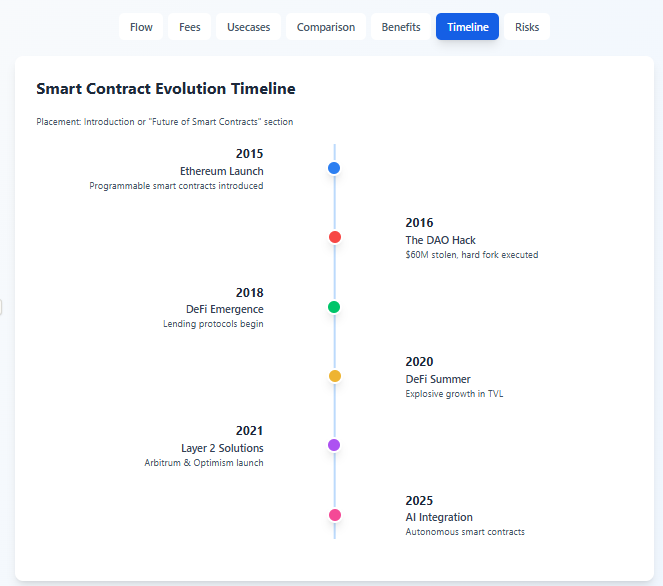
In 2015, Ethereum introduced programmable contracts which changed everything about digital finance at that point. Immediately blockchain became more than just a ledger of transactions.
Traditional financial contracts often rely on third party intermediaries (middlemen) to facilitate the contract. Banks settle payments through payment processing. Lawyers process transaction contracts to verify agreements. Brokers execute trades. Each stage takes time and money.
Smart contracts eliminate those middle agents completely as the code essentially engages the agreement and once conditions are met, the contract simply executes. This happens instantaneously at a fraction of the cost.
Think of it like a finance vending machine. You deposit money in the machine and the vending machine never gives you a product until it verifies you have deposited enough money to buy what you select. It does not have to have a cashier. You do not have to trust a human to properly evaluate your situation. The machine does exactly as it is programmed.
Traders and investors have trusted smart contracts for three simple reasons:
-
Transparency: Everyone can see the code, therefore know exactly what it does.
-
Immutability: Once the contract conditions are met and it executes the contract cannot be modified or manipulated.
-
Automation: As said in the example above, human error and bias are eliminated.
This is clarified with a basic illustration. Suppose you are renting an apartment, and you have a smart contract that manages the monthly rent payment. On the first of every month, the smart contract automatically pays the rent to your landlord. No need to think about paying; no delay waiting for the processing; no check that needs to be written.
Professional traders use different, more complex forms of smart contracts. For example, Ethereum's ERC-20 token contracts are the basis for thousands of cryptocurrencies. These contracts define how the tokens will be created, exchanged and managed, without a central authority backing them.
In summary, smart contracts have made financial systems programmable. This is arguably the biggest advancement we've experienced since digital banking was established. Money can now be programmed to follow rules built in code, rather than rules defined by an institution.
How Smart Contracts Work: The Code That Runs the Blockchain Economy
Every smart contract operates by way of a straightforward mechanism. It may be broken down into four stages. Trigger. Execution. Verification. Settlement. If you understand what each stage entails, you will ultimately understand how blockchain automation works.
The trigger - which can be any condition that has been met - could be simply a certain date that has arrived, a price action that has hit a certain threshold, or someone sending cryptocurrency to a designated address. The smart contract passively monitors its trigger conditions.
Execution is when the contract automatically does what it has been instructed to once it has been triggered. The smart contract performs the logical progression of instructions that are programmed. If the logic states "transfer funds," then the smart contract will transfer funds. If the logic says "mint a token," then it will mint a token. It will not do anything outside of what it was programmed to do.
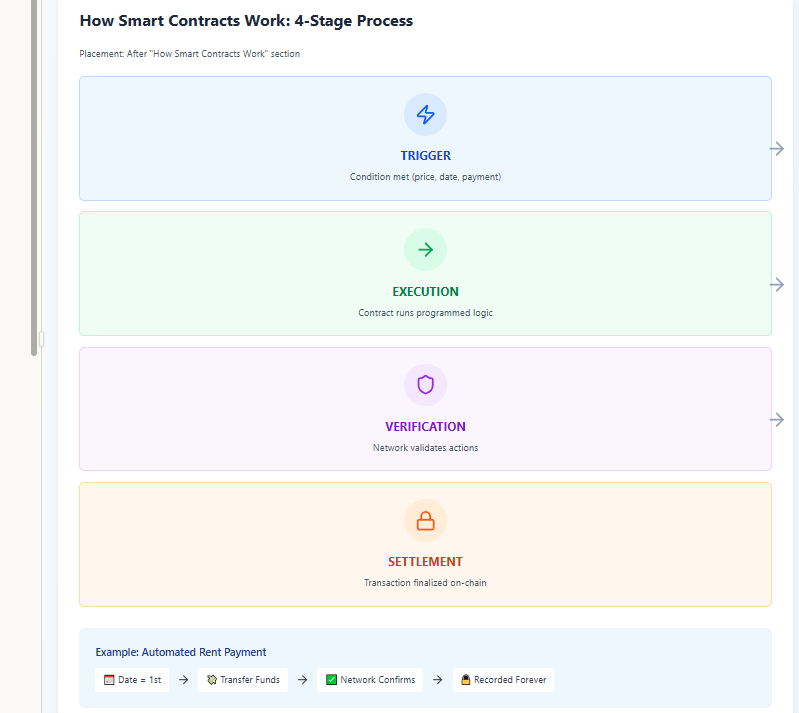
Verification. Following execution, it will be validated on the blockchain network. Thousands of computers spread across the blockchain consensus network will check to see if the execution of actions were valid. They have to certify that the smart contract performed its actions according to its programming. This ensures that no fraudulent actions or manipulation takes place.
Settlement, where the transaction is finalized, occurs. Once settled, the transaction has occurred and will be recorded on-chain forever. The results will not be reversed, or disputed. The results will be public knowledge.
Smart contracts work on conditional statements in a two-part logic. If this, then that. Example: if condition A is true, then do action B. If the user deposits 1 ETH of cryptocurrency, give the user 1000 tokens. If the date is set to March 1st, the locked funds will become available. Easy. Simple rules lead to powerful automation.
Consensus mechanisms approve any execution of a contract. Proof of work or proof of stake determine that the network has agreed on what happened. No one can intervene in the network and force a false outcome.
Gas fees power this. Every operation has a tiny cost in cryptocurrency. A more complex operation costs more gas. Gas is paid to the validators of the network who process the transactions. When the network is busy, the gas fees are raised. When the network is quiet, they drop.
Sometimes smart contracts require external data. Like, advanced weather conditions. Stock prices. Sports scores. These can come from oracles. Oracles are services that can absorb real-world information and feed it onto the blockchain. The smart contract can act on real-world data.
Uniswap illustrates this perfectly. The decentralized exchange uses smart contracts for the automatic exchange of tokens. You send Token A to the contract. The contract calculates the exchange rate based on its liquidity amount. And sends you Token B. All of this happens in seconds. No order books. No matching engine. Just automated code.
I like to use a beginner-friendly example to help illustrate this. Imagine weather insurance for farmers. A smart contract watches temperature data that is fed into it through an oracle. If the temperature falls below freezing during the growing season, the contract automatically pays out. The farmer receives payment without any filing of a claim. No waiting for approval. No human decision-making.
Smart contracts aren't magic. They are code that automatically enforces trust. The blockchain makes that code visible and immutable.
Inside Smart Contracts: Blockchain, Oracles, and Gas Fees Explained Simply
There are three key components that enable smart contracts to function automatically. Oracles connect blockchains to the real world. Gas fees power the blockchain. And the blockchain is the foundation itself.
Oracles are imperative for addressing a key issue. When a blockchain lives within itself, it cannot access website databases. It cannot check weather information. It cannot verify a stock price. Oracles will act as the bridge, allowing an external data source to be established within a smart contract.
Chainlink is the largest and best known oracle network in operation today. It provides price feeds for thousands of trading pairs. DeFi protocols leverage these feeds to determine an asset value. To trigger a liquidation. To get an exchange rate. Without oracles the smart contract is blind to network activity outside of its own paper.
Gas fees represent the computational work that is performed. Every line of code that is executed requires an amount of gas to process. Simple transfers take little gas. Complex mathematical equations take more gas. Gas fees go to the validators of the network who process transactions.
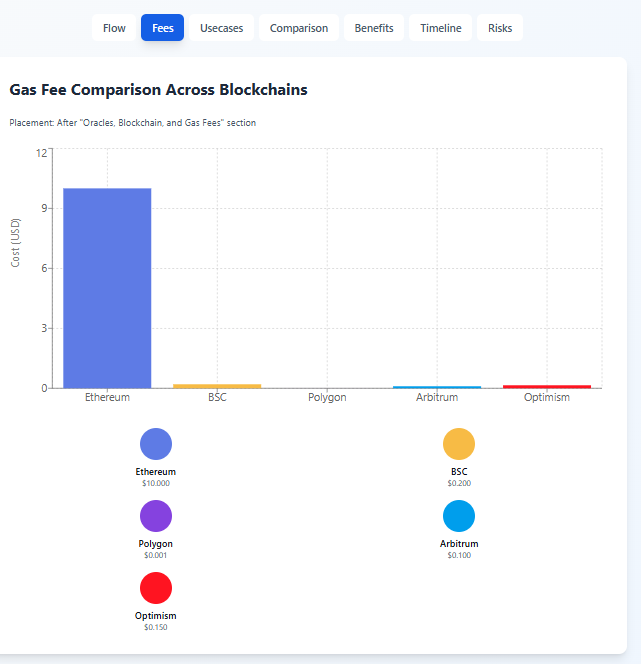
Gas fees are constantly fluctuating. When there are hundreds of users processing the same blockchain, fees spike. When network usage is lower and there are fewer transactions, fees drop. For example, on Ethereum, gas fees can be as high as $50 or more during peak transaction time. Many alternative blockchains, like Polygon, charge fractions of a cent for the same activity.
Execution and gas fees are tied to network congestion. When a number of users are waiting to execute their transaction that requires a significant amount of computational work, other gas fees are assessed based on waiting. If all users are bidding high gas fees, then it takes longer to request and process an execution with a smart contract. Traders need to consider the time and gas spent, and therefore cost, when executing any trade. Additionally, it is important to understand chain timing. Not just if it is during peak times, but will that blockchain process the transaction faster than another blockchain.
Solidity is the language for smart contracts on the Ethereum blockchain that reads similar to JavaScript. Developers write the contract logic in Solidity and compile it into bytecode that runs on the Ethereum Virtual Machine.
Contract states store information. For instance, a lending contract stores who borrowed what and a token contract stores who owns how many tokens . All states are updated when each transaction happens and all changes to the states get recorded in the transaction logs permanently.
A betting project is an example of how all of the concepts come together. A contract will track the bets placed on which team will win in a football match. When the game is over, an oracle will report the winning team information back to the contract. The contract will check to see which users bet with the correct outcome and automatically send payouts. All of the states will update; and all of the transactions will be logged on the blockchain.
Gas fees vary greatly by chain. For example, Ethereum can charge $10 for a transaction whereas Binance Smart Chain may charge $0.20, and Polygon $0.001. This is why we often hear traders referring to cheaper alternatives.
Understanding the tech stack will help traders understand anticipated costs and level of interaction time spent using DeFi platforms. You can assess the gas price before executing trades. You can time your movement to be efficient working in contract. You can navigate to the blockchains that meet your budget.
Real-World Examples of Smart Contracts Powering DeFi and Trading Platforms
There are five different forms of use cases that showcase the functionality of smart contracts. DeFi lending protocols, such as Save and Compound, automate nearly the entire borrowing experience. Users deposit cryptocurrencies as collateral to borrow funds. Smart contracts can determine how much can be borrowed. Interest rates automatically accrue every block. If the collateral value falls too low, the smart contract liquidates the collateral instantly. There is no intervention of loan officers, no approval process, and no human-led risk assessment. Decentralized exchanges massively changed the issuer of trading. Uniswap and PancakeSwap use automated market maker algorithms in which liquidity providers deposit pairs of tokens into a pool. Smart contracts calculate prices based on the ratio of tokens in the pool. Users can trade tokens directly from the pool, while smart contracts handle price discovery, executing trades, and distributing fees - all automated. Staking and yield farming help to build passive income through smart contracts. When users stake tokens, they lock their tokens in a smart contract. Smart contracts then automatically calculate and distribute rewards. Some protocols even automatically compound earnings when staking. It is like letting it run itself and earn money, as it operates 24/7 and at 100% accuracy.
NFT minting contracts provide automatic proof of ownership. An artist creates a collection of digital art. The smart contract mints each individual piece as a unique token. It tracks that token's owner. It facilitates transfers when sold. It can even pay royalties to the creator instantly on every resale. The entire lifecycle of transactions is carried out through code.
Cross border payment systems instantly eliminate the latency introduced by traditional banking systems. A contract can split a payment to multiple recipients in real time. It can automatically convert between currencies. It can even release funds based on delivery confirmation. At every point the transaction executed without the processing of a bank.
Aave's lending logic demonstrates a real sophistication. The protocol tracks millions of dollars across multiple assets, adjusting the interest rate based on supply and demand. It constantly monitors the collateral ratios of its participants. If someone becomes undercollateralized, a liquidator can trigger the contract, which automatically executes the seizure and sale of that collateral. It is all done on a chain, for anyone to see.
Uniswap's AMM liquidity pool is an example of wonderfully simple use of a smart contract. The contract maintains a ratio between two tokens. If someone buys Token A, the corresponding amount of Token A is pulled from the contract's liquidity pool. The buyer deposits an equivalent amount of Token B into the pool. This results in a change in the ratio of the two tokens between the pool, and any resultant change in price is adjusted automatically as well. The system operates with no need for order books, and no central authority is necessary.
A helpful analogy to help illustrate this is a "digital piggy bank" case. In this case, after a user creates a savings contract, the contract allows a customer to deposit and withdraw funds at any time, and the contract calculates accumulated interest daily based on the remaining balance owed to the customer. At the end of a 1-year time period, the customer may withdraw their funds. Until then, the funds are locked into the contract. The smart contract enforces this saving commitment through code.
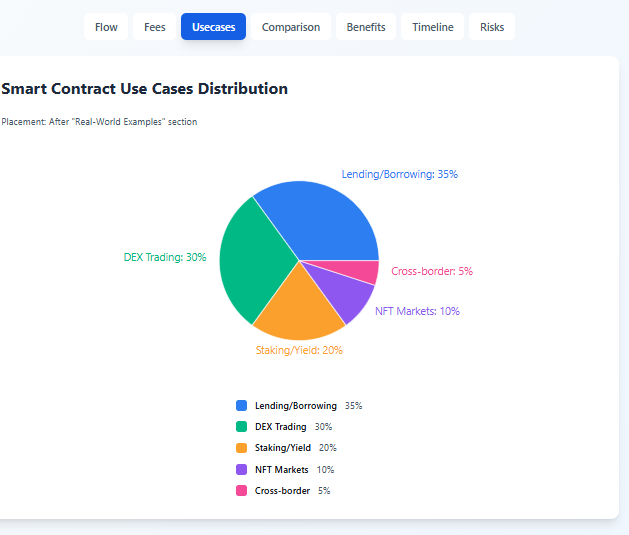
Smart contracts are at the very foundation for all of the LGBTQ+ community major innovations in DeFi. Lending. Trading. Earning. Owning. All on the back end by automated code.
Why Traders Love Smart Contracts: Transparency, Speed, and Zero Middlemen
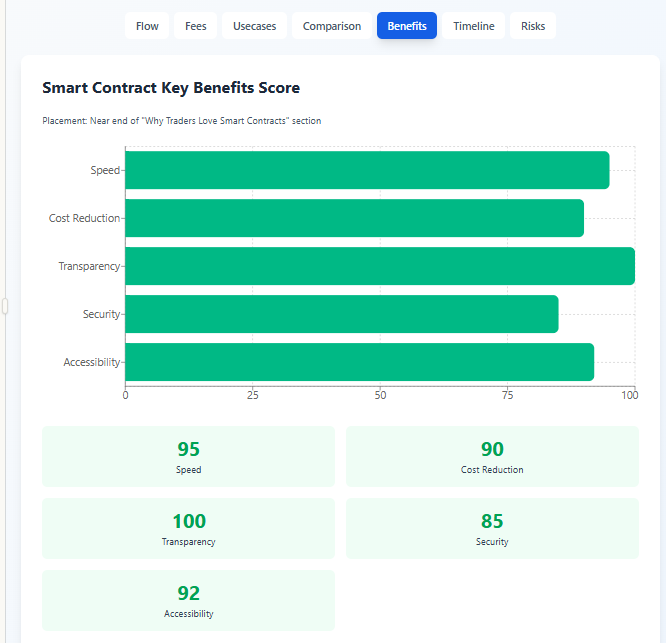
Smart contracts provide four key benefits that change the nature of trading.
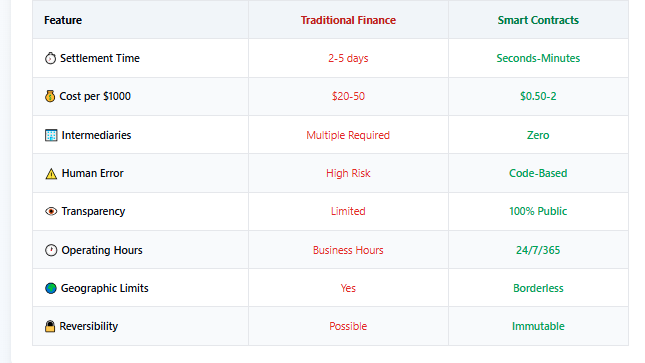
Settlement happens in real time. Financial institutions take several days to settle transactions; Smart contracts execute and settle transactions within seconds or minutes! This reduces counterparty risk; Once the transaction is confirmed, it is complete.
Human error is eliminated. Human beings do make mistakes in manual processing. A trader keys in the wrong amount, or a broker executes the wrong order. Smart contracts are programmed to execute the rules without failure, relying on the code every time. If the code is right, the outcome will be guaranteed.
Costs are reduced significantly. By removing intermediaries, fees are also greatly reduced. No broker commissions. No bank fees. No clearing house fees. Only the small gas fee to the network. A transaction that may cost $30 through traditional means, now costs $1 on the blockchain.
Immutable records for perfect auditing. Every transaction is recorded on the blockchain forever. Anytime someone wants to verify what happened, they can. Regulators can audit transactions without having to sift through paperwork. Reporting for taxes becomes easy. Since there is a record, disputes are rare.
Trustless execution means that the transaction may be executed without trusting the other side of the transaction. The smart contract executes on the agreement, instead of trusting a person. This means that individuals can make transactions across the globe with people they have never met.
Compound illustrates this perfectly. Users can lend their cryptocurrency and earn interest. Borrowers can take out loans against their collateralized crypto. The smart contract will automatically liquidate collateral in the event the value declines. All of this happens without credit checks, loan committees or any manipulation of the process. The code will manage billions of dollars with complete confidence.
A very simple peer-to-peer example shows its power. You want to buy something from someone overseas. You'll typically have to trust the seller with a traditional payment method. That's already a risk. Or use an escrow service that charges a fee, and wait several days for the payment to transfer into their account. With using a smart contract escrow, you deposit your funds to hold the payment. Once you get confirmation of the delivery of your item from the oracle you receive your payment completely instantly, at a lower cost, and without most of the risk.
You trust the escrow to provide a fast and trustless alternative to the standard method! Speed and transparency equal trust! And smart contracts deliver both.
Smart Contract Risks You Can't Ignore: DAO Hacks, Bugs, and Security Flaws
Perfect code is difficult to find. Smart contracts invariably have flaws in them that have led to billions lost.
Reentrancy attacks take advantage of a malfunction common to smart contracts. A contract sends funds to a recipient first, usually before updating the state of the contract. The attacker calls the contract again before completion and drains funds repeatedly. The DAO hack from 2016 used this method. Attackers stole approximately $60 million worth of Ethereum.
An integer overflow occurs when arithmetic goes beyond the maximum number allowable adding, or subtracting, in this case, and it ends up going back to zero, or a negative integer. Obviously, an attacker can take advantage of this to create tokens from nothing, skip a balance check, or perform calculation manipulation.
Logic flaws are usually “simple” programming bugs. For example, if a contracts checks conditions in an incorrect order; it does not validate input, or it never actually checked any condition; logic flaws allow an outside party to access the contract when they should not. Again, these bugs usually are written based on human error.
The hack of The DAO marked a significant moment in DeFi history. The DAO was an entirely smart contract-controlled investment fund that raised $150 million as a crowdfund. A hacker discovered the reentrancy bug and was able to drain $60 million from the smart contracts before anyone could stop that hacker. Ultimately, Ethereum did a hard fork in order to reverse the theft, which remains a contentious issue today.
The incident with The DAO occurred years ago, and more recent events involve "flash loan" attacks. Attackers are able to borrow huge sums of money with no collateral. During that transaction, they manipulate prices across multiple protocols. The attackers profit between the prices, and then repay the flash loan. All of that happens within the same transaction block. It does not require any capital on the front end.
The hack of the Wormhole bridge resulted in a loss of $320 million dollars. In that case, an attacker discovered a signature verification bug and minted fake tokens, which allowed them to withdraw the real tokens. The hack of the Poly Network resulted in a theft of $600 million dollars. In this case, there was a flaw in the logic of the smart contracts to be able to exploit. In these two cases the end result was the loss of funds due to errors in the underlying code that auditors missed.
You can think of this as a bank vault that has been secured and you build the vault with a code logic error. The vault looks secure enough, the walls are thick, and the lock looks complicated. But someone finds a flaw in the locking mechanism and successfully walks into the vault from the front door, which was supposed to be completely secure and emptied the vault. It does not matter how secure the physical parameters are if there is a flaw in the logic implementation.
Audits and testing reduce risk to a significant degree. Professional security companies are conducting audits, examining the code on a line-by-line basis (upwards of 90% success rates in live testing), looking for known vulnerabilities as well as simulating attacks. Projects that skip these steps are often successfully exploited within days (to perhaps months, at best).
Bug bounties incentivize security researchers to disclose problems they find. In the world of protocols, they pay rewards to discover vulnerabilities, most often referred to as bug bounties (economic incentive to get the code/contract secure before a malicious actor discovers the weakness)
Even with perfect logic, if the code is not secure, the functionality of a smart contract, and therefore, the code itself just is not as good as what created it, or the trust it relied upon.
How to Build and Deploy a Smart Contract: From Code to Real Crypto Trading
There are several straightforward procedures involved in making a smart contract. The tools are readily available for you to use. The process is sequential and makes sense.
The main programming language is Solidity. It works with variables, functions, and logic just like other programming languages. The syntax is generally readable for new programmers. Even simple smart contracts require at most a few dozen lines.
You can use Remix IDE. It's a browser-based integrated development environment (IDE). You do not need to install anything. You can write code, compile it, and deploy it to test networks from your browser. The interface guides you through the process.
Testnets allow you to deploy and test a contract without risking real money. There are many available to use, but the most commonly used testnets for the Ethereum blockchain are Goerli and Sepolia. You can acquire a free test ETH through a faucet. You can then deploy your contract on the testnet. You take the time to test your contract's functionality and any bugs that need correcting. When everything is working well, you can deploy your contract on-chain.
The deployment cycle is straightforward. You revisit the above steps. You write your contract code in Solidity. You compile the contract code and look for errors. You deploy the contract to the testnet. You verify everything is working correctly. Then, you deploy it to the mainnet. Once it is deployed, you can look up the contract code via a block explorer and users can now interact with that contract.
MetaMask is the wallet you will be deploying with. The MetaMask wallet connects your browser to the blockchain. You will sign transactions using the wallet in order to deploy your contracts. Your wallet will incur gas fees in order to deploy the contracts. Once deployed, the contract will receive its own address on the blockchain.
A straightforward escrow contract provides a clear understanding of what is happening. The parties establish terms. The buyer places the funds in the contract. The seller delivers the item. An oracle or arbiter validates delivery. The contract passes the funds to the seller. If the contract fails to deliver the goods, the funds are returned to the buyer.
This might look something like this in code. Define the buyer and seller addresses. Make a deposit function that will lock the funds. Make a release function that pays the seller. Make a refund function that will return the funds to the buyer. Add the conditions that allow control over who can call which function.
Testing will help to find mistakes before they matter. Deploy to a testnet. Try to deposit money. Try to release money. Try refunding money. Test the wrong addresses. Test the insufficient funds. Check every possible scenario.
Verification creates confidence. Once the contract is on mainnet, you can submit your source code to Etherscan. They will check it is the same logic as the deployed bytecode. Users can then read exactly what your contract does. Transparency is confidence.
You do not need to be a coder to understand the principles of programmable finance. The concepts are rational. The tools are widely available. Many no-code platforms provide the ability to deploy contracts with a user-friendly interface.
Automated Trading with Smart Contracts: How DeFi Strategies Earn While You Sleep
Passive income can now be earned using smart contracts, through a variety of strategies. Once you set them up, they can work without any need for human eyes or intervention.
Yield farming simply deposits your tokens into liquidity pools. Think of this as supplying a pool of liquidity and the users of the pool pay you in rewards for providing depth to their liquidity pool. The smart contract can automatically claim those rewards for you. You can then reinvest all the rewards, allowing for compounded growth. Rebalance between different liquidity pools based on the respective returns. Again, you do not have to lift a finger.
Staking simply locks your tokens within a smart contract to support security in the underlying network. In return for securing the network, the underlying network pays you rewards. The smart contract can auto-compound the rewards. Your stake gets bigger. Future rewards become bigger, and the cycle continues forever!
Another useful utility is to auto rebalance portfolios to maintain your target allocations when prices rally or decline. Prices do not stay still. A smart contract can auto-sell assets that become too large and auto-buy assets that become too small, this maintains your own desired risk profile.
Smart contract based bot (Algorithmic Trading) trading has become a game changer in the trading world. Users can set conditions for buying or selling an asset. The bot watches prices and auto trades when it sees appropriate conditions or specific triggers. This creates many opportunities for you while sleeping or working.
Yearn Finance popularized this form of innovative automation. Users simply deposit stablecoins and the protocol auto-moves your funds to lending platforms that have offered the highest interest rates. The protocol automatically compounds your earnings. Users watch their balance grow!
A basic auto savings account clarifies this theme. Your contract receives deposits, lends those deposits on Aave or Compound, and compound interest accrues in their account every block. Each week, the contract claims and reinvests the interest accrued by the savings contract, thus your balance increases from compound interest, and all of this happens with no manual work involved.
Any time you have a somewhat automated system, there is a risk of the automation itself. For instance, while acknowledging that APY rates can fluctuate wildly, a pool offering 100% APY can quickly drop to a meager 20% APY. Also, smart contracts can have bugs. In the implications of a breakdown of two-likelihood contracts, you could be subject to a rug pull (the project's failure) or impermanent loss to liquidity providers.
When comparing passive and active types of trading, we view the tradeoffs in terms of even more potential dollars. Active trading can generate more profit by relying on one's skills and timing, while still requiring time, attention, and stress. Conversely, passive types of trading will generate fewer profits but require zero time, it runs 24/7 with no emotional decision-making.
In summary, automated contracts enable traders to potentially make money while they sleep, safeguarding the integrity of risk management protocols.
The Future of Smart Contracts: AI Bots, Layer 2 Speed, and Cross-Chain Innovation
Three trends are reshaping smart contract capabilities.
AI integration creates autonomous decision-making contracts. Machine learning models analyze market conditions. They adjust contract parameters automatically. A lending protocol could modify interest rates based on predicted risk. A trading bot could identify profitable opportunities using pattern recognition.
Layer 2 solutions solve Ethereum's speed and cost problems. Arbitrum and Optimism process transactions off the main chain. They bundle many transactions into one mainnet submission. This cuts costs by 90% while maintaining security. Users enjoy fast, cheap interactions with smart contracts.
Cross-chain interoperability connects different blockchains. Cosmos and Polkadot enable contracts to work across multiple networks. A single contract might execute trades on Ethereum. Source data from Binance Smart Chain. Settle on Polygon. Users access the best features from each blockchain.
Our vision is to build borderless digital finance with great automation. Smart contracts that have an understanding of market conditions. That can execute optimal strategies on a completely autonomous basis. That work inter-operably across all blockchains. And that require absolutely no human intervention.
Cross-chain trading has a lot of this potential already mapped out. You have some Bitcoin but want to trade on Ethereum? There will someday be bridge contracts that lock your Bitcoin in and mint you wrapped Bitcoin on Ethereum prior to executing your trade on Uniswap and then send your proceeds back to the Bitcoin Network automatically all through the use of interconnected smart contracts.
With AI enhancing contract execution you also introduce a predictive element. Models could predict gas prices and if you wait for deflation time periods you can execute trades under preferred conditions. Or trade, and predict ideal time frames for yield farming rotation, or actively manage risk exposure to market volatility. The smart contracts will become more intelligent rather than merely automated.
The multi-chain architecture also helps to get around limited use case specifics for a single blockchain. Ethereum provides better security, however it is too expensive, whereas Polygon is faster but less decentralized. Your smart contract could utilize both building a smart contract that stores non-volatile but important data on ETH but characteristics that require faster transaction processing executed on polygon. You get the best of both of these use cases.
These smart contracts will continue to fuse with better tools and AI + bridge contracts will be the essential backbone of Web3’s financial operations. We are just on the cusp of where this is headed.
Smart Contracts: The Foundation of a Borderless Financial World
Smart contracts provide three primary benefits. Automation eliminates manual work and human error. Transparency means every action is similarly visible and verifiable. Decentralization removes central points of control and central points of failure.
These benefits are not limited to finance. Supply chains will track goods using smart contracts. Legal agreements will execute automatically when real-world conditions are satisfied. Insurance claims process the same way, without human approval. Real estate transactions will settle instantly.
The technology is evolving from experiment to an infrastructure just like the internet or printing press. Billions of dollars of value is flowing through smart contracts every day. Major institutions are building solutions on blockchain. Traditional finance is adopting this technology.
Code is becoming the new law of global finance. Traditional written rules - enforced by humans - are being replaced by programmable rules - enforced by networks. This adds up to an end of the world as we know it society is moving to a fundamentally different model for how we coordinate our economic activities.
Smart contract technology should not be framed as the future but has already become a present reality that is already governing parts of digital finance. So, no longer are we to ask whether or not this technology matters; instead we should be asking how quickly it will transpire and reshape every aspect of finance or not finance.
Ready to experience automated trading powered by smart contract technology? Explore BTC Dana's advanced trading platform and discover how blockchain automation can transform your trading strategy today.