



Here’s an image: you look at currency pairs going up and down by pennies and the ticks last seconds. Most traders will scroll through past that, but AI sees something else. It sees patterns in the chaos, places to enter precisely at the tick, and gets out before you even finish your coffee. This is AI Scalping and it’s revolutionizing how today’s traders approach the high frequency markets.
What Is AI Scalping?
Scalping has always been about speed. Traditional scalpers make dozens; sometimes hundreds of trades each day, profiting by small price movements that most investors would think were simply noise. We are talking gains of 5 to 15 pips in Forex or pennies per share in equities. The aim isn’t one enormous trade but many tiny trades that aggregate to be something meaningful.
AI amplifies this idea. Instead of a person looking at the chart for hours at a time, the AI will process thousands of data points per second. It analyzes micro-patterns in price action, volume spikes, and order flow that a human will not see from the side of their eyes.
Here is a real life example: on a EUR/USD 1 minute chart the AI will register that every time the price hits said moving average while decreasing volume by 15%, there is a 7 out of 10 chance we would get a 5 pip bounce in the next 2 minutes. A human trader may take weeks to determine that.
For the beginner trader, let me explain it this way: you are watching a stock that has consistently traded between $50.00 and $50.10 all day long. AI recognizes that at 10:30AM, the stock drops to $50.02, consistently, before bouncing back to $50.08. That is $0.06, if you are trading 1,000 shares, that trade equals $60 in a matter of minutes. And do this a couple times and you understand where I am going with this.
The only difference between both styles of scalping is the processing power of the computer, and the emotion. Consensus ledger traders make decisions based on gut instinct and pattern recognition that has built over a long period of time. They have bad days, tired days, emotional days, and make mistakes. AI doesn’t. AI will follow its programming regardless of fear or greed dictating the decision.
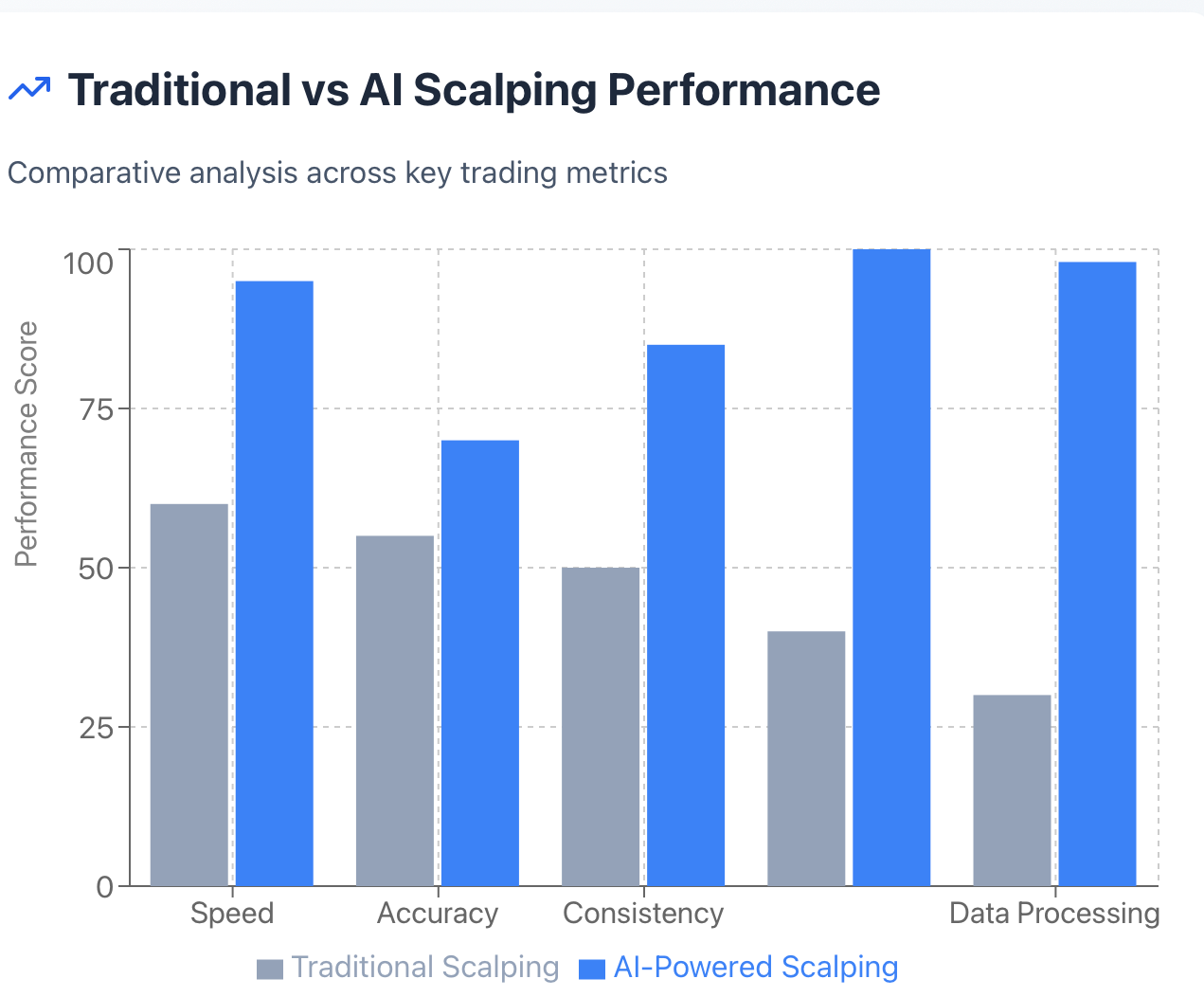
Let me be clear about something: AI is not a money printing machine. It is a sophisticated tool, and you must still understand what it is doing, and why. The traders generating profits are not following signals from the AI. They are using AI models to assist with their trades.
How AI Actually Generates Scalping Signals
When an AI signals to "BUY," what are you seeing behind the scenes? Let's outline the technology without going too far down the rabbit hole.
Most scalping AI uses one of three fundamentals: neural networks, reinforcement learning, or decision trees. Neural networks are the heavy lifting. They're trained on years of historical price data, to detect patterns prior to profitable moves. If you feed them examples of 10-pip rallies with enough time series prior, they will trigger the same conditions in real-time.
Reinforcement learning takes an entirely different approach. It resembles the training of a dog only the dog is an algorithm and the reward is profit. The AI makes trades in a simulated framework, and it gets a "reward" for profitable ones and a "punishment" for losses. After millions of simulated trades and reinforcement, it is a systematic protocol to learn which strategies work, and which don't.
Finally, decision trees are the most simple and clear. Decision trees resemble complex flow charts "IF RSI is below 30 AND volume increased by 20% over the last 5 minutes AND price is above the 50-period MA, THE signal is to BUY"
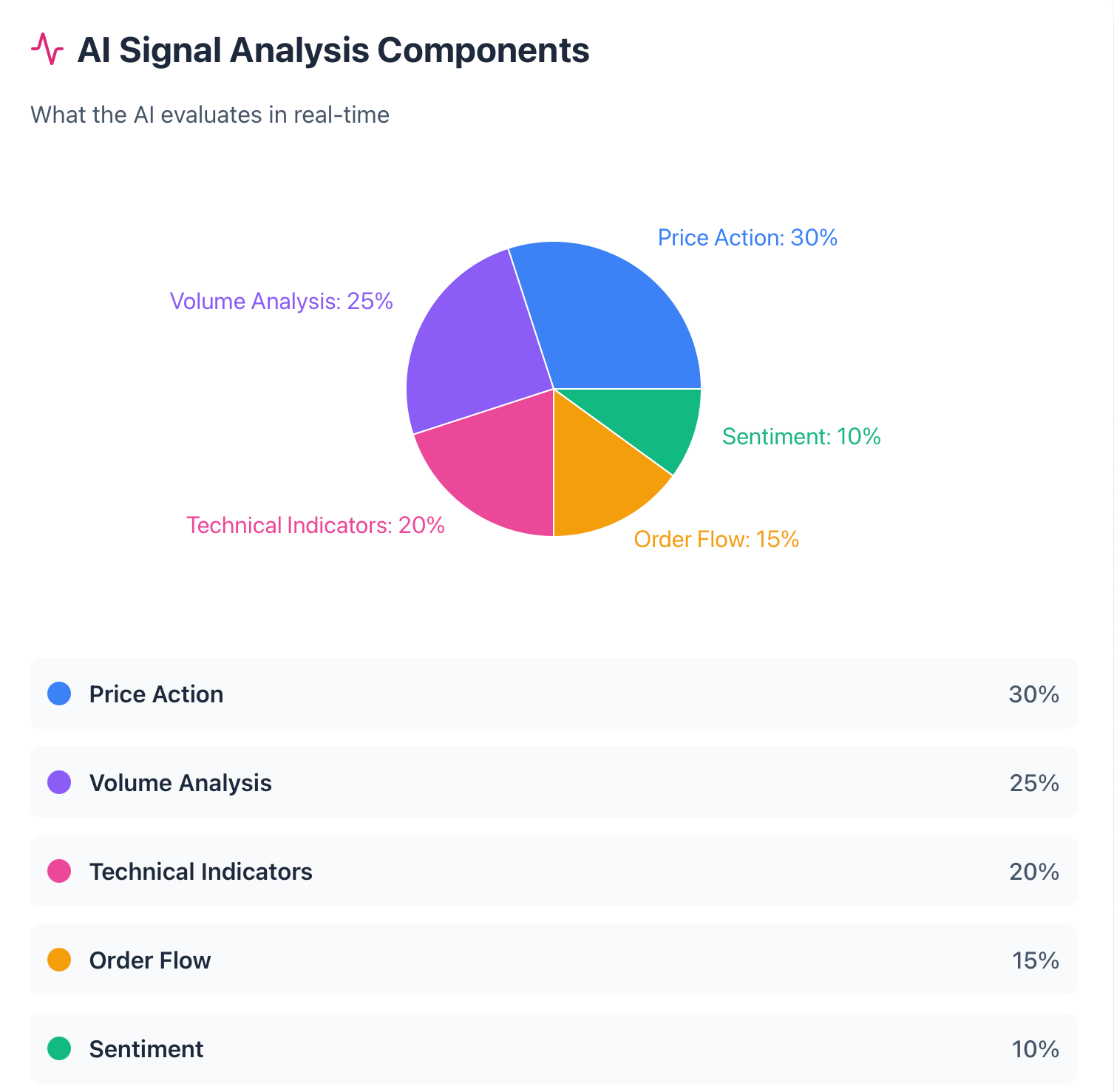
This can be illustrated by example. If you were trading BTC/USD on a one-min chart, the AI will be evaluating in real-time at the same time:
-
Price action across all time frames
-
Order book depth, and/or changes
-
Historical behavior of the price at the similar levels
-
Correlation with other crypto assets
-
And even qualitative news sentiment scoring from social media feeds
When all of these criterions agree from training, Bam! you get a signal. Maybe it determines that BTC is consolidating at the price of $43,500, volume just spiked 40 percent and any time this occurs the price increases 100 bucks within the last 5 minutes, and that is your signal.
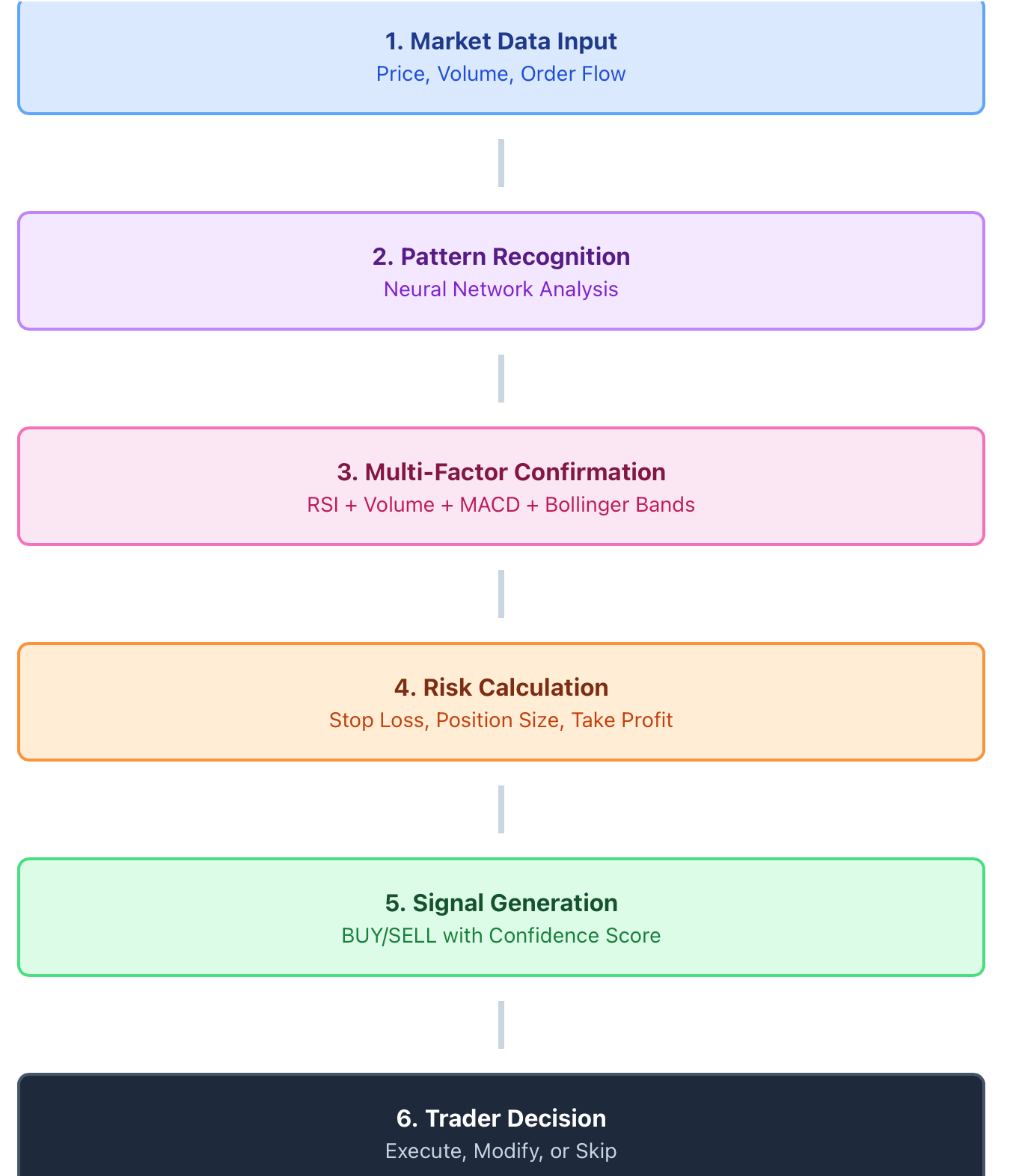
The best of AI also includes risk controls in the AI framework. It won't just tell you when to "enter" the market, it will also calculate proper position size, best stop loss levels and optimal take profit stations based on current volatility of the market. If the market becomes "choppy" the AI may even increase or lower the signals autonomously due to change in uncertainty.
The important thing is to understand how AI advances noise. Where you see random price jumps, AI may identify repeated and correlated conditions from thousands of similar instances. However, you need to better understand when it is making a call! And not be an impulse trader where you simply follow. If you don't know "why" you are entering a trade, you won't know when to question the signal.
Why Different Markets Need Different AI Approaches
AI scalping is not a universal solution. A method that works with forex may blow up your account with crypto, and stock market AI requires a total recalibration.
Forex markets are your scalper's utopia. You have very high liquidity, ultra-narrow spreads, and general volatility patterns that are somewhat predictable. EUR/USD might only be a 50-pip move in a one-day period, but that's plenty of range for 20-30 scalping opportunities. AI in this space focuses on technical patterns, order flow, and time of day behaviors. European session opening? Well then, you can expect the typical patterns. Data drop at 830AM US time? The AI knows what happens next.
The stock markets provide different challenges. Sure, there is liquidity in established names like Apple or Tesla, but you're additionally limited by a degree of news sensitivity that can destroy any scalping strategy in seconds. An unexpected earnings report or FDA approval is all it takes for your 10-cent scalp to turn into a 50-cent loss. A good stock-scalping AI will incorporate some degree of sentiment analysis, scans for breaking news, and shut down during high risk times like the FOMC or earnings.
Crypto is the Wild West. 24/7 markets, crazy volatility, and liquidity that disappear in seconds. BTC can easily move 2% in 10 minutes on an arbitrary Tuesday afternoon. This seems like the ideal version of crypto for scalping until you realize that volatility can work against you too. AI strategies for crypto must have aggressive risk management, and be able to adjust to changing conditions quickly.
An AI that is successful in a non-volatile crypto-conditioned market, can fail spectacularly when billions of dollars are moving.Let’s make it more tangible: if you’re risking $100 per trade across all three, for example, you’re likely looking for a $5-10 profit per trade in forex while risking $5 for a stop-loss, or between 5-10% return with 5% risk in stocks you may be looking for $8-12 profit while risking $6 during normal hours.
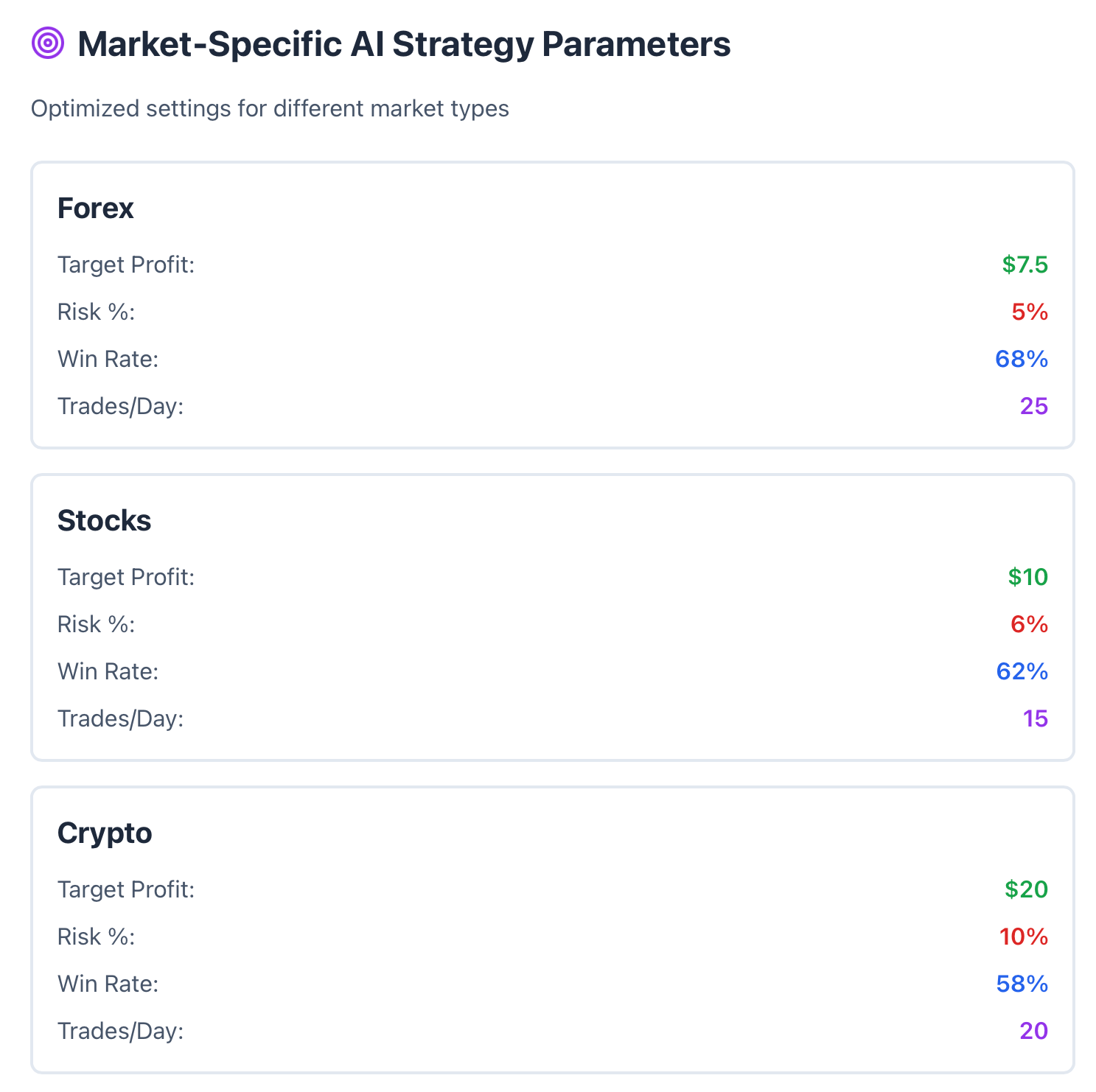
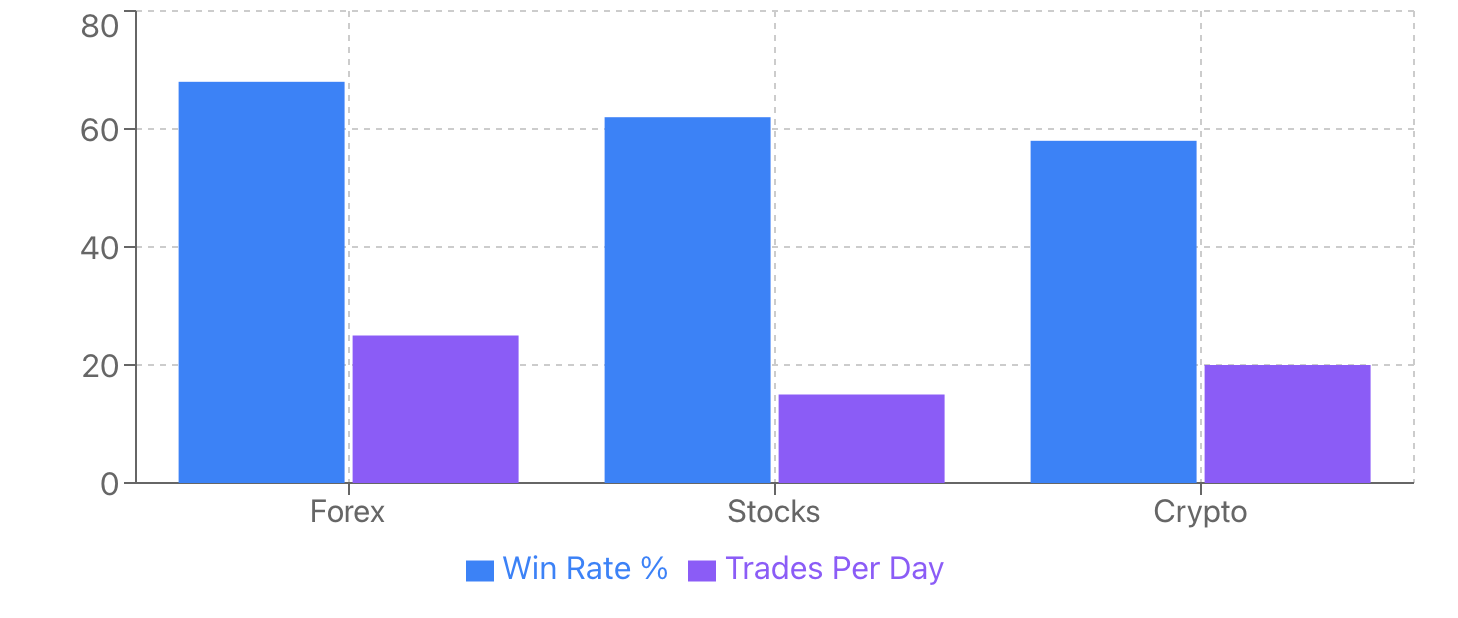
In crypto, you'd be looking for $15-25 while risking $10 but factoring in the volatility. You are still risking the same dollar amount, but your AIs have to be coded differently completely to account for the differences.
The best-trained traders would use different AI modeling for each market. Your FX market scalping AI probably runs 24/5, your stock AI only runs during regular market hours when spreads are tight, and your crypto AI probably avoids certain time periods when trading volume dies and spreads widen.
Reading AI Signals Like The Pros
An AI signal to the scalp is quite different from saying "buy" or "sell." The most sophisticated AI systems provide context, probability, and conditions. Learning to read these types of signals is often what distinguishes profit scalpers from those that blow up their accounts.
Buy/sell signals are pretty simple, but the details carry very important information and don't be confused. A plain alert signal would say "BUY BTC at $43,500," while a good AI signal would say "BUY BTC at $43,500, confidence 75%, target $43,600, stop $43,450, valid for next 3 minutes." Do you see the difference? You know the confidence of the AI, you have precise risk and target evaluation, and you understand the trade has a time-limit.
And finally, the alert signal, this is where things get richly complicated because alert signals don't tell you to enter a trade, but they tell you the market conditions are developing and developing in the trading strategy "The price is getting close to a significant support level, there is a notable volume there, and the pattern you are hypothesizing maybe a pennant is about 60% complete." This is a cue to consider getting ready, consider variables, and be ready for when the price finally gives you the right signal to trade.
The triggered logic will practically always involve a multitude of criteria. An example could be, based on BTC/USD:
Price breakout (over $43,500, which was prior resistance) + Volume increased (30% over the mean average) + RSI (Relative Strength Index) above crossed the 50 mark + Price is above the 20-period Exponential Moving Average, which provides an AI signal for you to get involved on the long side.
The AI doesn't only decide on price alone, but it has confirmed the move is now supported with volume, momentum, and all the major trend momentum basically aligned.
This is where the beginners make mistakes. They just see the "BUY" and they click it, and they don't see the entire picture, and the AI gets blamed when the trade doesn't go in their favor. Buyers trade price action in one way that has already affected prices; these buyers are basically an out of the past.
Professionals will do everything they can to evaluate every signal track positively. Does this fit my current status to what I see on my charts? Am I encompassing other variables that the AI cannot evaluate? Does the climate of association & other interpersonal variables contextually apply?
A bit of an indicator might be to ask yourself 3 questions every time you consider any of the AI signals as well:
-
Do I see what my AI is making a buy/sell call?
-
Does my risk-reward fit my account size?
-
Am I emotionally ready to take this trade?
If 'No' to any of these then I can move on.
Another potential factor, the most successful traders will track signal behavior, possibly over several months; they must recognize that they won't get signals every time, and describe with pattern recognition.It's possible your AI is 80% accurate on EUR/USD during London hours, but 55% during the Asian session. Use that information to filter the signals you take.
The Psychology of High-Speed Trading
Scalping is exhilarating. It’s like a video game. You see numbers flashing, trades executed, profits (hopefully) rolling in. But the psychologic stressors are intense, even with the AI helping.
The biggest mind game is combined loss streaks. You can have a 70% win rate and go through a 5-loss run. It happens. With scalping and trading stocks, one can and will go through them on a daily basis. The trap is falling into a lapse in discipline stemming from the loss. You start adding size to get it back, or you mark a mental trading line in your head and miss the next 10 winning signals.
The AI removes emotion from the analysis, but not from your execution. You still have to hit that click. You still have to see your account balance swing hundreds or thousands in minutes. That’s stressful, and as we all know, when stress levels reach their peak, one gets stupid.
The biggest friend in scalping is the stop-loss. When you are watching an active trade go against you, the temptation to move a stop-loss "just a few pips" in a counter direction is insane. Do not do it. If the AI calculated a stop-loss of $43,450, but it’s currently at $43,455, there’s your stop for a reason. Moving the stop-loss against the side of a trade means you are letting emotion override the system, and that never leads to any successful outcome.
Do not fall into the trap of “overtrading.” The AI can calculate dozens of signals per day but does not take that as an invitation to execute every signal. Many professional stock scalpers may not even trade for 2-3 hours when conditions are optimal. They do not sit there all day or for even 12 hours grinding through trades. And that’s how you become mentally fatigued, make mistakes, and give profits back.
Here is a classic example that all traders must battle through; the AI suggests you sell XYZ stock. You execute the trade following the signal. The trade goes against you immediately, you panic and exit for a small loss.
After looking back at the stock, the stock reversed outside, the stock then reversed back towards the original target you were anticipating. You just let panic override the system. We have all done this and it is something we all face early on in trading. The answer is to find your position size so small you don’t freak out over your loss.
I know a trader that uses a rule in which any trade executed makes his heart rate jump is too big. If you feel anxiety when watching a $50 scalp trade, it means that position size is too big for your psychology. Scale back your trade to $25 to $10 until you can get past the unsettling feelings.
At the end of the day, discipline, especially in the new world of AI, matters just as much or more than the AI algorithm. You can have the best pre-programed signals in the world, but if you cannot adhere to your own trading rules to avoid perpetual losses, the AI will not matter.
Establish a time to start trading and how long to trade. Set a maximum loss for the day. Set a maximum number of trades to trigger round-the-clock monitoring. When you hit a day maximum and you clearly hit your limits, the trading day is done. Walk away and come back the following day.
Making Your AI Strategy Actually Work
To begin with, you have an AI scalping strategy. But the real challenge is to obtain ongoing profitability which requires both optimization and back-testing.
In the back-testing phase, you'll determine if your strategy is pure genius or pure garbage. You'll take your AI signals and run them through historical data. If your BTC/USD scalping AI reports a 70% accuracy, does that still mean something for the past six months? The past year? Any time there was volatility or no volatility?
Many traders skip the back-testing process and immediately go live trading. This is a rookie mistake. You should understand how your trading strategy works in different market conditions before putting your hard-earned money at risk. An AI that performs well in trending markets may drain your account to nothing in a consolidating (sideways) market.
Parameter optimization is the other area in your AI that you can modify to achieve a better outcome. Perhaps you set a 20-period moving average to determine direction. You need to also back-test with a 15, 25 and 30 period moving average. Which set of parameters gives better results? You may be surprised how an adjustment of a few (or no) periods would be substantially different for your trade outcome, Either good or bad!
For example, a trader was running a BTC scalping A.I. and noticed in the back-test review on one specific back-testing period, there was a win rate of only 58%. He back-tested the market and his own AI signal data and figured out his A.I. was allowing signals during a period of low liquidity. So he needed to add a volume filter to only allow signals above a certain average volume of 5-minute bars. After implementing the volume filter, the AI win rate improved to 68%.
Multi-timeframe analysis is another great way to improve your results. While your AI is providing 1-minute signals, a 5-minute or 15-minute and confirm your signals/direction to avoid false signals. If your AI signal is to buy on the 1-minute chart, but the higher time frame shows a strong downtrend, would you take the trade?
The main point is to always treat your optimization process as an ongoing process post-live trading. The market changes, and what worked for you three months ago might not work today. You should review at least every week for continued trends in your winning trades vs your losing trades and shape your trades accordingly, and always be looking for ways for more filters.
Warning: don't go down the rabbit hole of over-optimization! Curve fitting is tuning parameters perfectly by the historical testing, rather than failing with extreme current or new data just moving through the back-testing process. Your goal is not to achieve the perfect strategy by curve fitting to the historical data. Your goal is to find robust strategies across all market conditions.
Supercharging AI Signals with Technical Indicators
AI technology is remarkable; however, any system that follows it should apply technical indicators along with it to create a sturdier system. Enter confirmation trading.
The RSI, or Relative Strength Index, is good for confirming scalping. Say your AI signals a buy on BTC at $43,500, but the RSI reads 75 (overbought). This is a caution flag. You can skip the trade entirely or wait for the RSI to come down before opening the position. Conversely, if the AI indicates a buy and the RSI shows bullish divergence (the price makes lower lows, but the RSI makes higher lows), now you've got a good confirmation system.
MACD is great for confirming momentum, too. Say the AI notices a breakout formation in the chart, but at the same time, the MACD is also crossing bullish. Now you have a trend in alignment with momentum, or a higher probability trade beyond just the AI signal.
Bollinger Bands are perfect to provide the context of volatility. If your AI signals a buy, but the price is already at the top band, then your indicator tells you that you may be buying at a short-term extreme. In this case, you might adjust your take-profit target lower for a potential shorter term trade or perhaps just pass on the opportunity altogether. And buying with AI confirmation when the price nears the bottom band will give you a great risk-reward and greater probability of success.
Let’s take our EUR/USD complete example. Your AI gives a buy signal for 1.0850. Before you trade, you check:
-
RSI: 45, just out of the overbought market and indicators indicate there is still room for price to run
-
MACD: just crossed bullish
-
Price: bouncing off the center Band of the Bollinger Bands
-
Volume: 25% above average
All signs are gone. This trade would have multiple confirmations. Now compare that trade to the AI signal if the RSI indicates that it is overbought, the MACD is bearish, and the price is retracing off the top Bollinger Band. In this case, that is a pass.
The balance is to find that sweet spot without falling into paralysis by analysis mode where you ignore trades because they do not meet the expectations of having 10 or more indicators. You system does not require that many indicators, pick and choose those variables to conform and stick to it, go with 2 to 3 indicators that complement your AI.
Most traders build hierarchical systems: AI generates the theoretical signal--and the indicators act to facilitate the filters. Does the signal pass through all filters? Take the trade. If it fails to go through at least one filter? Skip the trade. In this case, your system develops a lower frequency of trades yet continually increases your win rate.
Real Success Stories from AI Scalping
Theory is great, but real-life examples really hit the point home. Let's look at some actual examples of AI scalping in action.
BTC/USD Short Term: During a relatively stable 3-day period at the start of 2024, an AI system picked up on a pattern and made the trader aware that BTC had been bouning between $42,000 and $44,000. Every time BTC bounced off $42,200, with declining volume and the price reverted upward to at least $42,500. Using this signal, the trader made 15 profitable scalps over three days, averaging around $180 per trade on 0.1 BTC positions. On the 16th trade, the stop loss triggered a $90 loss. Overall, the net profit was $2610 in just 72 hours.
How did the AI make this happen? The AI picked up the range bound behavior quicker than a human could, backtracked and calculated the exact entry point using volume profiles, and even calculated a tight stop loss. The trader only had to execute the signal and remain disciplined enough to take the signals.
EUR/USD during news: One trader's AI had been trained to recognize the 5-minute price action immediately after non-farm payroll releases. It determined that 60% of the time after the initial spike, the price would reverse within 15 minutes. When the AI chirped to take a counter-frame trade, 12 minutes after the initial announcement, he entered short at 1.0895, proceeded to hedge a 15 pip move down to 1.0880 eight minutes later. That was a $150 profit on a standard lot. The trader explained it was the same trade set up used month over month with the same results.
Tesla Intraday Scalping: A novice trader applied AI signals first thing in the morning during Tesla's calculated first hour of trading with solid directional moves. At 9:47 AM the AI provided a long entry signal above the breakout threshold of $245 along with volume confirmation. Entry was made at $245.10 and exited at $246.25.
A stop was placed at $244.80. This generated a profit of $1.15 per share on 200 shares for a total of $230 profit in 18 minutes. If the trade went wrong, the stop loss would have resulted in a $60 loss. This is a classic 3:1 risk-reward trade that the AI identified prior to the move being apparent.
These types of trades can be compared to the same traders last year prior to using AI signals. Their average win rates ranged from 52-55% which even before spreads and commissions, was barely breakeven. Without becoming too wordy, their win rates increased to 65-70% with the use of AI signals along with effective risk management. That is a huge difference over hundreds of trades.
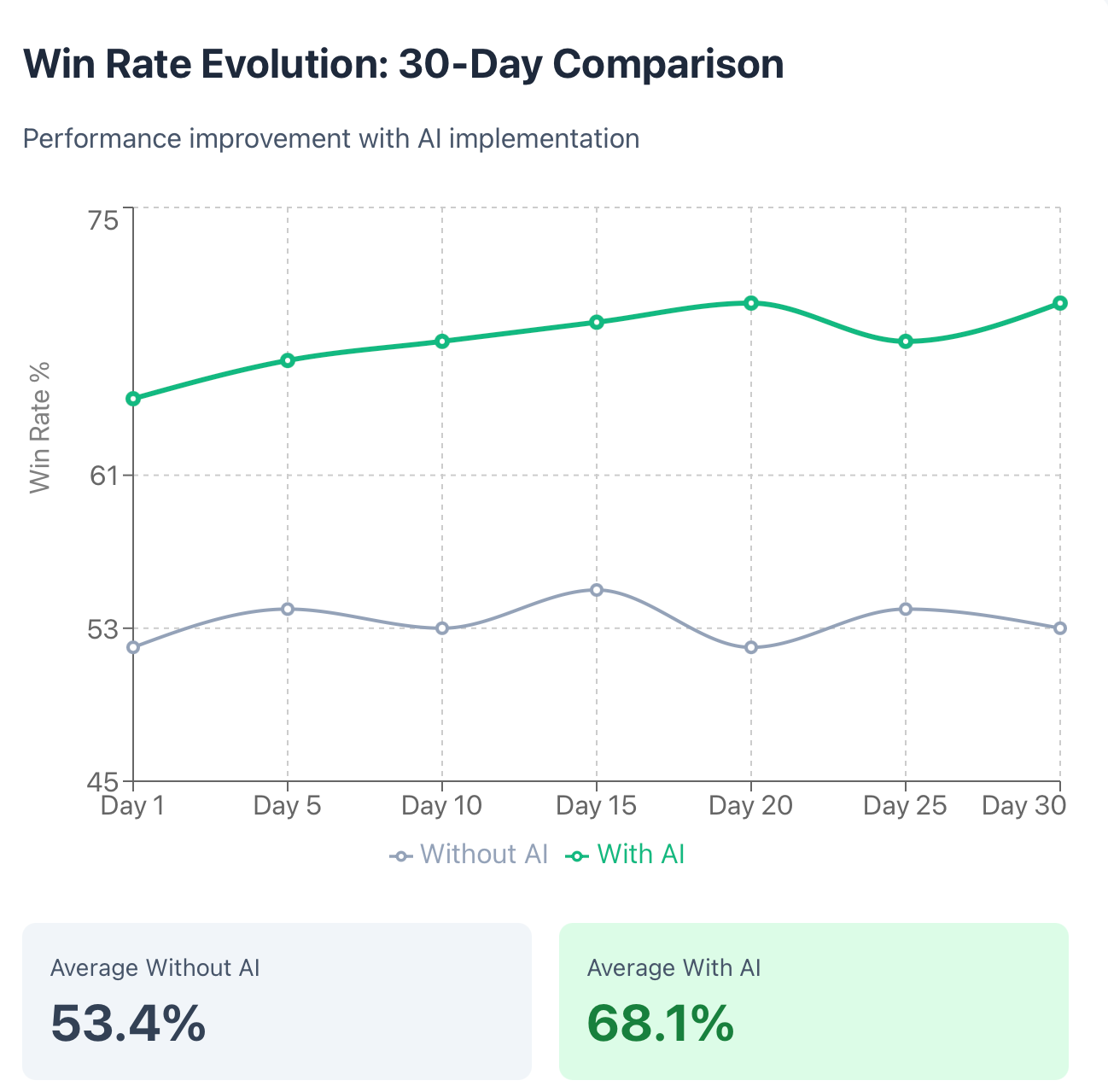
The one common connection for AI scalping is one thing, but it is the discipline of traders who understand their signals, respect risk management with stops, and do not overtrade doing what comes natural to them as traders, which is taking profits quickly after becoming attached to a position. The AI provides you the edge, but it is up to you, the trader, to discipline yourself into profit.
Smart Risk Management: Your Real Edge
Want to know the secret that separates the consistent winners from everyone else in AI scalping? Spoiler alert: it's boring. It's not good at all. It's risk management.
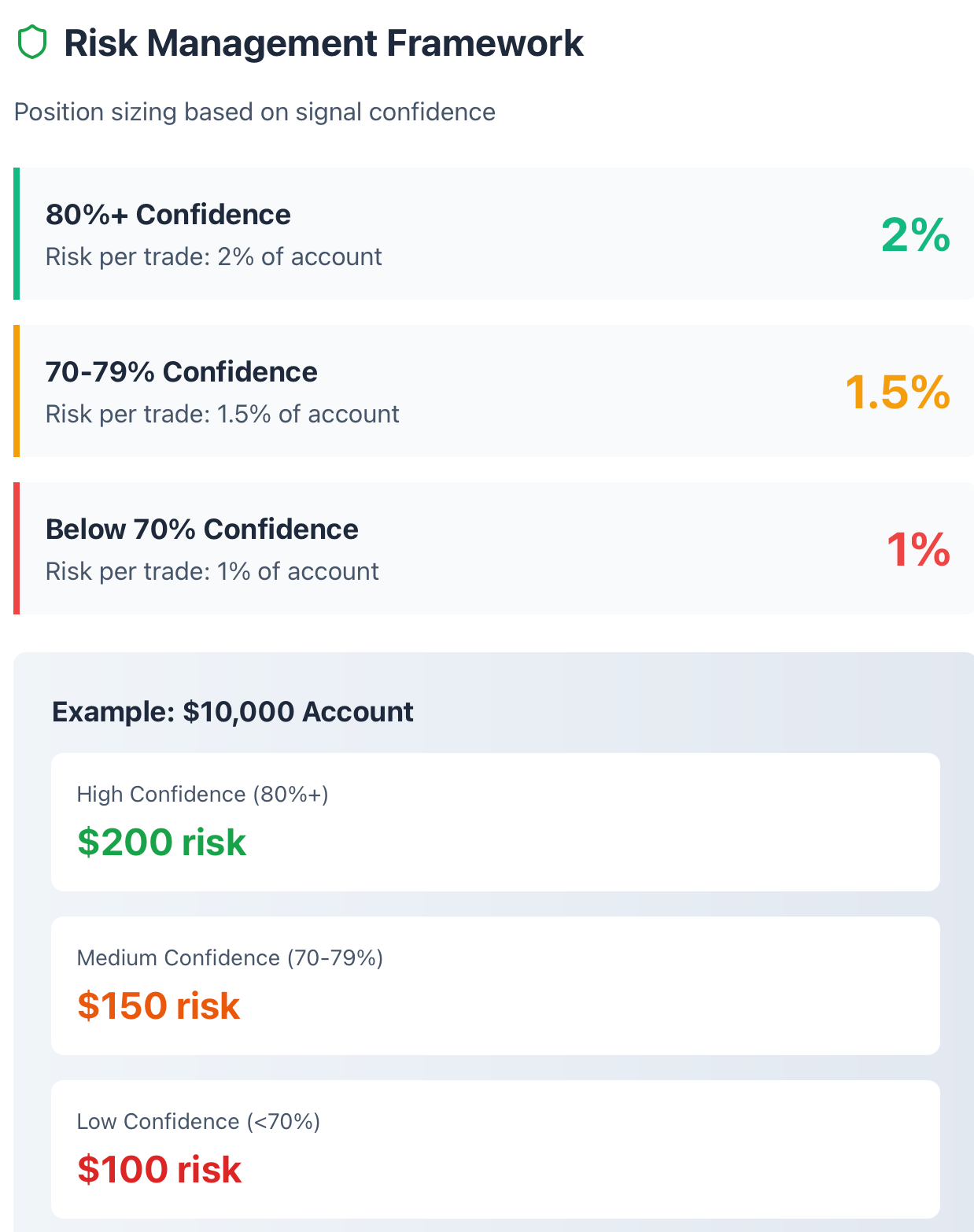
Let's talk about position sizing to start. Common rule of thumb: do not risk more than 1-2% of your own account on a single scalp trade. If you have a $10,000 trading account; that's $100 to $200 maximum risk per trade. Doesn't seem like much, right? But consider that you can take 10 losses in a row without very damaging effects to your account. And in scalping; a streak of losses happens even if you feel you did everything right with the AI.
Implementing a daily loss limit, will stop the spiral downwards.Set a limit for how much you're willing to lose in a single day. That limit can be a percentage of your account (e.g., 5%) but when you reach it, you're done trading for the day. Period. No exceptions. You aren't "going to trade your way back" when you're emotional, and you may very well make worse decisions.
Maximum trade counts matter too. If you're taking 40 trades a day, you're probably over trading, and chasing marginal setups. Professional scalpers will often set a limit of 15-20 trades a day at maximum and only take the highest probability signals.
Here is a framework: categorize AI signals by their confidence level. 80% confidence signals get 2% risk. 70-79% confidence signals get 1.5% risk. Below 70% confidence, either skip it or use 1% risk. What this does is organize your risk based on the quality of the signal.
You need to calculate your stop-loss before you get into a position. If a stop-loss goes too far below your desired loss, do not trade that setup. Use stop-loss levels based on the structure of the setup, not based on your desired loss amount. If the correct stop-loss makes the position size too small for the risk you want to take, pass on the trade. Do not widen stop-losses to fit a bigger position.
The math is easy to compute but it can have an enormous impact: if your win rate is 60% or greater, you consistently size all of your position sizes, with a risk reward of 1.5:1 or better, then you will be a net profitable trader over time. If you mess up any of these variables you will not be successful.
If you are thinking about considering AI scalping, please do not deposit a bunch of money and just start clicking buttons.
Here is the better approach.
First, paper trade. Most platforms will let you create demo accounts for free that give real time data, and you can set it up to look like a live trading account. Paper trade for at least 30 days and follow AI signals in a simulation.Keep a record of each trade as you analyze what works and what does not while you develop your own process with no financial consequences.
You want to go live, so start small. Like, really small. If your goal is to trade standard lots, start with micro lots. Losing $500 on a simulator doesn't teach you anything. Losing $50 in live trading while you're still learning? That will have enough sting to change your behavior.
Pick a single market to start. Don't try to scalp forex, stocks, and crypto all at once. Master one market, achieve consistent profitability, and then move to the next market. The skills and calibrations you will need to rack and stack differ based on the type of market.
It's important to maintain a trading journal. For every trade, you should make at least a bullet point for notes. Write down the reason for entry, the reason for exit, your emotional state, the profit/loss amount, and lessons learned. After 100 trades, you will start to see patterns. You will see exactly where your edge is in the market and what areas are best to avoid as money leaks.
Lifelong learning is a must. Markets are always changing, AI learns and is constantly updated, markets change with new strategies. Spend a few hours a week reviewing your trades, studying market behavior, and adjusting your process.
Network with communities that consist of AI scalpers. I'm not saying to copy their signals and trades, but learn from their decisions and mistakes made in the market. You will discover important changes in the market that you might not have known.
Finally, use AI as a tool to give you an advantage; make it work for you. The traders partaking in profitable trades are not blindly agreeing with every signal from AI. Traders utilize AI to analyze the market quicker and accurately than they were able to previously. Then they apply their own judgment and risk to complement what AI has provided.
If the speed of scalping excites you and you're willing to put in the time and effort, AI will give you a real advantage. Just remember technology without discipline will only make you lose money faster. Be small, test everything, and don't risk any more than you can afford to lose. The market will "test" you every single time you engage with it when scalping. If you need more information about this you need to definitely check BTCdana.com.