




In the 1970s, a man named Richard Dennis transformed $400 into over $200 million. Not with luck or insider information, but with a set of rules for trading that anyone could understand. Dennis was no Wall Street person. He was middle-class in Chicago, started trading at 25, and demonstrated something profound: great traders are trained, not born.
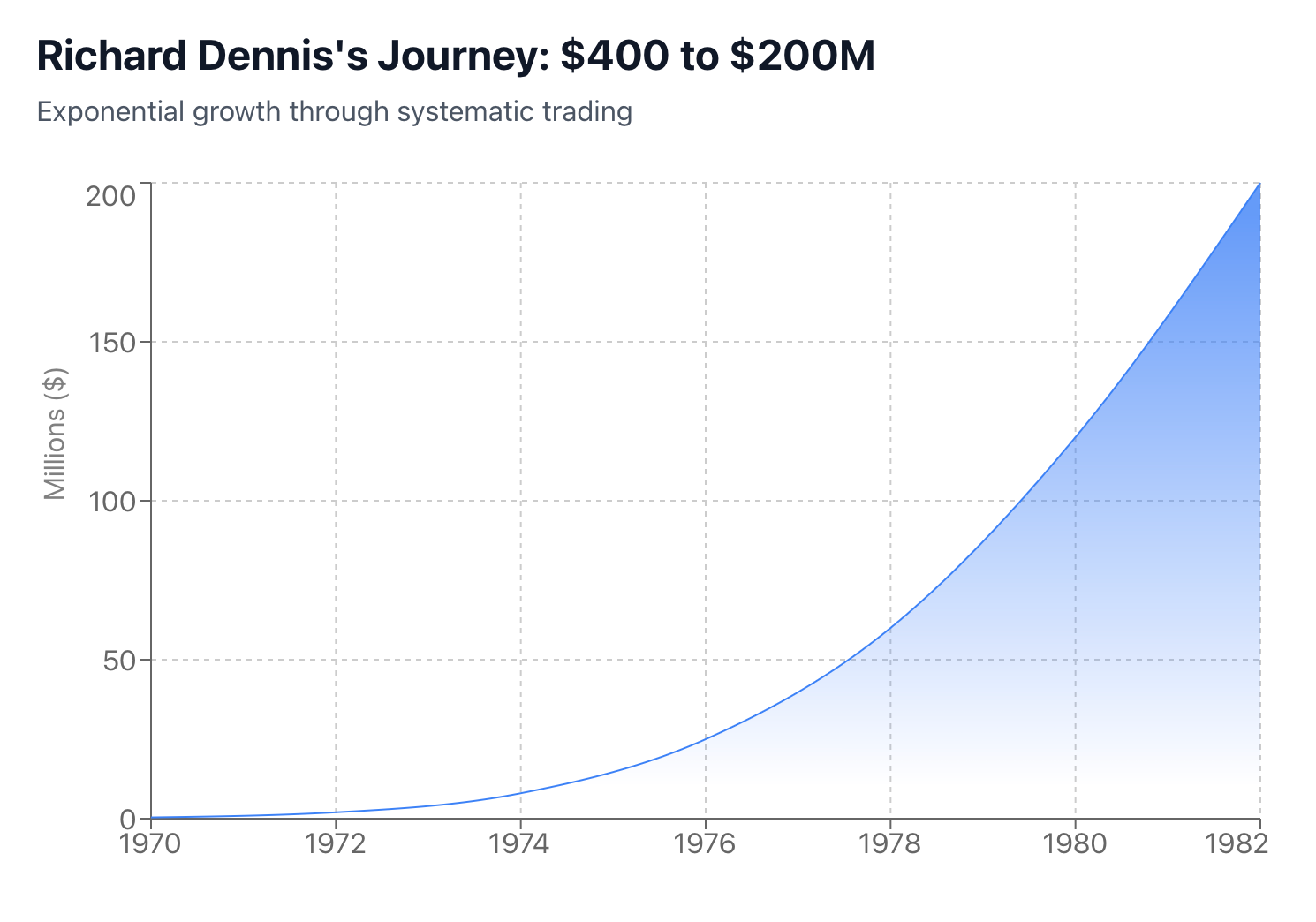
Dennis's well-known Turtle Trading experiment was proof of this. It was Dennis's belief that success in trading has nothing to do with instinct, but rather an adherence to rules. At one point he placed an ad in the paper, selected a group of people (none of whom had any previous trading experience), trained them in his system over two weeks, and gave them real money to trade. Most of the traders ended up doing very well in trading, and some even went on to manage hundreds of millions.
The entire event created a paradigm shift in how people think about trading. Before Dennis, people thought it took years of experience and innate talent to become a successful trader. Dennis proved that a trader's ability to follow a process and a proven trading system was far more important than innate talent.
What distinctly separated Dennis from other traders was his commitment to adhering to rules. Whereas other traders relied upon hunches and emotions, Dennis created a mechanical system of trading utilizing a trend following system to apply his rules. He bought when prices broke to new highs. He sold when prices broke to new lows. He got out of losing trades quickly. He let winning trades make him money. The concepts were simple, and many traders know the basic concepts, but few actually take the basic ideas seriously.
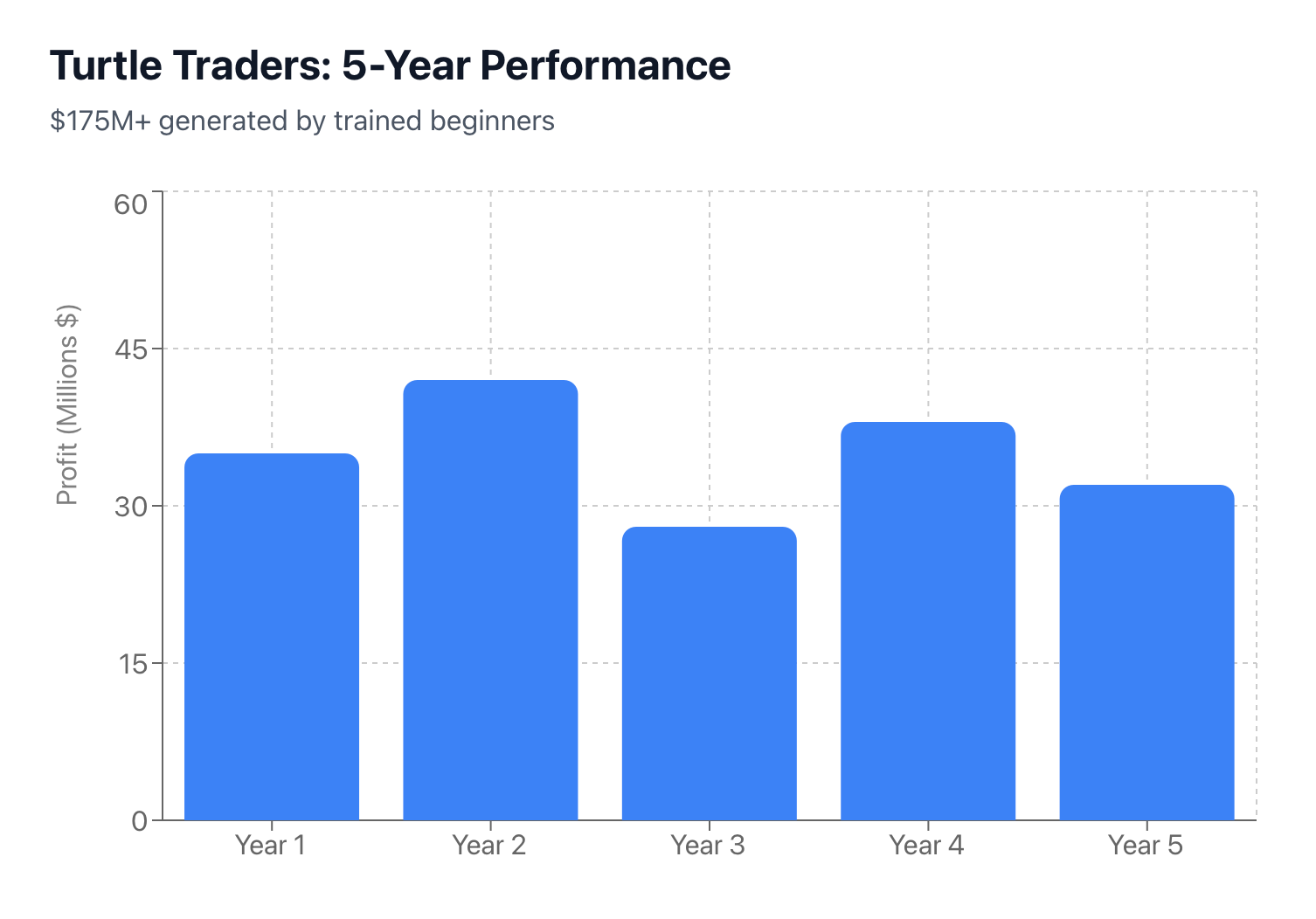
The entire Turtle Trading system came about from a bet between Dennis and his trading partner William Eckhardt. Eckhardt believed you needed the innate skill of a trader to be successful in trading, whereas Dennis did not.They agreed to settle the matter by training complete beginners and following their outcomes. Dennis won that bet resoundingly. Dennis's students earned more than $175 million in five years.
The Core System That Changed Everything
Turtle Trading wasn't rocket science, which is why it worked. The system was objectively clear, defining entry and exit rules based on price breakouts. No guessing about where markets would go next. No sophisticated indicators. Just price action and strict risk management.
Here's how it worked. When a commodity or futures contract made a new 20-day high, that was the signal to buy. When a commodity or futures contract made a new 20-day low, that was the signal to sell or go short. There was also a longer-term 55-day breakout system for capturing big moves. The only challenge was having the resolve to take action when the signals occurred.
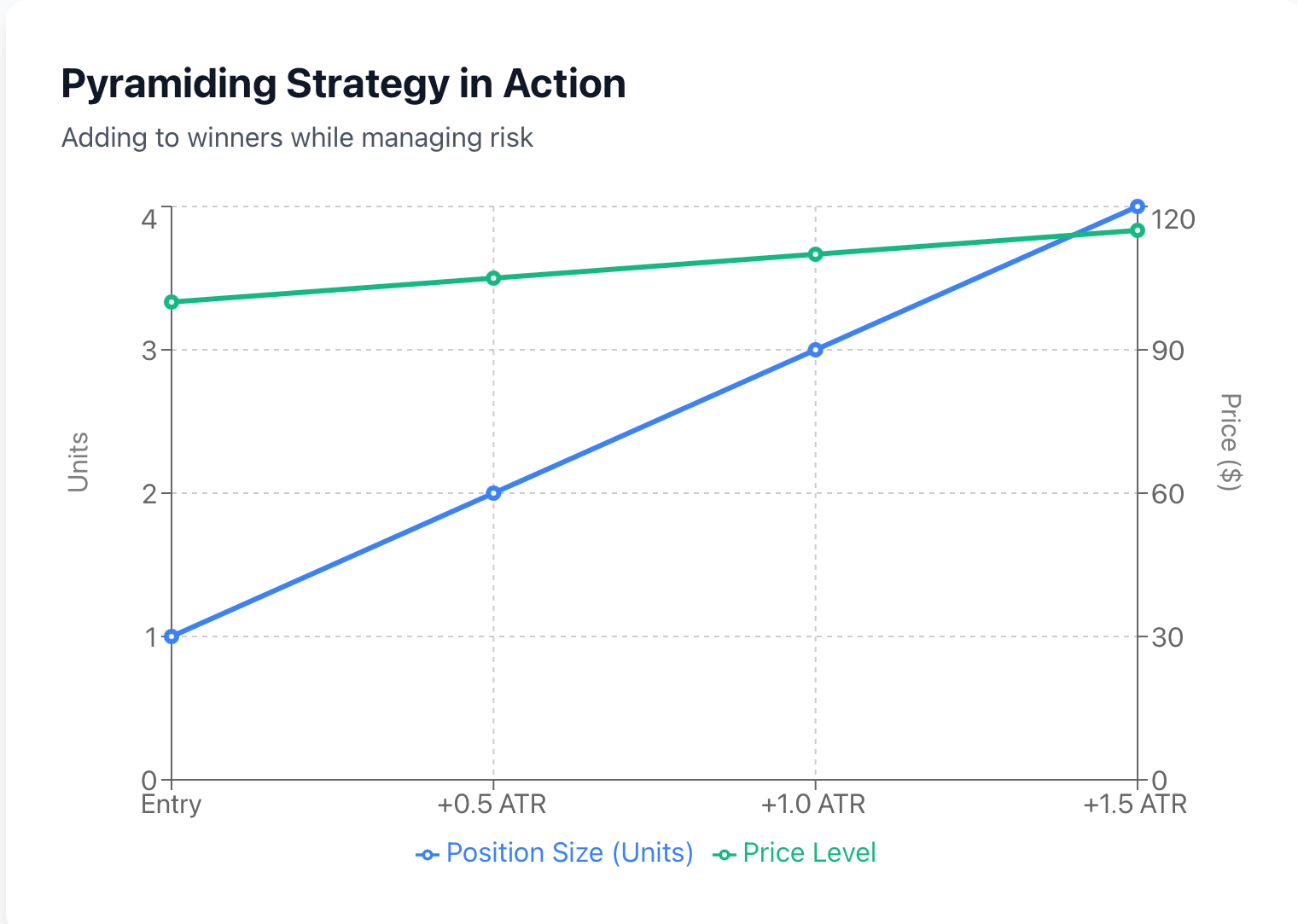
Position sizing was just as important as the entry rules. Dennis taught the Turtles to risk 1-2% of their total account on any single trade. This helped mitigate losses and increase longevity, especially during a prolonged loss. When a trade was favorable, they would add to the position at determined time intervals. This was called pyramiding. Pyramiding an account when a trade was winning significantly contributed to outstanding returns.
Stop losses were not negotiable. Every trade had a pre-determined exit- based on a multiple of average true range, which is one measure of volatility. If the price crossed that level, you would exit the trade automatically. No second guessing and no praying it would bounce back. The stop loss rule alone saved the Turtles from disasters.
The beauty of this system was the flexibility.You could take these same concepts and apply them to stocks, currencies, commodities, or even crypto today. Markets change, but human nature will stay the same. Trends still establish themselves. Breakouts still work. Risk management still truly determines who survives.
From Classroom to Trading Floor
The Turtle trainees came from a variety of backgrounds. One was a game designer. Another was in accounting. Several had never traded anything in their lives. Dennis didn't care. He was just looking for people who would follow the rules without questioning the system every second.
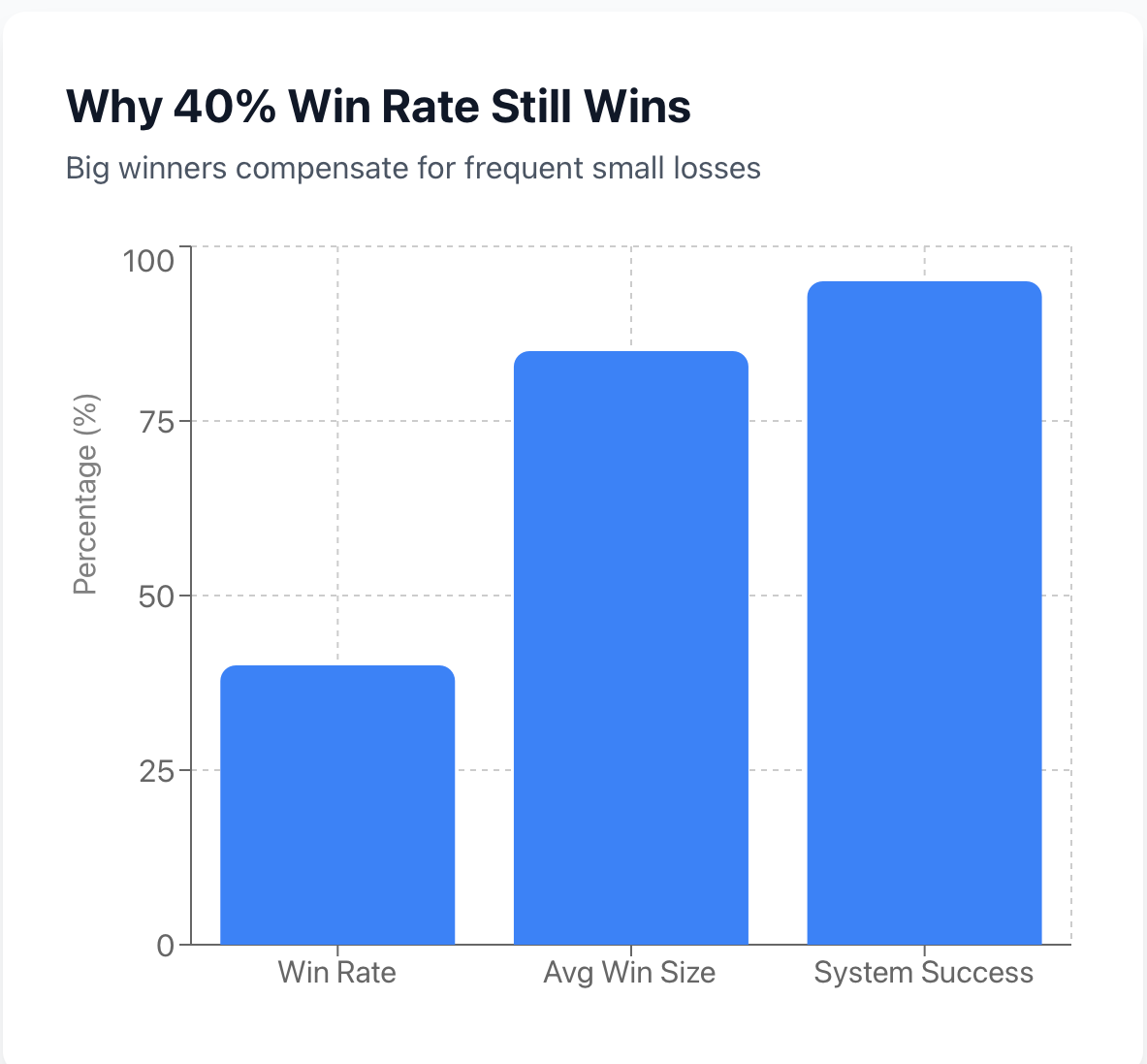
Training would take 2 weeks. Dennis covered the topics of position sizing, entry signals, stop losses, and the mental discipline to stick to the plan. Dennis emphasized that losing trades would happen. The system would only win about 40% of the time, but when the winners were so much bigger than the losers, it would still prevail in profits.
Then, came the hard part, the Turtles were trading with real capital. Dennis would fund each Turtle from $500,000 to $2 million account sizes. Most people would completely freeze up when that much money was on the line. The Turtles had to endure their instincts of taking profits early or keeping losers just in case they would come back.
Jerry Parker was one of the most successful Turtles of all time. He literally followed the rules to the letter and then later started his own fund which grew to billions in assets. His success did not come from some intellectual capacity that he understood better than other traders. He just had the discipline to take the system exactly as taught, trade by trade and year by year.
Not every Turtle did so equally well.Some people couldn't bear the emotional anguish of witnessing fluctuations in their positions. Some people began to second-guess their signals and make modifications solely upon their own discretion. Those who consistently stuck with the rules performed well. Those who strayed away from the rules did not do well.
The experiment demonstrated Dennis' point entirely. Give people a reliable system and adequate training and they will be able to make decisions rivaling professional traders. The missing ingredient in most trading is not intelligence or experience. It is a proven strategy and then discipline to execute it with fidelity.
To Dissect the Entry and Exit Rules
The 20-day breakout method was the aggressive entry method. You bought when the price moved above the highest high of the last 20 days. You sold or went short when the price dropped below the lowest low of the last 20 days. The 20-day breakout method entered trends earlier, but produced more false signals.
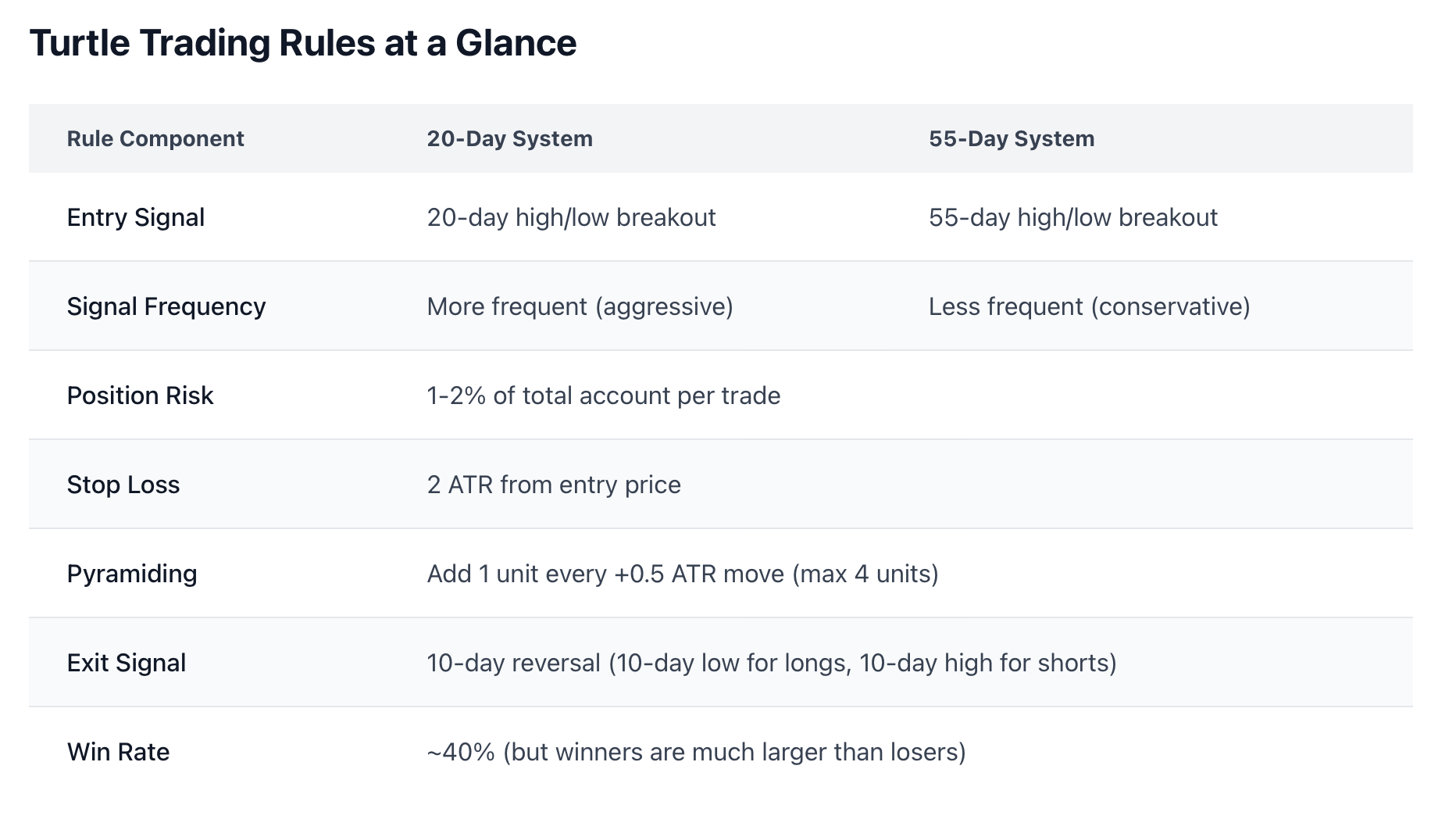
The 55-day breakout system was the conservative method. It waited for the price to break a 55-day high before entering a trade. This eliminated smaller moves and concentrated on major trends. The tradeoff was being late to the trade and missing a profit in some cases.
Position sizing was done by using a concept that Dennis called "units." A unit was simply defined as 1% of total risk taken in the account. The Turtles would compute volatility using average true range and then would decide how many contracts to trade so that a 2 ATR move against them would only take them to a full 1% of capital risk.
The approach kept position sizes aligned with account size and market volatility. Pyramiding enabled winning trades to become larger positions. When a position had a positive movement of 0.5 ATR, the Turtles would add a unit. The Turtles could add as many as four units on the same trend. Therefore, their largest position was in their best trade, exactly where you want to max out exposure.
All the stop losses started at 2 ATR away from the entry. As positions became profitable and the Turtles added units, stops moved higher to lock in gains. This was to allow the trend to run as long as possible while still ensuring losses were cut quickly when the markets reversed.
Once the price crossed over a 10-day low for longs or a 10-day high for shorts, that was the rule to exit. It was designed to get you out before too much gain was given back. An acceptance that you're never going to get the exact top and bottom; better to keep most of your gains than try to squeeze the last tick.
Modern Applications That Still Work
Fast forward to today, and these principles are rock solid still. Currency traders use breakout strategies on currency pairs like EUR/USD. Crypto traders use them with Bitcoin and Ethereum. Stock traders look for 52 week highs to locate momentum moves.
The key is to take those principles and adapt them to the time frames and particulars of your market and style. Day traders might use 20 period and 55 period breakouts on hourly charts, while swing traders tend to stay with daily charts, and long-term investors could even use weekly or monthly time frames.
The need for risk management is more important than in Dennis' day - with high-frequency trading and algorithmic systems dominating the markets and causing volatility after the fact - similar to what was experienced. This idea of risking 1-2% per trade is critical to remaining in the game.
Technology makes executing Turtle strategies easier than the original Turtle's ever had it. Trading systems that we use at the state-of-the-art level as of the date of this writing (February 2023) - platforms like TradingView, MetaTrader, and NinjaTrader - automatically calculate the breakout levels, position sizes, and stops. You could run a backtest of sorts on a 30-year period in a few minutes.
Cryptocurrency markets in particular are a great fit for trend following. The large rallies and crashes in Bitcoin created the large moves designed to capture. The only note about trusting your stops to let conditions stop losses, regardless of volatility.
Forex pairs would be the next solid choice from an execution point of view. The major currencies tend to trend well and have deep liquidity for large size positions. The fact that Forex is a 24-hour market and you won't be able to stare at the market all of the time is also good discipline to maintain the mechanical aspect that Dennis always proposed.
Expanding Across Multiple Markets
Professional traders that follow trends diversify across dozens of markets simultaneously: stock indices, bonds, commodities, and currencies. This diversification minimizes risk and increases your chances of capturing a substantial trend somewhere.
The rationale is compelling. If you only trade one market, you are entirely dependent on that one market being a good trend. If it chops sideways for months, you are stuck in a drawdown. If you trade 20 markets, there is a reasonably good chance that at least a couple are trending strongly enough to make up for the ones that are choppy.
It's very important to consider the correlation factor when you build a portfolio of trades across multiple markets. You don't want everything to be moving in lock-step. If for example, you mix negatively correlated instruments such as bonds and stocks or some set of commodities and currencies, you will smooth your equity curve. When one sector is going bad, another may just be going good.
The original Turtles traded in everything from gold to crude oil, bond futures, stock index futures, etc. The nature of the portfolio sheltered them during times of market chop, when a particular sector might have little to no trending instruments. If grain and agricultural commodities were not trending positively, at least energy or metals were a strong trending opportunity.
Modern traders have access to markets that the original Turtles likely could have not envisioned. You can trade volatility through VIX futures. Bitcoin futures are available if you choose a regulated futures exchange. Micro contracts allow even the smallest of accounts the ability to trade accounts that previously required a six figure club.
Having multiple instruments to trade also makes the complexity of multiple markets easier to define with some automation. If a market entry rule is too complex to define for a live trading plan, you can code the Turtles rules into a program to monitor and account for multiple markets, calculate position sizes, and execute trades. It removes the emotional factors of trading and ensures a consistent adherence to rules.
The Lasting Impact on Trading
Dennis changed the face of systematic trading.Prior to the Turtle Trading phenomenon, there was an element of secrecy within the world of trend following. The Turtles validated that the strategies had merit and shared the underlying methodology with the world.
As a result, today we have an endless number of hedge funds and CTAs utilizing some variation of the principles taught to the Turtles. Quantitative trading firms ran with the concepts even further. Many are combining trend following with mean reversion, volatility strategies, and advanced risk models. But a lot of those firms are still utilizing the same breakout ideas and position sizing that Dennis taught.
The fact that trading tools have become democratized means that individuals can implement these same strategies as a regular human. Individuals no longer need Richard Dennis to give them $2 million. In fact, anyone can start with a few thousand dollars and adjust position sizing downward to size their trades with mini or micro contracts.
Returns that account for risk-adjusted returns are much more valuable than returns that are purely based on absolute profit. A trader that makes 20% a year and has very low volatility, shallow drawdowns, etc., will outperform a trader that has 50% returns but has a gut wrenching 40% drawdown. A large point of emphasis for the Turtle system was controlling for risk, which made the equity curves much smoother for compounding over time.
The critics of trend following say markets will not work as well as they have in the past with trend following signals, as there are too many human beings using the same signals for the same markets.
Nevertheless, the data shows that trend following diversified strategies can continue to produce positive returns. The important part to understand is these systems need to be used in the context of a bigger plan, and not solely dependent on one system.
In fact, there is evidence of real results from the original system. Historical tests confirm that disciplined execution can yield great results. When back testing crude oil futures from 1983 to 2000, the 20-day system generated returns in the vicinity of 15% annualized returns and reasonable drawdowns below 25%. These are not astronomical returns, but they are steadfast.
The S&P 500 futures even delivered even greater returns during periods of strong bull and bear markets. The entire rally was captured by the system from 2009-2020, the system remained with the trend higher, cutting losses through minor corrections. The trick was simply to remain in the position, during that long grind higher, instead of jumping out of the position every time there was a small dip.
In one example from the 1990s, Gold futures were bought when it broke above 380 a troy ounce (55 day high). The position pyramided as it went higher to 420, and then again to 450. It exited when the market reversed below a 10 day low of 440. The total profit was over $40,000 per contract.
Another example is when we traded crude oil from $20 to $80 in the 2000s commodity boom. The turtle system went long on the breakout above $25, then added positions at $30, $35, and $40, and kept adding to the positions. The exit was around the $75 level. This single trend made millions for traders using these rules.
The system provided short signals in the financial crisis of 2008. In late 2008 when the stock indices broke below their 55 day lows, the system went short in the crash year, and made money. This shows the value of trading in both directions and not only looking for bouts of long setups.
There were losing periods too. In the choppy sideways markets of 2015-2016 the market whipsawed trend followers with false breakouts, and we stopped out again and again without real opportunities to make sustained moves.Discipline is essential at this stage. You must accept the small losses and continue to follow the signals, knowing that the next trend can always recoup your equity.
Moving Forward
If you are just starting out, keep it simple! Pick one market to focus on. Perhaps an index ETF or a major currency pair and monitor the 20-day and the 55-day highs and lows in each market for a couple of weeks manually. This will give you a good feel for how breakouts develop over the longer term. Paper trade before putting real money on the line.
Take your time determining your position sizes. To do this, determine what 1% of your account is and then use that number to determine the appropriate number of shares or contracts to trade based on volatility. We utilize this and it protects you from taking too large of a position size for your account somewhere down the line.
Place your stops before entering a trade. Do not place them after entering a trade. Know exactly where you will get out if a trade goes against you. Place those stop orders immediately, it will eliminate your ability to talk yourself out of taking the "psychological loss" later.
Keep a trading journal documenting every trade. Document the entry price, stop level, position size, exit price, and profit or loss in your journal. Review your trading journal each month to determine if you've noticed patterns in your execution. Are you cutting your winners too short? Are you letting your losses run? The data analysis will help you determine that.
Embrace that draw downs are part of the deal. Even Dennis went through 50% draw downs on his path to making his fortune. The real question is not whether you will lose money on a trade, but whether you will stay disciplined during the draw down and stay with the system you have developed.
Back test your strategies before going live. Most, if not all trading platforms, offer some kind of back testing capacity where you can run basic turtle rules against historical data. This is a critical step to building confidence in your approach and will prepare you for what to expect regarding win rate, net profit, and max draw down expectancy.
The financial markets reward those who can consistently follow a proven plan over a repeatable amount of time, not 2-3 weeks. Dennis and his Turtles again proved this point that when faced with systematic rules, the truth was ruled out and logically taking emotion out of the decision is a better way to make consistent gains.
It’s easier than it sounds - be disciplined and develop a solid strategy and execute it consistently through time. Your money will do a lot of the work for you as far as compounding and increasing your account gets.
Are you ready to take it to work? As you read through this portion of the book, make note of the potential breakout levels and focus on the market you will use. This week, track those breakout levels, proper position sizes based on the account you will use, and take the next valid signal to that breakout level. The only difference between studying trading and actually trading, is one executed rule.