




If you’ve been trading currency for a few weeks or longer, you may have heard other traders talking about "NFP Friday" with excitement or with trepidation. Some traders steer completely clear of the markets on NFP Fridays. Others view it as the best opportunity of their trading month to catch explosive market moves. What is NFP, and what gives it the power to move the world of trading?
Let me take you through everything there is to know about the Non-Farm Payroll report and how to trade it without having your trading account burned out.
What is NFP? The Non-Farm Payroll Report
NFP means Non-Farm Payroll: a monthly report that shows how many new jobs were added to the U.S. economy (excluding farm workers, government workers, and a few other categories). The report is published by the U.S. Bureau of Labor Statistics on the first Friday of each month (8:30 a.m. ET).
NFP is like the economic report card. When many new people are getting jobs, those people are spending money which means businesses stay open and the economy is doing well. If the economic report card shows fewer new jobs than the prior month, it is a signal that things might be getting bad for the economy.
The report has three main components:
-
New jobs added: The total number of jobs added from the previous month
-
Unemployment rate: The total percentage of people actively looking for a job and who cannot find one
-
Average hourly earnings: The average pay of workers, per hour.
All of the numbers are important because all of the numbers impact directly what the Federal Reserve does with interest rates.Significant growth in jobs could prompt the Federal Reserve to raise interest rates to stave off an overheating economy, while weak data could lead to cuts to stimulate growth.
This is where it becomes intriguing for traders: the U.S. dollar usually strengthens when the NFP numbers exceed expectations. For example, if economists expected an increase of 150,000 new jobs, but the number came in at 250,000, the dollar index would usually spike immediately after the report. In the same way, the stock market would typically rally on good news and gold (which stands in competition with the dollar as a safe haven asset) would often decline.
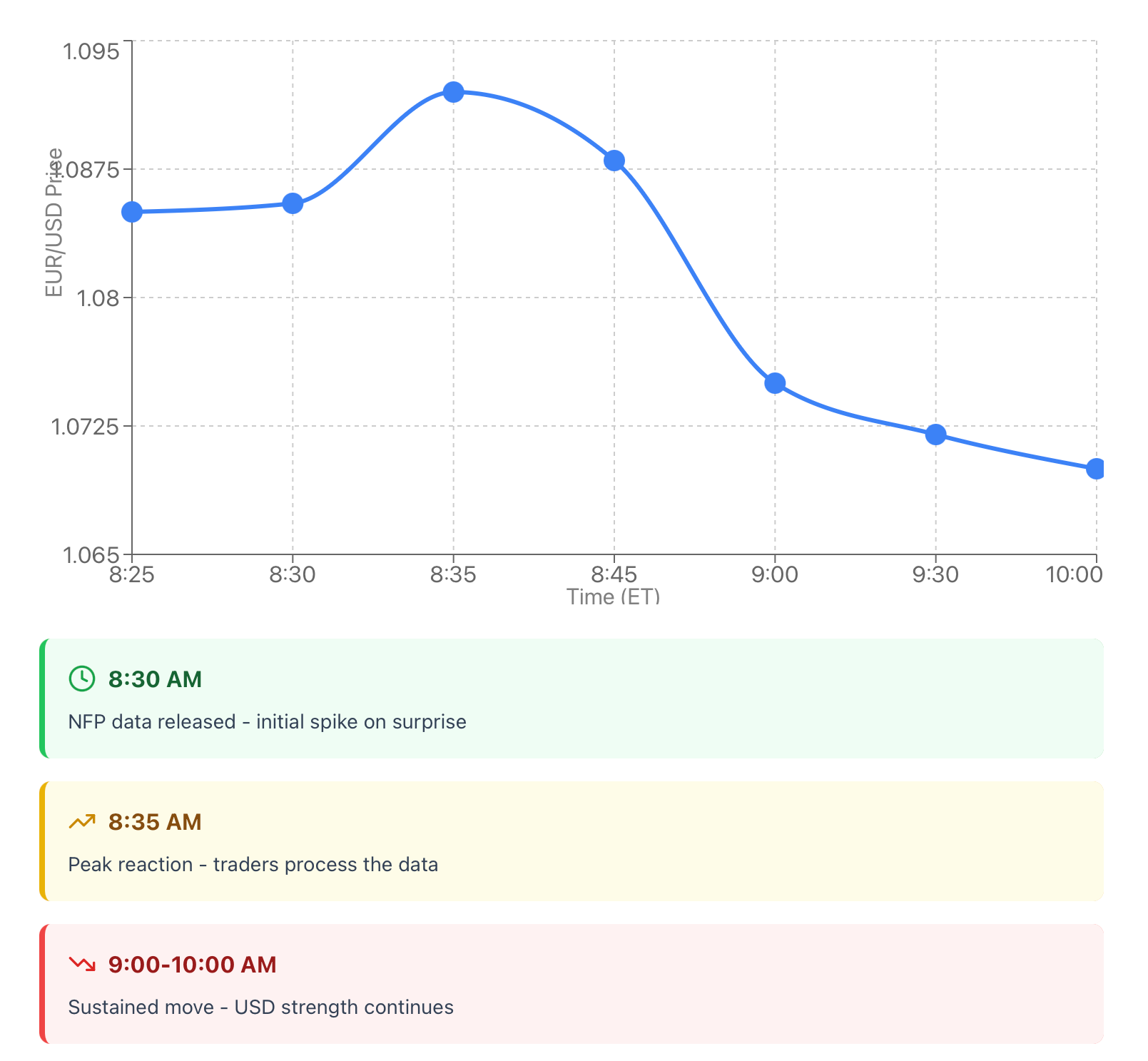
I remember monitoring the February 2024 NFP report, where the job increase came in well above expectations at 353,000, against a consensus number of 180,000. The dollar spiked in a matter of moments, I watched as EUR/USD was forced lower as it dropped over 100 pips in the first hour, and my trading group chat erupted.
Why is NFP Important in the Forex and CFD World?
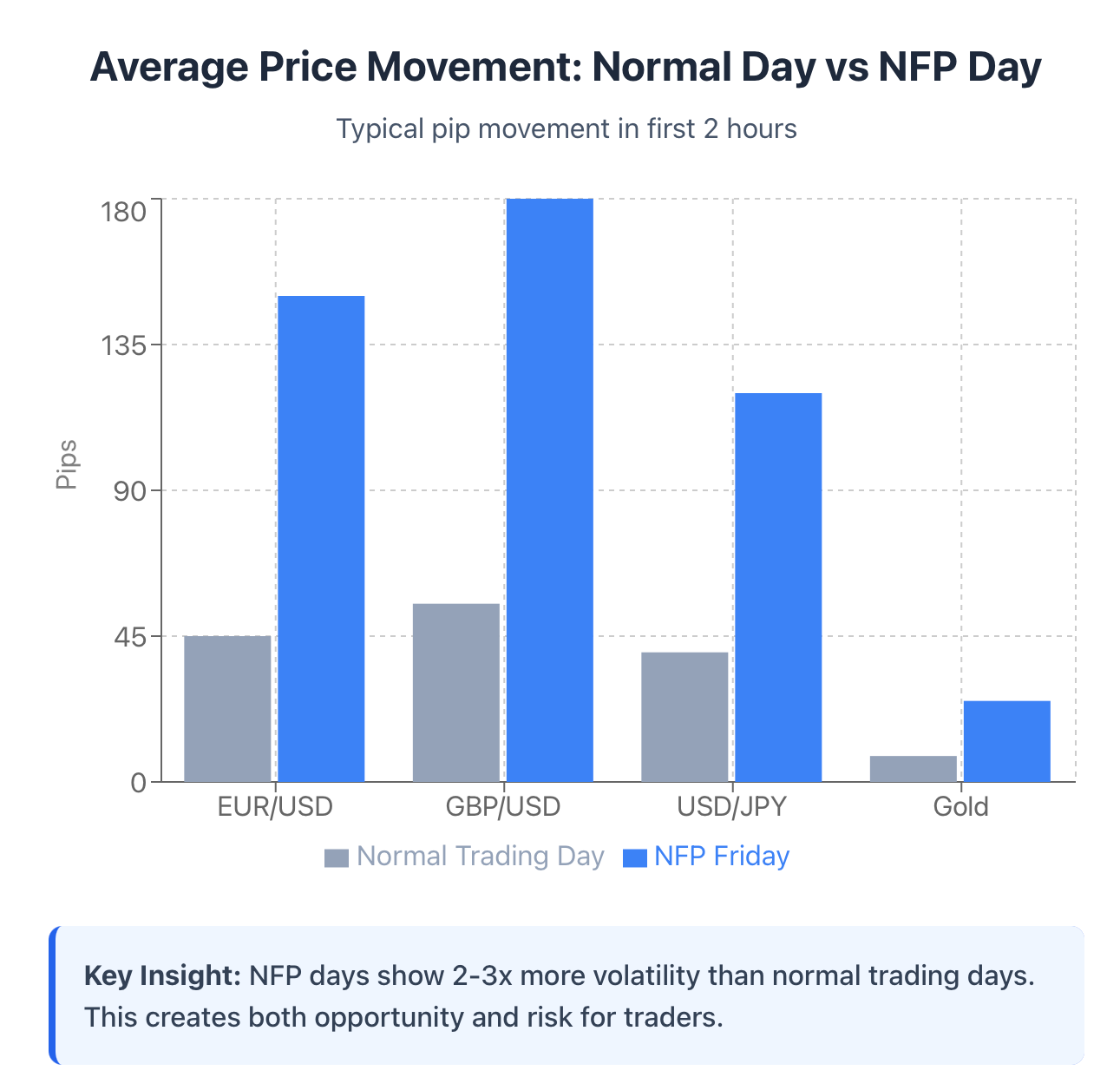
NFP days are different. On an NFP Friday, the market personality of the asset pair or indices completely changes. If you were to look at an average Tuesday for the EUR/USD, you might see a move of 40 - 50 pips over the following trading day. On an NFP Friday, you could see the same pair move 150 pips within the first two hours of the NFP release.
The real action starts when actual numbers differ from the consensus number that the analysts had expected. Markets hate surprises, and the NFP report time is filled with them. To set the stage, say that all of the analysts were forecasting an increase of 200,000 jobs, but the actual reported number was only 120,000.
Traders who have positioned themselves for a dollar rally are suddenly forced to unwind their positions, leading to quick price activity as orders flow in.
Major currency pairs respond in different ways:
-
EUR/USD tends to have the largest moves here again because it is the most commercially traded currency pair in the world. If the NFP number comes in stronger than expected, expect the Euro to be hammered lower because the dollar is rallying.
-
GBP/USD responds in a similar way, but generally has even more volatility as the natural jumpiness of the pound is amplified on the NFP release.
-
The USD/JPY often has a gap at the market open since it will gap higher or lower on weekend news that disagrees with the Friday NFP data. There have been times I have seen the USD/JPY gap 50 pips on Friday's data or announcements that can make or break the day's trading plan for traders.
In addition to the currency pairs, stock indices such as the S&P 500 and NASDAQ typically respond to the NFP. Strong job numbers tend to lead to a move higher in stocks as speculators look at economic growth. Gold and silver generally go down as the dollar goes stronger, so again stronger than expected NFP data would see weaker price movements in precious metals.
The main takeaway is this: NFP days are not for the faint of heart. I have seen veteran traders stop out of their interest or positions in a matter of minutes because they did not have a good handle on the volatility they should expect for this day. Not only is risk management important on these days, but it is imperative.
How NFP interacts with other economic indicators
NFP is not based in isolation. Smart traders will look at how NFP fits with other economic data to gain a view of the greater picture.
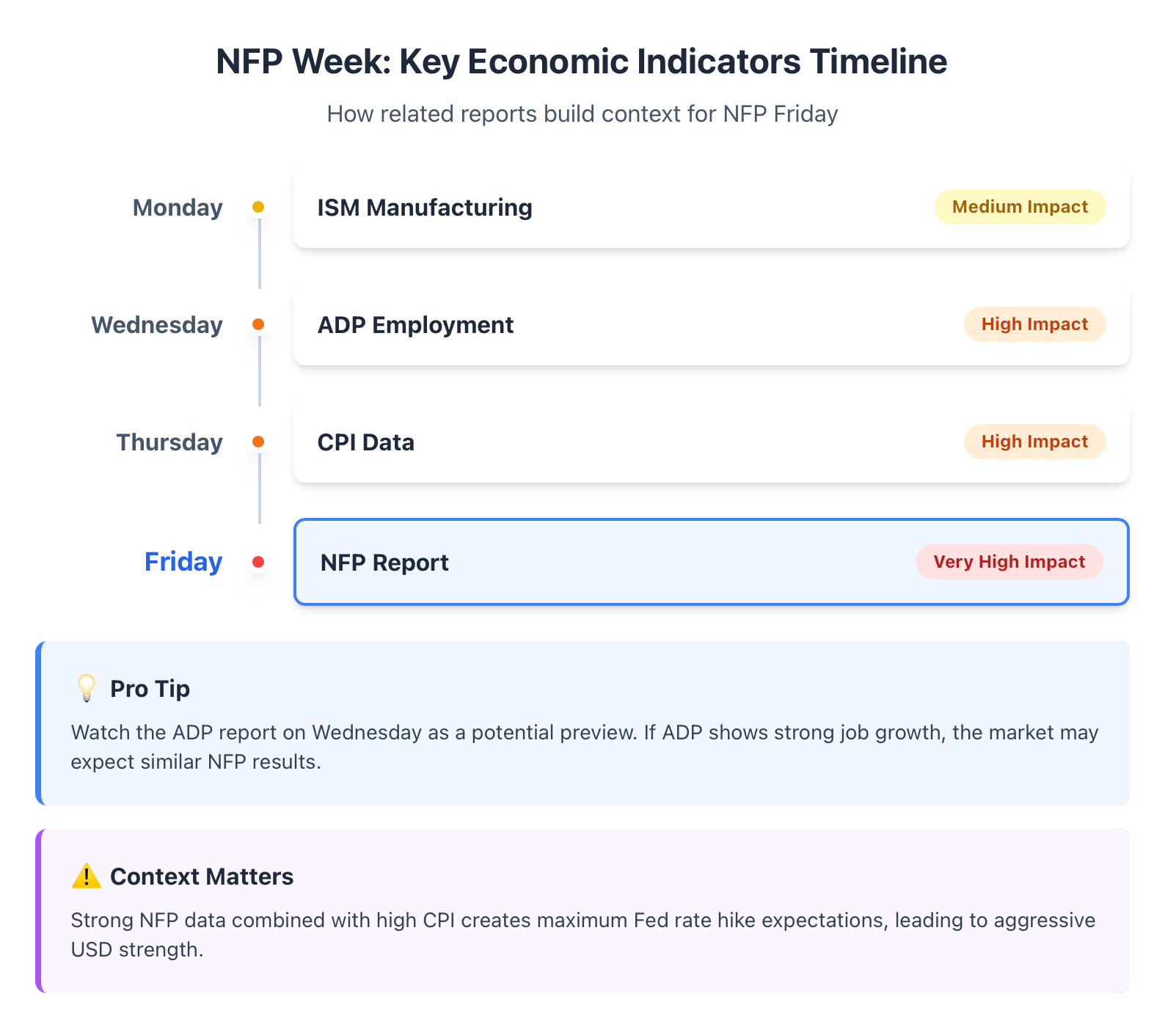
ADP Employment Report is released two days prior to the NFP report and is released measuring jobs added in the private sector. Some traders use this as a leading indicator for the upcoming NFP report, although the ADP and NFP reports often differ by a large margin.
Consumer Price Index (CPI) is released around the same time as both the NFP report and the ADP report. CPI measures inflation. When both CPI and NFP are "hot"/strong, it feels like you got an A on your midterm and final. The Fed gets even more comfortable with the idea of increasing rates, which tends to lead to stronger dollar rallying.
ISM manufacturing index is also released in the week leading up to the NFP report. The ISM shows industries reporting that manufacturing entities are expanding or contracting. A strong ISM number in combination with strong NFP data shows broad economic strength across the economy.
Think about evaluating a student. You would not think a student failed if they did not meet your standard on a test without looking at their homework grades, participation in the class, or contemplating how they progressed through the semester. In the same way economic data is evaluated, a good NFP piece of data means much more if supported by other data including; strong retail sales, increasing consumer confidence, and health measurement in the manufacturing.
I have seen it happen before where the NFP number was good, beat expectations, and the dollar fell sharply due to weak CPI data released the week prior. The market was pricing in that based on the CPI number, the Fed would not raise rates regardless of how good the NFP data was. All of the different contexts about this data means so much.
How to Analyze NFP Data Like a Pro
Professional traders don’t simply pay attention to the top-line number. They look closely at the contributing pieces, and how they fit in with the markets’ expectations.
So what should you look for?
The expectation gap is everything! If the forecast is for 180,000 jobs, and the actual number is 185,000 - that is basically a miss. You may see a blip higher above the out number, but odds are you will not see any significant sustained move. But, if the forecast is for 180,000 jobs and the actual non-farm payrolls, NFP, (job number) is 280,000 - that is a huge beat that will imply price action.
The unemployment rate is also as important as the headlining number. For example, job additions can be above expectations for NFP, however if the unemployment rate ticked up, from 3.7 % to 3.9 %, this would imply people are coming back into the workforce, because of desperation not abundance of opportunities.
Average hourly earnings are another avenue, with more implications for wage inflation - which is something that the Fed looks at closely. If hourly earnings are rising too quickly, then concerns for rising inflation return and expectations for increasing rates - once again rise.
Let me give you a real, viable, example looking back. In March, 2023, the NFP number came in at 236,000 (0.001 below the forecast of 239,000), however average hourly earnings rose by 0.3% versus the forecast of 0.2%. The dollar sold off initially reflecting the job miss but after the news was digested reflected the wage inflation component - further gains for the dollar.
Multimillion dollar hedge funds took advantage of this nuance - catching this tweak for both moves.On NFP days, risk management means that you will get your stops run over. Use larger stops than normal, decrease position sizes, or even sit out if you don't like the volatility. It is perfectly acceptable to sit on the sidelines if things are too volatile for your risk strategy.
Using NFP Data with a Multi-Timeframe Analysis
One of the biggest mistakes I see traders make is trading NFP with the same timeframe as they do the rest of the month. You need to approach NFP days differently.
Start with the daily chart to get a big picture. Is the euro / US dollar trending up, trending down, or ranging? This gives you directional bias. If the price action has been strictly trending down for 3 weeks and then NFP comes out strong, then and only then should you start looking to short the EUR/USD on any strength.
Now, move to the 4-hour timeframe to get the key support and resistance levels to trigger on NFP day. Those act as magnets in times of volatility. The price may spike through them at times, but it often comes back down.
Once you have a bias and chart level(s) prepped, the next part is NFP day. On that day, we watch the 15-minute timeframe for entry signals. We already know the price action based on the higher timeframe levels and bias.
It is on the 15-minute mark where we are going to see the immediate price move. I personally like to wait for 5-10 mins of chaos followed by a bit of retraction on the news. Typically the knee-jerk reaction is often reversed once the traders process the whole report, thus setting up a small window of opportunity for proper price entry.
If EUR/USD is in a daily downtrend , and if we have a strong NFP - potentially more towards the top end of key levels I identified on the 4 hour chart- I will look for probable set up on the 15 min chart that has the EUR/USD rally up into a 4-hour level of resistance. This kind of conjunction allows for high probability with a clear stop above.
The idea behind multi-timeframe analysis is that you won't get chopped up in the initial 15 min volatility of the report, and still get into the sustained move. You will be trading with a bias and while there is volatility, it won't be as furious as without bias.
Step-by-Step Strategy for Trading NFP
Allow me to outline a straightforward plan for you to implement.
Prior to NFP data getting released:
Review the economic calendar for the consensus forecast. Understand what number constitutes a significant beat or miss. Take a look at the previous month's data and any revisions. Check out the current trend on the daily charts for your pairs of choice.
Step 1: Determine the Trend.
Open up your daily chart. Draw your trendlines and/or gauge whether price is making higher highs and higher lows (indicating an uptrend), or lower highs and lower lows (indicating a downtrend); this will indicate the direction that you can advantageously trade.
Step 2: Mark Key Levels.
Make a note of clear support and resistance zones in the four hour chart or daily chart. This could be a point in price where price has previously reversed at multiples times or not far from a round number (like 1.1000 on EUR/USD).
Step 3: Wait for Data Release.
At precisely 8:30 ET, it should be released. Make sure to read the headline number as well as the unemployment rate and wage data and compare that with expectations. Watch the price for some sort of initial reaction, although you will hold off entering anything until the reaction unfolds.
Step 4: Define Your Entry.
If the NFP data supported your directional bias (strong data en route or bullish), wait for a pullback to a key level. If NFP did NOT support your positions, you might want to take the day off or at least consider taking a smaller position.
Step 5: Trade with Stiff Risk Management.
Once you are ready to execute on a trade, enter the trade with a stop loss (implied by your key levels identified earlier).On NFP days, I will normally risk just 0.5-1% of my account.
Then take profit at the next major support or resistance level.
Step 6: Review
After things settle down, you want to review what just happened. Did the market react as you expected it to? Where did you trade well or poorly?
For a tangible example, in September 2024 I was watching USD/JPY in a very clear uptrend off the daily chart. NFP beat expectations significantly, and I let the initial spike settle before I engaged long at 147.50 (a previous resistance turned support). My stop was at 146.90 and I took profit at 149.20. The trade took about sixish hours to work out and I was risking less than 1% of my account.
Common Mistakes Traders Make Regarding NFP
I believe I've made every mistake you could possibly make on a NFP. So let me help you, and save you some pain.
Overleveraging is the killer. Traders see the big movement and say, "I can make a month's profit in one morning". They load up on size while they see prices move their way, and then the reversal stops them out. Use half or even a quarter of your normal position size, on NFP days.
Ignoring the expectation gap is another classic mistake. A trader sees 200,000 jobs were created "that is great". However they do not realize the market was actually expecting 300,000 jobs to be created.The dollar declines, and they find themselves on the wrong side.
Poor stops get people smashed. You can't use your standard 20-pip stop on a day like today where pairs are swinging 100 pips. Either widen your stops accordingly, or reduce position size to keep the dollar risk the same.
It's easy to see the first move happen and get hyped, and jump in on something 100% of the time, but that first 5 mins after NFP is ceaseless chaos. Spreads widen, liquidity becomes thin for a moment, and prices spike to levels that will not hold. I have seen countless traders buy the top of that first spike only to see the whole thing reverse.
Emotional trading costs more accounts than anything else. You see the price shooting up without you and you panic and jump in on no plan, and then get stopped out the other way. Or you take a loss and immediately revenge trade it back.
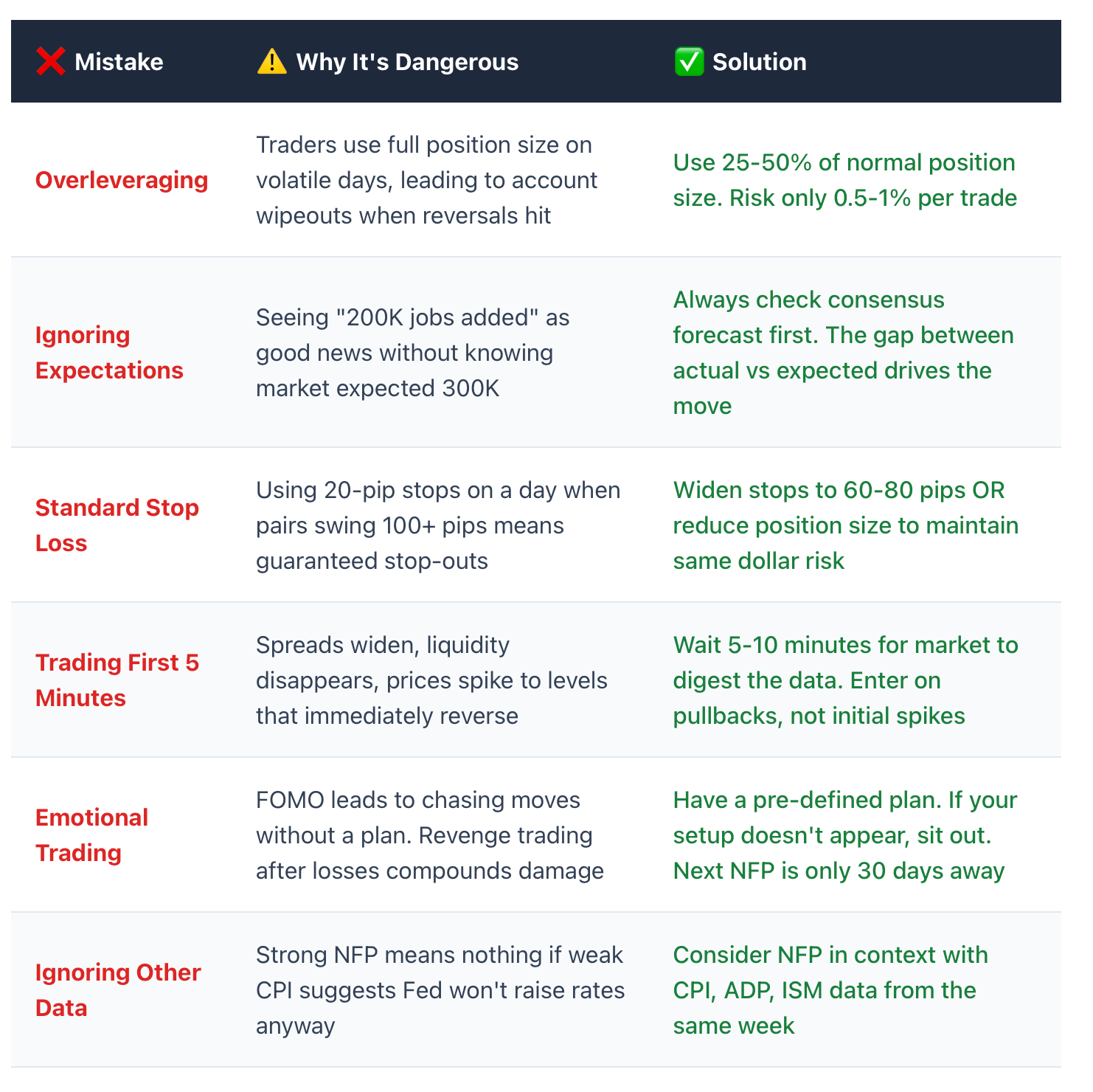
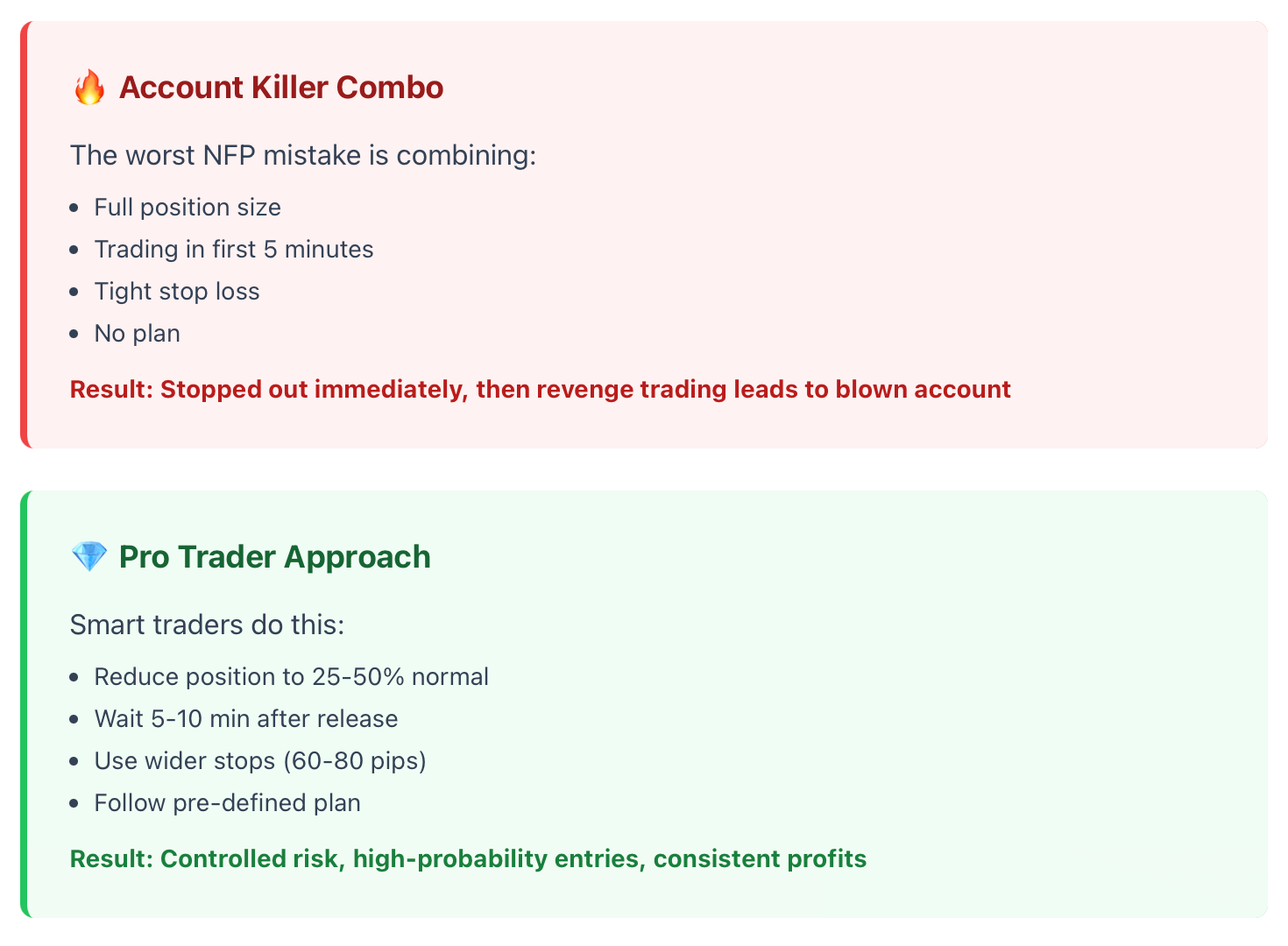
The answer? Have a plan from before the data dropped. Know the criteria for entering, stop level, and profit target. If the market does not give you your criteria then do not chase - there is another NFP next month.
Start trading NFP with real skill
NFP trading is not about betting on a coin flip. It's about understanding how employment data affects central bank policy, how central bank policy affects currencies and then positioning yourself to profit from these moves and manage risk wisely.
You now have the framework - you understand what NFP measures, why it matters, where to research and read it in context to the other indicators you watch; you use multi-timeframes to find your high-probability setups and then have the discipline to manage the risk. Most traders miss the point of these steps and wonder why they are losing money every NFP Friday.
Are you ready to put the learning into practice? Try out and open a demo account at btcdana.com and you can trade the next NFP release risk-free. You can see how the market reacts, and test your strategy before risking real capital, and build that confidence you need.