




Introduction: Why Dividend Adjustments Matter in CFD Trading
Contracts for Difference (CFDs) allow for speculation on price changes without actually owning the underlying stock. You make or lose money based on whether the stock price increases or decreases. Pretty simple, right? But here is where it gets interesting.
In the stock market, when companies pay dividends to their owners or shareholders, something interesting occurs in the CFD world. However, you do not own the actual stock; it still affects you through adjustments we refer to as "dividend adjustments."
Consider a hypothetical scenario: Let’s say you borrow a friend's jacket. While wearing the jacket, your friend reaches into one of the pockets and finds his $20 bill. As you have borrowed the jacket, you might expect to get that $20 from the friend, even though you did not technically purchase the jacket to own, you would expect to receive that bill. But that is the way companies' and CFDs work in a dividend adjustment.
The reason this matters is because without the dividend adjustment or inclusion, and if you disregard it, you might think you are gaining or losing profits, but is simply the market correcting itself. An example of this is if a stock theoretically dropped by $2 on dividend day, one might think the long position was losing profits. If that stock paid a $2 dividend, well, you'll see that $2 amount credited as an adjustment in the CFD that offsets the drop in price.
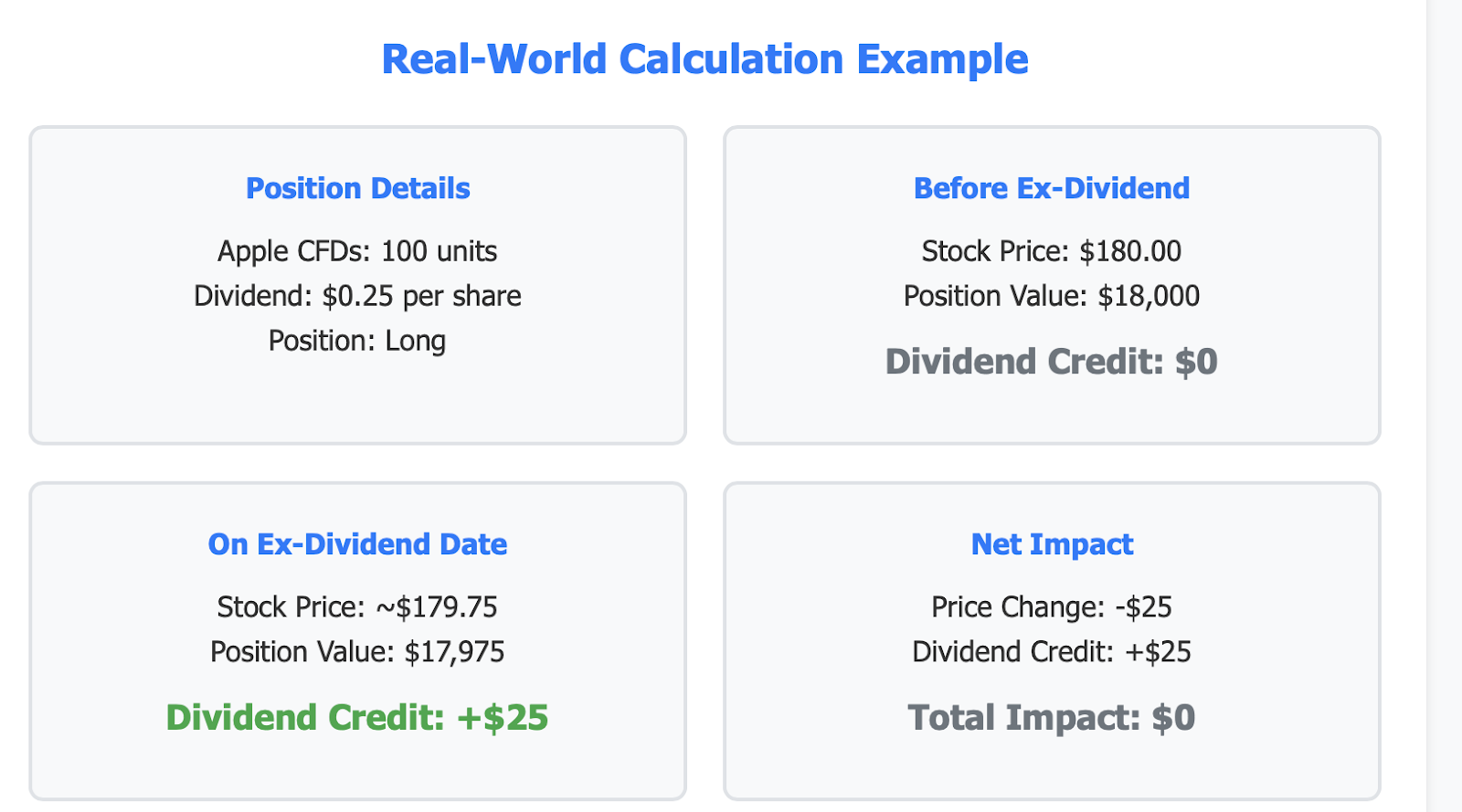
Real-world scenario: Imagine you have 100 Apple CFDs, and Apple issues a $0.25 dividend. Your account is credited $25 (100 shares × $0.25), even though you do not actually own Apple shares. If you don't understand the mechanics of CFD trading, you may misinterpret the positive impact on your account and miscalculate your future trades accordingly.
In summary, dividend adjustments are neither gains nor excessive costs. Dividend adjustments are adjustments that you must make to ensure CFD trading is fair and in line with the real market impact.
What is a Dividend Adjusted CFD?
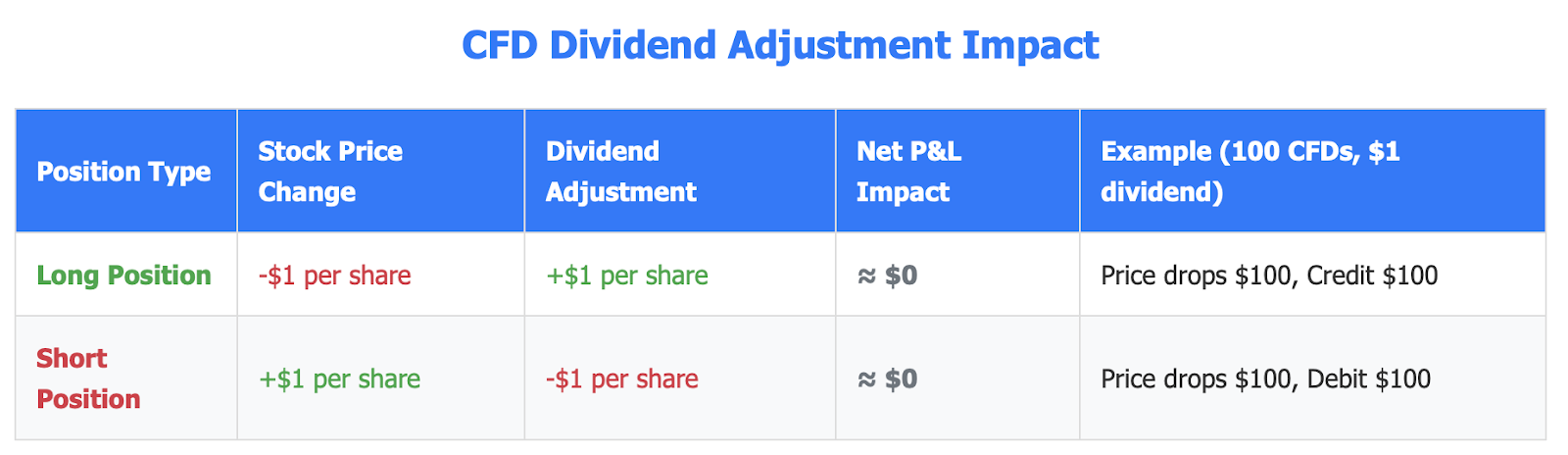
Dividend Adjusted CFDs are simply a CFD position that is adjusted for the payment of dividends from the underlying stock. This is done to ensure your CFD trading experience is similar to what would be happening if you owned the stock shares.
The summary of the mechanics are:
-
Long-open positions receive cash credits equal to the dividend.
-
Short-open positions must pay the dividend.
This is a systematic process as it must be fair to ensure against traders gaming the system.
To exemplify further, let's say Tesla issues a $0.50 dividend per share. If you are long 100 Tesla CFDs, your account is credited $50. If you are short 100 Tesla CFDs, you pay a debit of $50. That's it!
But why does this occur? When a stock is "ex-dividend" (the day that new buyers will not receive the upcoming dividend), its price is expected to decrease, roughly by the amount of the dividend. If no adjustment occurs, it would unfairly benefit short sellers and penalize long buyers.
Think of it this way: a soccer/football match and Team A scores a goal. The fans wearing Team A jerseys get free drinks. If you are wearing a Team A jersey you rented it would be honored. The dividend adjustment is your free drink.
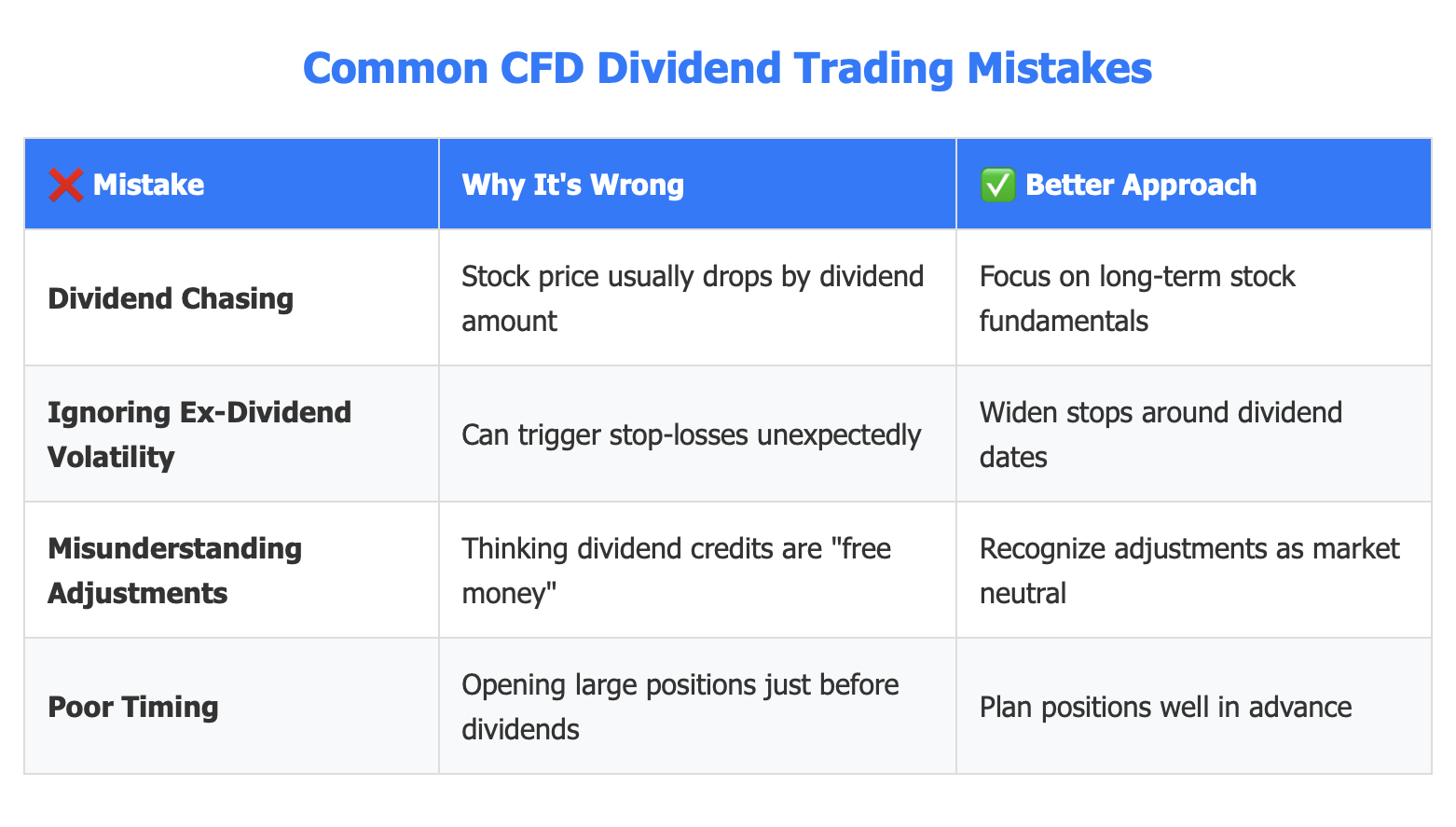
This is where many traders miss the point. Dividend adjustments are not free money or penalties; they are simply market adjustments to keep everything balanced. If they were not made these instruments would create artificial advantages that do not exist in the cash stock market.
There is also a timing consideration to be mindful of. The adjustment typically occurs on the ex-dividend date. This is the day that the stock will price itself lower, naturally adjusting for the dividend payment. Your broker handles this for you. No need to track every dividend announcement.
While each brokerage might have slightly varied procedures, the basis for dividend adjustments on CFD positions and the voting of shares is consistent across the finance world. Whether you're trading US tech stocks, European banks, or Australian mining companies, the logic for dividend adjustments remains the same.
How Dividend Adjustments Affect P&L in CFD Trading
This is where it gets really important to your bottom line. Dividend adjustments directly affect the profit and loss on your position but not always in the way you think.
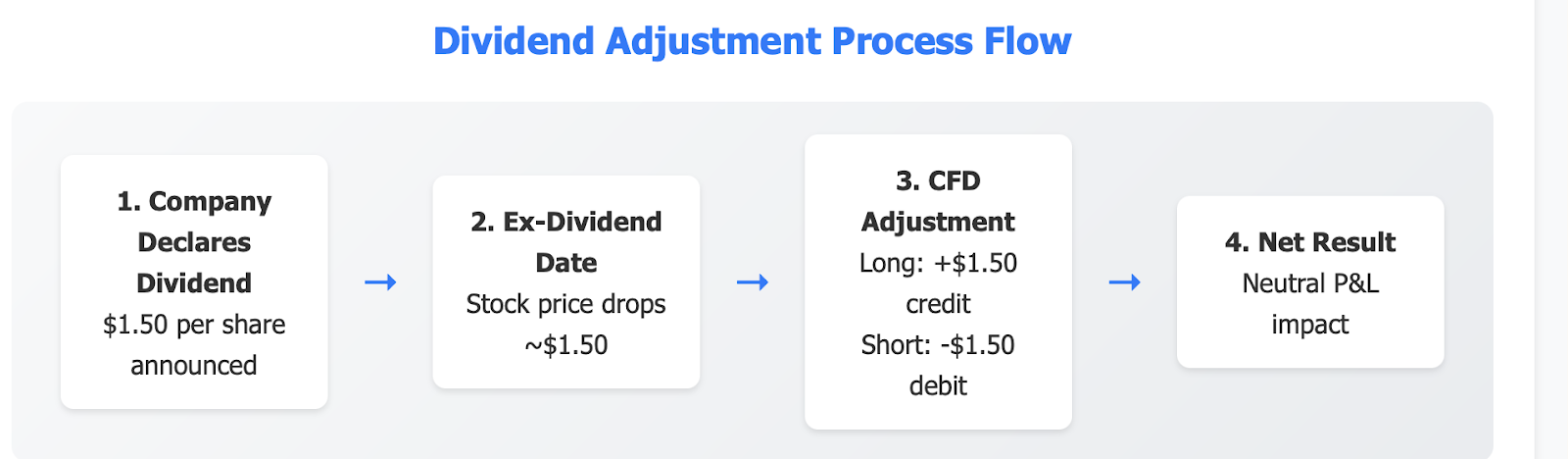
When a stock goes ex-dividend, two things happen simultaneously:
-
The stock price drops (at least normally) by about the amount of the dividend
-
Dividend adjustments occur on CFD positions
-
Because of how the two effects occur at once, they'll generally cancel each other out for most traders.
So let's break this down:
For Long Positions:
-
Stock price drops by the dividend amount (you've lost on paper)
-
You get credited with the dividend (you made cash)
-
Net amount of profit and loss is roughly neutral
For Short Positions:
The stock price declines by the dividend amount (you gain on paper). Then you pay for a dividend amount (you lose cash). Overall, you get about to net zero:
To illustrate, let’s assume you have a long position of 200 BP CFDs currently trading at $30. BP announces a $1.50 dividend. When BP goes ex-dividend, the stock is around $28.50 (a decline of about $1.50).
-
Your position loses 200 shares x $1.50, or $300, of value.
-
Your CFD account receives a dividend credit of $300 (200 shares x $1.50).
At the end of the day, you effectively haven't lost or made any money at all.
You can think of this like a soda you buy that costs $3. When you get to the cash register, the soda costs $2, and you receive a $1 voucher. In the end, you still paid $3 for the soda, just in a different way.
This adjustment removes arbitrage opportunities. Without dividend adjustments, traders could manipulate and game the dividend dates at every stock. They could buy long just before the dividend date and close out short after. The adjustment mechanism removes this opportunity.
However, it is important to note that the stock price may not necessarily drop by exactly the amount of the dividend. As you know, due to market conditions, investor sentiment, or some other factors, the price may rise or fall by more or less than the expected amount. Either way, there will be small opportunities and/or risks immediately surrounding dividend dates.
Some traders have attempted to take advantage of the volatility surrounding dividend dates; however, to have an advantage in this area requires a detailed understanding of the dynamics taking place. For most CFD traders, the bottom line is more basic: dividend adjustments are simply neutral corrections, not opportunities for profit.
How you manage your positions during or after the dividend date is what may have true implications. Large dividends tend to create a volatility market just after the dividend is paid since pricing adjustments occur immediately. Even margin requirements may change around dividend dates. Traders with experience understand these risk management implications.
Dividend Adjustments Across Global Markets
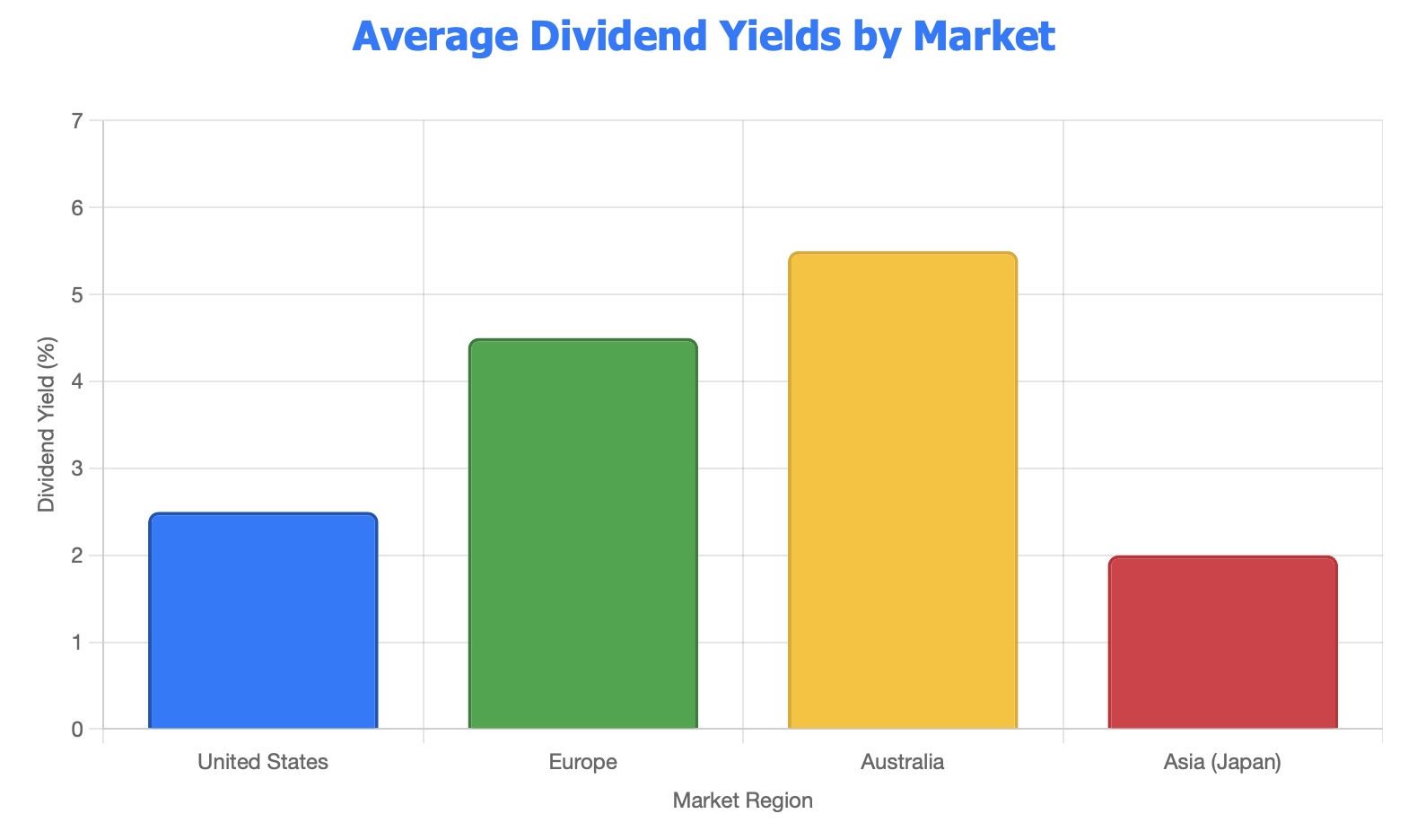
While dividend policies vary widely both across countries and sectors, the adjustment mechanism is the same in all markets. Knowing the differences will allow you to later anticipate when adjustments might occur, and how significant they will be.
United States: Commonly, American companies pay quarterly dividends, though that is not ubiquitous. Tech mega-cap companies such as Apple and Microsoft have commenced dividends in the last several years, and traditional blue-chip stocks, including Coca-Cola and Johnson & Johnson, have extensive, decades-long histories of dividends. Dividend yields in the U.S. are moderate and generally fall between 1% and 4% from most large, typical U.S. companies.
Europe: European companies typically pay annually or semi-annually and, on average, pay better dividends. Traditional banks, such as HSBC, or well-known energy companies, such as Shell, will frequently pay dividends with yields greater than 5%. Some European stock markets have different tax treatment in regards to dividends, but these differences do not affect CFD adjustments directly.
Australia: Australian banks have a historic legacy of high dividends that frequently average better than 6%. Australian mega-cap companies such as Commonwealth Bank or BHP often pay significant dividend amounts regularly, so dividend adjustments are another important consideration for Australian CFDs.
Asia: Japanese companies are known for their small dividends in the history of two companies. This is changing, as Asia (especially Japan) has many companies that pay dividends sporadically, so following charts on dividends is even more critical.
The standardized nature of dividend adjustments means you can trade CFDs across global markets without concern about differing rules. Whether you're holding S&P 500 CFDs or Euro Stoxx 50 CFDs, the same basic principle applies: if you are long a position you receive a credit, and if you are short you have a debit.
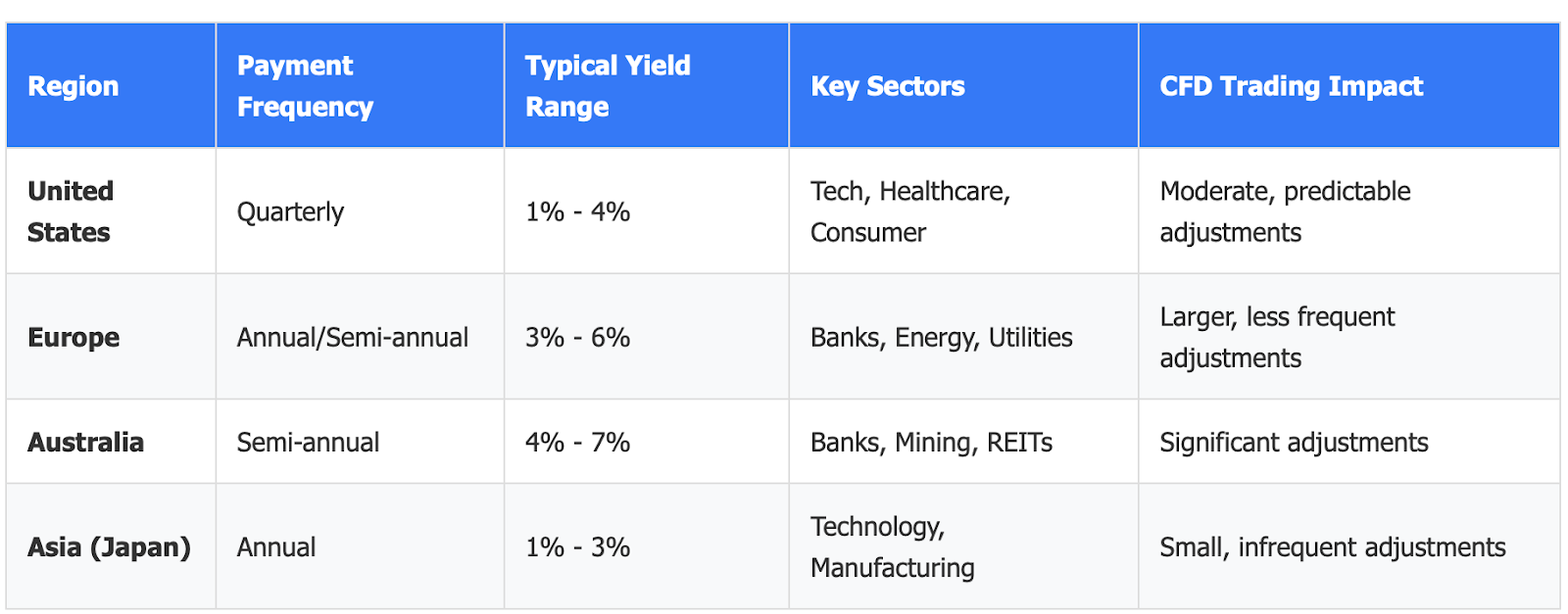
There are also sector considerations. Utilities and telecommunications firms will tend to pay more stable and predictable dividend payments, whereas banks may pay higher yields but have a more volatile payment history. Most technology firms may pay only a small dividend, or no dividend at all. Real Estate Investment Trusts (REITs) usually pay at least most of their income out as dividends causing much larger adjustments.
As an example, if you are trading CFDs on a European utility stock paying 7% in dividends annually, you can expect more significant dividend adjustments than if you were trading a US tech stock paying 1%. So, size your positions appropriately.
Brokers manage these global complexities on your behalf. They manage dividend announcements for all of the major global markets, and pays or applies credits/debits accordingly to the specific stock's scenario. You need not be an expert regarding international dividend policy, but an understanding of the general principles will help you trade much better.
It is important to remember that while adjustment mechanisms are applied equally across assets, dividends will react differently dependent upon the market environment. For example, European markets may react quite differently to a dividend announcement than Asian markets, potentially providing some interesting trading opportunities for the trader with sufficient experience.
Trading Strategies with Dividend Changes
Intelligent CFD trading includes understanding how a dividend adjustment fits into the overall trade strategy. While dividend adjustments are fundamentally neutral in the context of market movement, the immediate trading environment around the date of the dividend declaration can provide opportunity as well as risk.
CFD Traders with a Monthly Exposure: If your trade is held long for weeks or months, you can effectively ignore dividends. You really should be focused on the long-term trend of the underlying stock and not shorter-term market movement driven by the dividend. Even still, you should be aware that your account balance will reflect movements on the dividend date even while the privately-held position built-in to account is moved higher.
CFD Traders Holding Through Days: This is where it gets complicated. Dividend announcements can create volatility in the days leading up to the ex-dividend date. Some stocks could rally before the ex-dividend date as dividend-oriented investors jump in; on the other hand, some stocks can begin to decline ahead of ex-dividend if they disappoint investors. You should consciously build this volatility into your risk management plan.
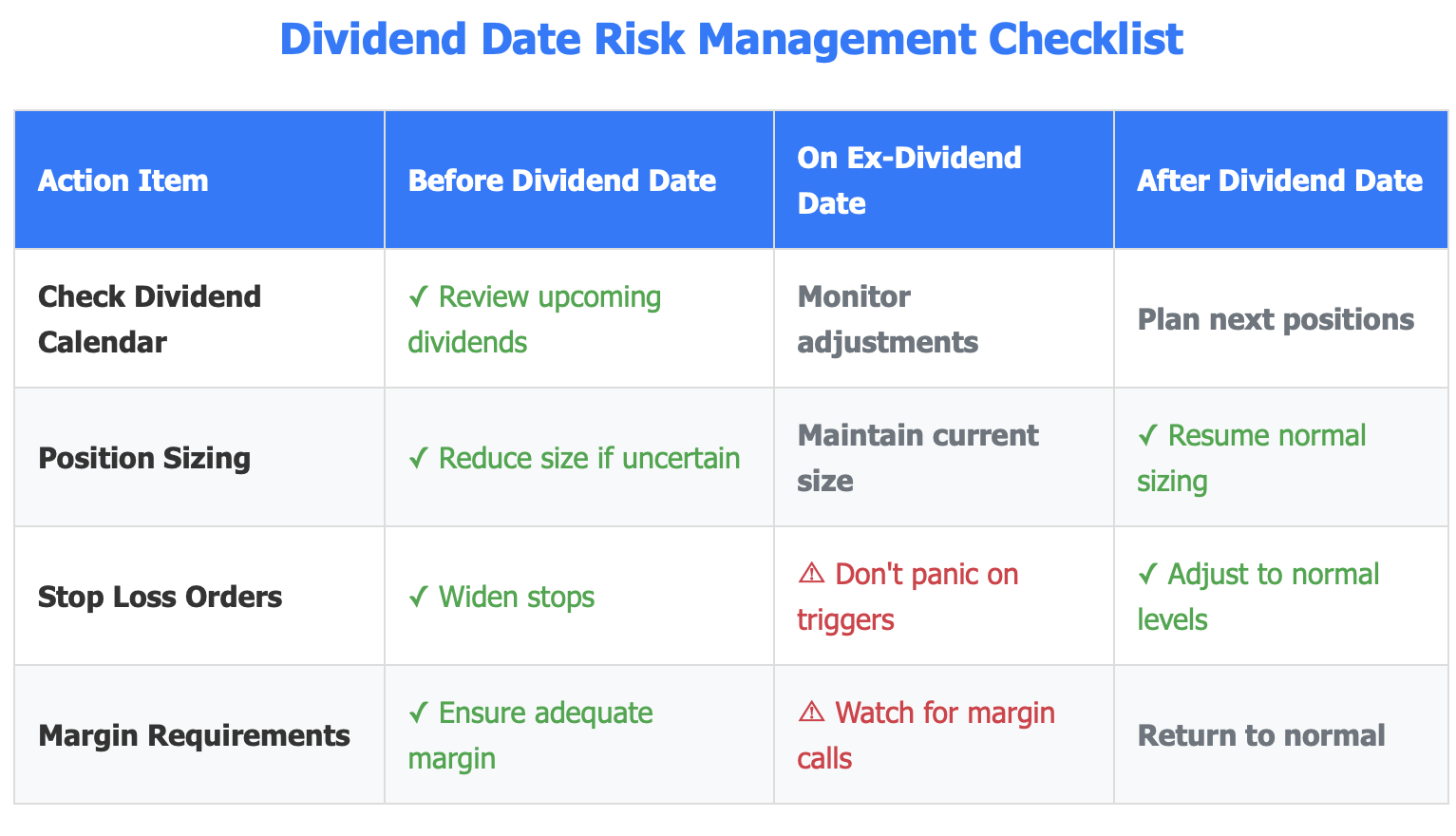
Risk Management around Dividend Dates: If you don't have a conceptually established strategy, it is best to not start new large positions before the dividend announcement period. Volatility can trigger stop-loss orders you don't want your findings with market orders being triggered; or margin calls. If you own large positions, you will want to ensure you have enough margin and they stop-loss level is positioned appropriately.
Advanced traders will opportunistically take action on dividend dates. For example, advanced traders may open long positions in high dividend yield stock prior to dividend announcements, based on the expectation that the announcement will drive added buying interest by investors buying stocks for dividends. They may also open short positions after stocks go ex-dividend, anticipating selling pressure from dividend motivated investors exiting their positions.
As the dividend date approaches, here's a trade checklist to varying degrees of what to do:
-
Browse your broker's dividend calendar for the upcoming dividend payment date.
-
Alter the position size if you're uncertain of the theoretically higher volatility that can transpire at dividend time.
-
If your balance gets triggered on ex-dividend date, do not panic.
-
If there's a dividend payment date, and it will trigger a large dividend payment, you might want to close some or all short-term positions before date declared dividend date.
-
Wider stops should generally be used around dividend dates to minimize being whipsawed.
There are hedge funds focusing on long short dividend arbitrage; although, this type of trading has far better risk management, and sophisticated trading knowledge of markets. I would argue that in the end, this is likely a phrase of the predefined action a majority of retail traders consider, more than for any reasons of understanding you will shorten your loss permitted on dividend-adjustment stocks as dividend proceeds become less esteemed.
The pitfalls of timing the dividend payment:
A common mistake that many traders make is trying to time the dividend payment exactly. Many traders will buy CFDs shortly before the ex-dividend date to collect the dividend. However, many confirmed adjustments in the stock price usually adjust for a CFD's dividend payments as well. A trade you thought would be profitable and worth the risk of holding a CFD short term just did not pan out. This also is not the best way to try and profit off dividends.
What do we want you to get out of this? Treat the dividend adjustments as an administrative aspect of trading rather than trading opportunity. Trade the underlying stock based on the fundamentals and/or technicals. The dividend adjustment and/or payment will take care of itself.
Conclusion: Understanding Dividend Adjustments is Benificial for your CFD Trading
Dividend Adjusted CFDs may seem confusing at first, but it is a simplified way for traders and CFD holders to address the dividend adjustment to share price. By simply accounting for what is happening in the underlying stock market, dividend adjustments can help make CFD trading equity and transparent.
The main point is straightforward: dividend adjustments are neutral adjustments not a chance for a profit or egregious fees. Dividend adjustments simply add a measure of hedging to your CFD trading, and avoid any artificially created bias for or against you pre or post dividend date.
Whether you are trading U.S. tech stocks, European banks or Australian resources, the rules of dividends and other adjustments are fundamentally the same everywhere. Long positions get credited, short positions get a debit, and generally a net effect is priced into the stock price move.
Smart trading doesn’t try to work out how to get an edge from dividends and other adjustments. Instead, it understands how all these mechanics work, and builds that into their trading plan. They price a plan around dividend payment dates, risk management along the lines, and don’t get caught off guard by normal market corrections.
Just keep in mind, successful CFD trading comes down to understanding market fundamentals, your personal risk management, and understanding the mechanics of the market you are trading in. Adjustments and dividends are just part of a comprehensive strategy for your trading.
Are you prepared to apply that knowledge in a demo account to see how dividends function in a real-world environment? There is no substitute for hands-on experience when it comes to CFD's.
Set up a demo account today at btcdana.com, and set up dividends and adjustments in action! Become embroiled in the fundamentals prior to trading with live capital, your future self will appreciate and thank you for taking the time to legal!