




Introduction to Dividend Adjustments in CFD Trading
Contracts for difference, or CFDs, are financial products that allow traders to speculate on the changes in price of stocks. When a stock pays a dividend, that stock's price changes, and this change also applies to your CFD position. Why is this important? Because any adjustment to dividends will directly affect your profit or loss in CFDs.
Picture this scenario: you're playing a video game. Your character accmulates reward points for tasks completed. The game distributes bonus points to all players each month. Due to your character's total value being affected, all players receive bonus points at the same time in your video game. A CFD dividend adjustment operates very similarly.
Full-time trading professionals see this adjustment every day. For example, Apple pays a dividend quarterly to all shareholders, when this dividend is executed, the price of the Apple CFD would be adjusted downward by the price of the dividend. If you held the Apple CFD position before the dividend was executed, your account would show the price adjustment immediately. The dividend adjustment of the CFD ensures your CFD position remains fair with the affected stock price.
It is important for CFD traders, especially beginners, to learn and understand dividend adjustments, it is one of the more important aspects of CFD trading. We are led to believe that many same traders lose their trading profits to dividends, mainly because they do not understand this adjustment. Your profits or losses on trading CFDs invariably depend on how you interpret dividends affecting the price of CFDs.
What is a Dividend Adjustment? Definition and Purpose
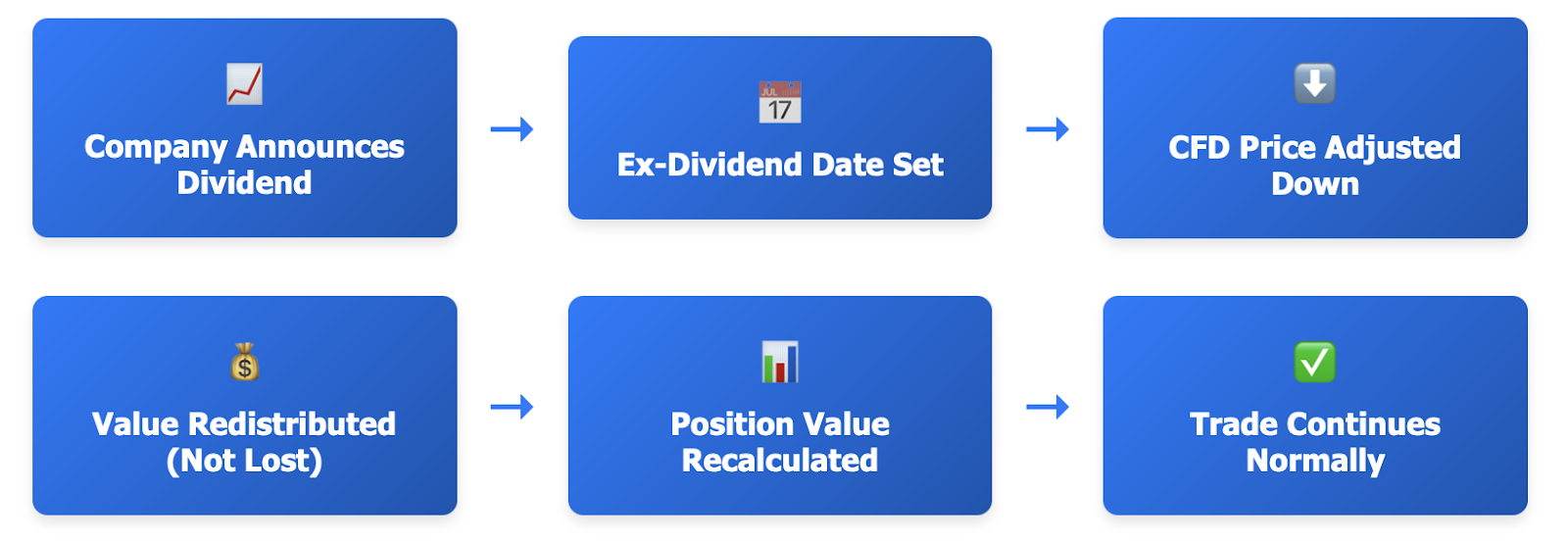
A dividend adjustment alters the price of the CFD. The alteration reflects dividend payments on the stock it is based on. The adjustment is applied on ex-dividend day. Most often, CFD platforms simply take out the dividend amount from the opening price.
Let's provide an example. Microsoft pays a dividend of $0.62 per share. The Microsoft CFD price is reduced by $0.62 on the ex-dividend day. If you hold 100 Microsoft CFDs, the value of your position is then reduced by $62. This is not a loss, just a price adjustment.
Suppose you own 10 virtual trading cards, and these trading cards have a value of 2 reward points each. The total value is 20 reward points. The virtual game initiates a dividend, and you then redeem those reward points on your cards. The reward points that you redeem have now decreased your total point value. Therefore while the card value has decreased, your total reward value is no different, simply rearranged.
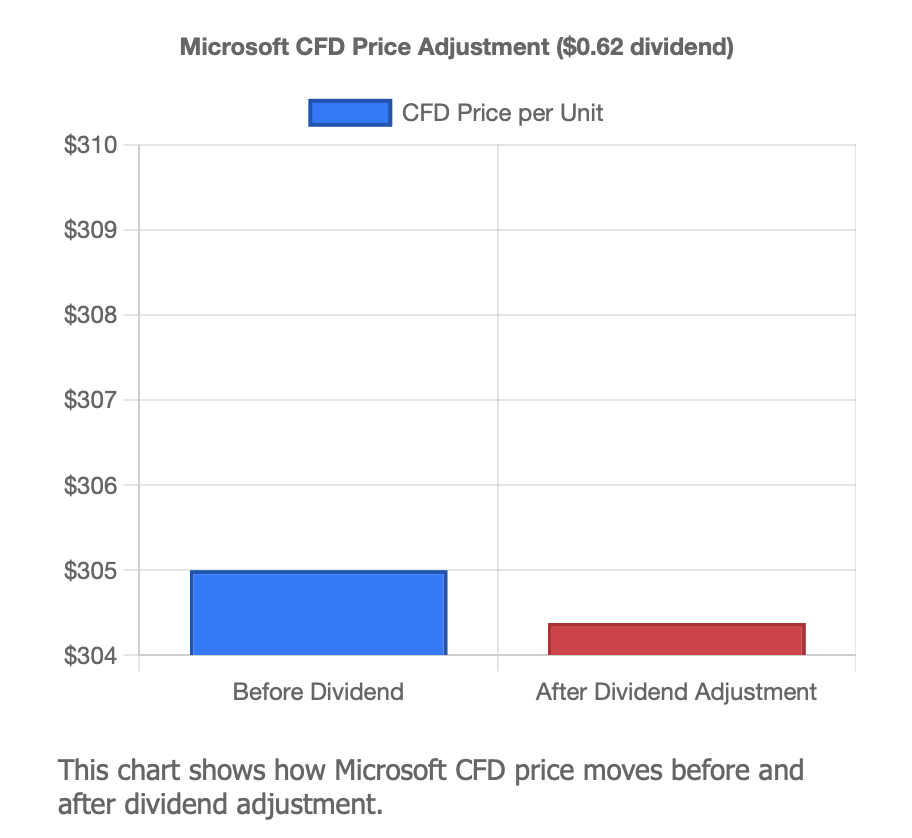
Why do the adjustments happen? The reason is primarily to maintain the option value of your CFD with the underlying asset. If there are no adjustments, the option value is displaced further following the dividend payment, and profits could be miscalculated based on the price action. Adjustments prevent any such confusion.
Consider a scenario where there is no adjustment. A stock pays a dividend. The price of the stock decreases on the ex-dividend date. However, your CFD price is not adjusted. You find that all of a sudden your CFD shows a price for the stock that is divorced from reality.
This will create a false point of trading opportunity. Real market forces do not allow that kind of inertia to continue indefinitely. Apple, Microsoft, and Coca Cola all consistently pay dividends. They also have predictable dividend schedules. Their CFD prices are adjusted every single time they pay a dividend. Long-term traders who own CFDs on these stocks must be cognisant of these adjustments. Short-term traders should also be cognisant of the ex-dividend dates.
How Dividend Adjustments Are Calculated
The calculation is simple. Here is the basic formula:
Adjusted CFD price = Pre-dividend price – (Dividend per share × Number of shares held)
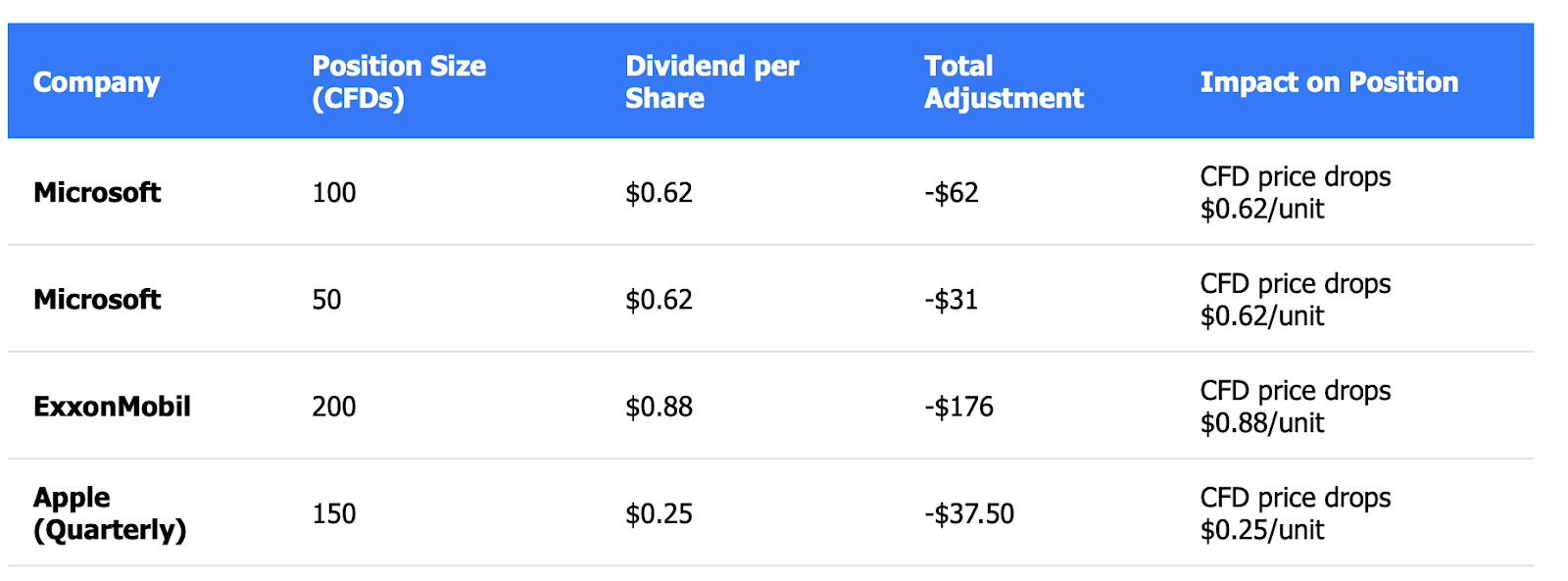
Let's work through a simple example. You own 100 Microsoft CFDs. Microsoft pays $0.62 per dividend. The math is easy:
$0.62 × 100 = $62. Accordingly, the value of your position declines by $62. The price of the CFD drops $0.62 per unit.
This applies to your entire position. If you owned 50 shares instead of 100, the adjustment would have been $31. If you owned 200 shares, the adjustment would have been $124. The math is scalable based on how much you own.
Some platforms will provide a cash adjustment. Other platforms will just drop the price of the CFD. Both calculations will get to the same place, and your accounts will be properly adjusted either way. The only difference is how the platform visually changes the markets with the dividend adjustment.
Short-term traders care less about dividend adjustments. They close positions quickly and it may impact them for a day or two. Long-term investors will have various dividend adjustments across months and years so it is important to track those adjustments.
Adjustments to dividends will impact your cost of trading. Dividend-related adjustments will continue to influence your profits and losses. They can even have an impact on your margin requirements. If the value of your position takes a hit due to a dividend adjustment, you have less equity available in your trading account, and if you are not careful, this could impact the margin available to you as well.
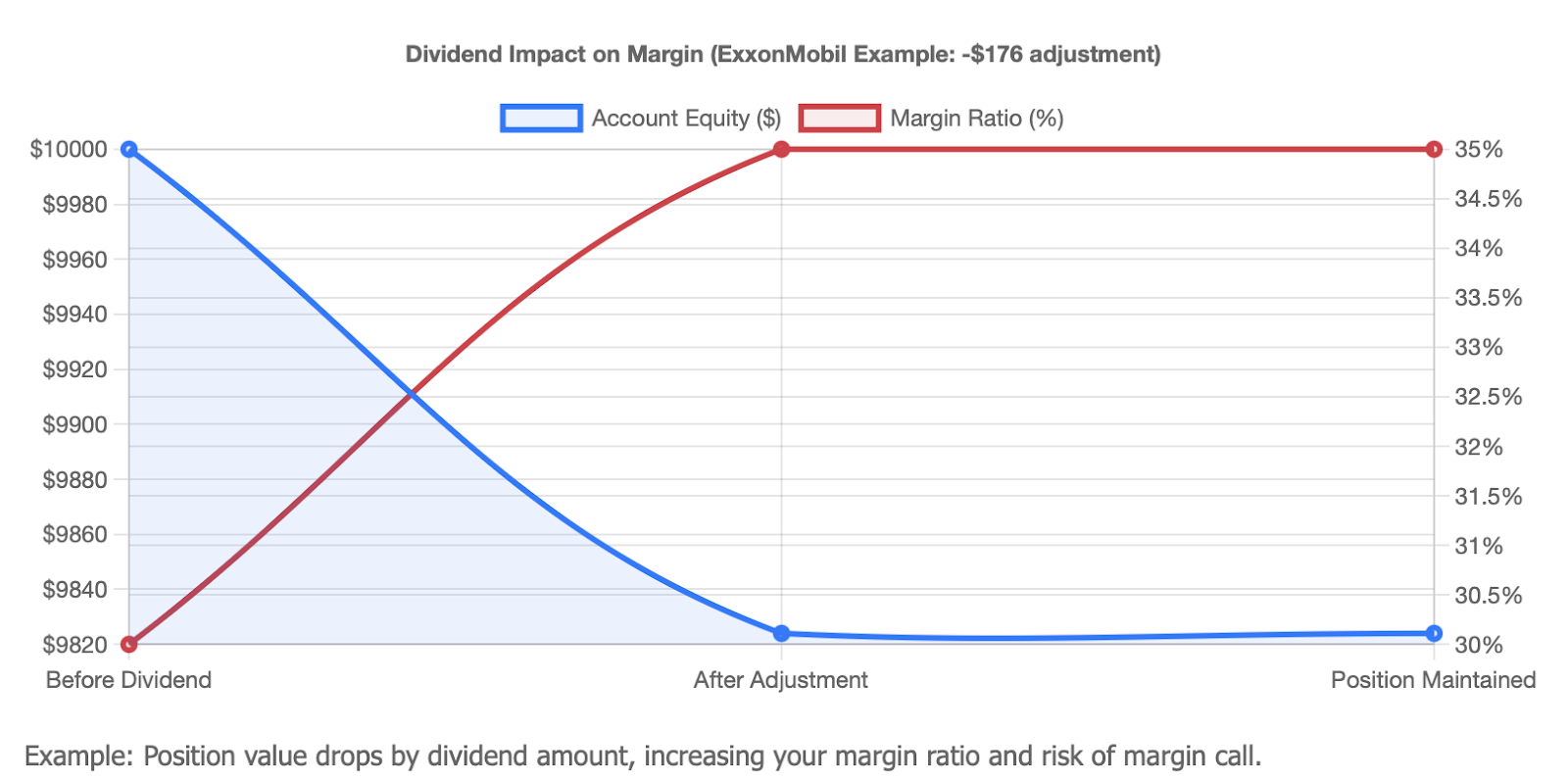
Here’s another example. Let’s say you’re holding an ExxonMobil CFD and they pay a dividend of $0.88 per share, and you’re long 200 CFDs. That means your dividend adjustment is $0.88 x 200 = $176 which you would expect to have money out of your account. Hence, there is a $176 reduction in equity in your account.
Now, in terms of looking at profits, you have purchased ExxonMobil CFDs at $100, and the share price rises to $105; you think you made $5 per share for trading revenue. But with a $0.88 dividend adjustment, your profit is $4.12 per share. In many cases, traders forget this adjustment and mistakenly run profits based on the full price movement, and gain more than they actually have.
How Dividend Adjustments Affect Trading Strategies
Various trading styles react to dividend adjustments in different ways. High-frequency traders usually remain unaffected because they generally close their positions within a matter of minutes or hours, which typically does not coincide with the enforced adjustment which happens once per quarter (rather than in real-time) for dividends.
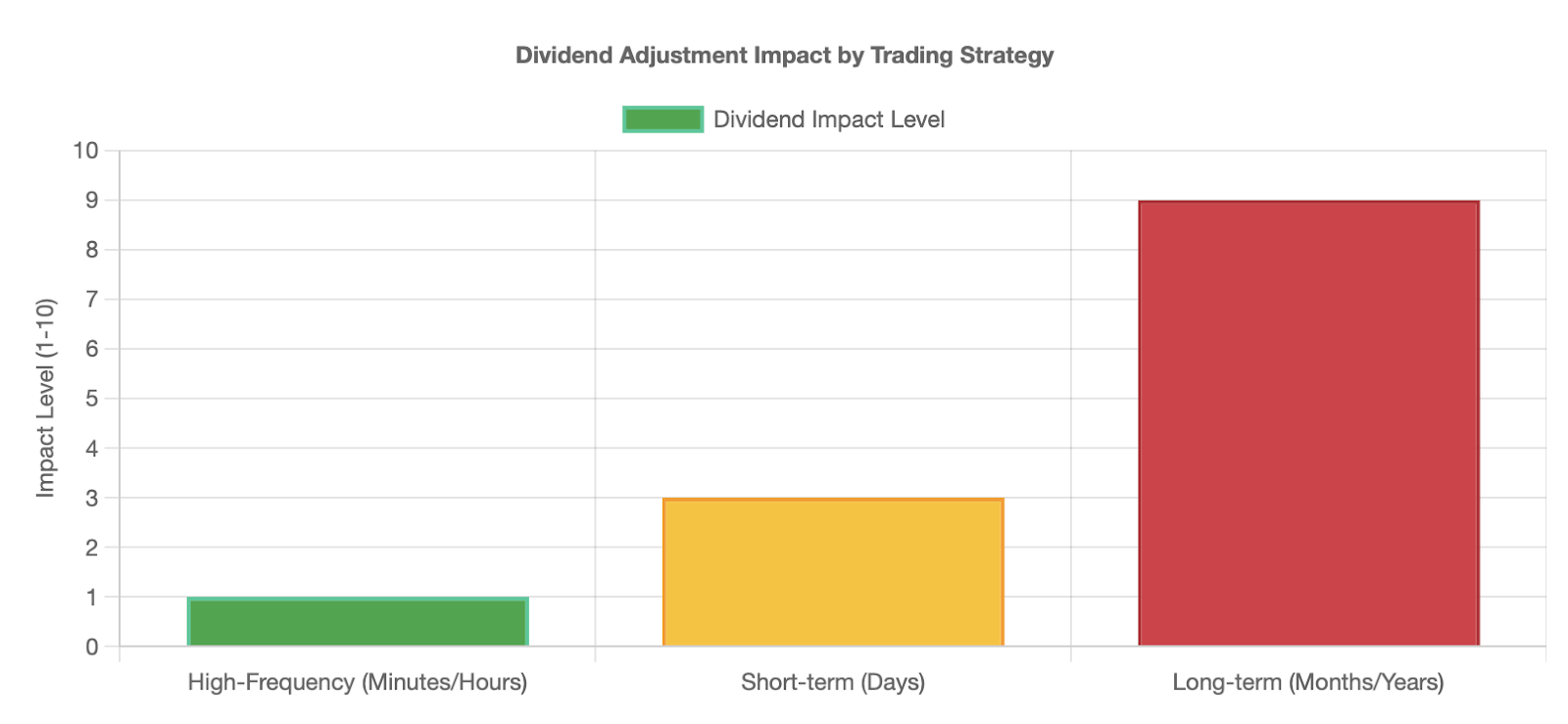
For long-term investors, they must take the dividends into consideration when holding a position for longer than a month or two. Since multiple dividends would have been paid during that time, they must assess the impact of dividend payments in relation to the adjustments in price caused by the quarterly payments. Balancing dividend income versus price is a component that ultimately assesses their strategy success.
Think of a point reward strategy in a game - players earn points every month (not real-time) and at the same time, the game distributes bonus points to all players at the end of the month - players who are more thoughtful will develop strategies that navigate those bonus point distributions. They have learned when to hold points and when to double (or more) up on acquiring points. The same line of skill and thoughtfulness applies to CFD dividend payment adjustment.
When hedging strategy is involved, considerations need to be made - hedging a stock position by going short the CFD, means both sides have the dividend adjustment enforced. Your hedge will still work, but you need to account for the dividend payment adjustment and reflect it in your costs calculations.
Long-term CFD strategies should have comparisons made in respect to dividend relative to the decrease in the price that is factored in - certain companies pay a dividend, and at the time of payout, you can often see the stock price adjustment slightly decrease. This has no positive or negative long-term effect; it simply redistributes value without creating more profits - shrewd investment firms understand this.
Price fluctuations tend to increase in and around the ex-dividend date. Often traders will adjust their positions, one way or the other, before dividend payments are made. This increases volume, increases price, and can decrease liquidity temporarily. Savvy traders size positions relative to these timing events.
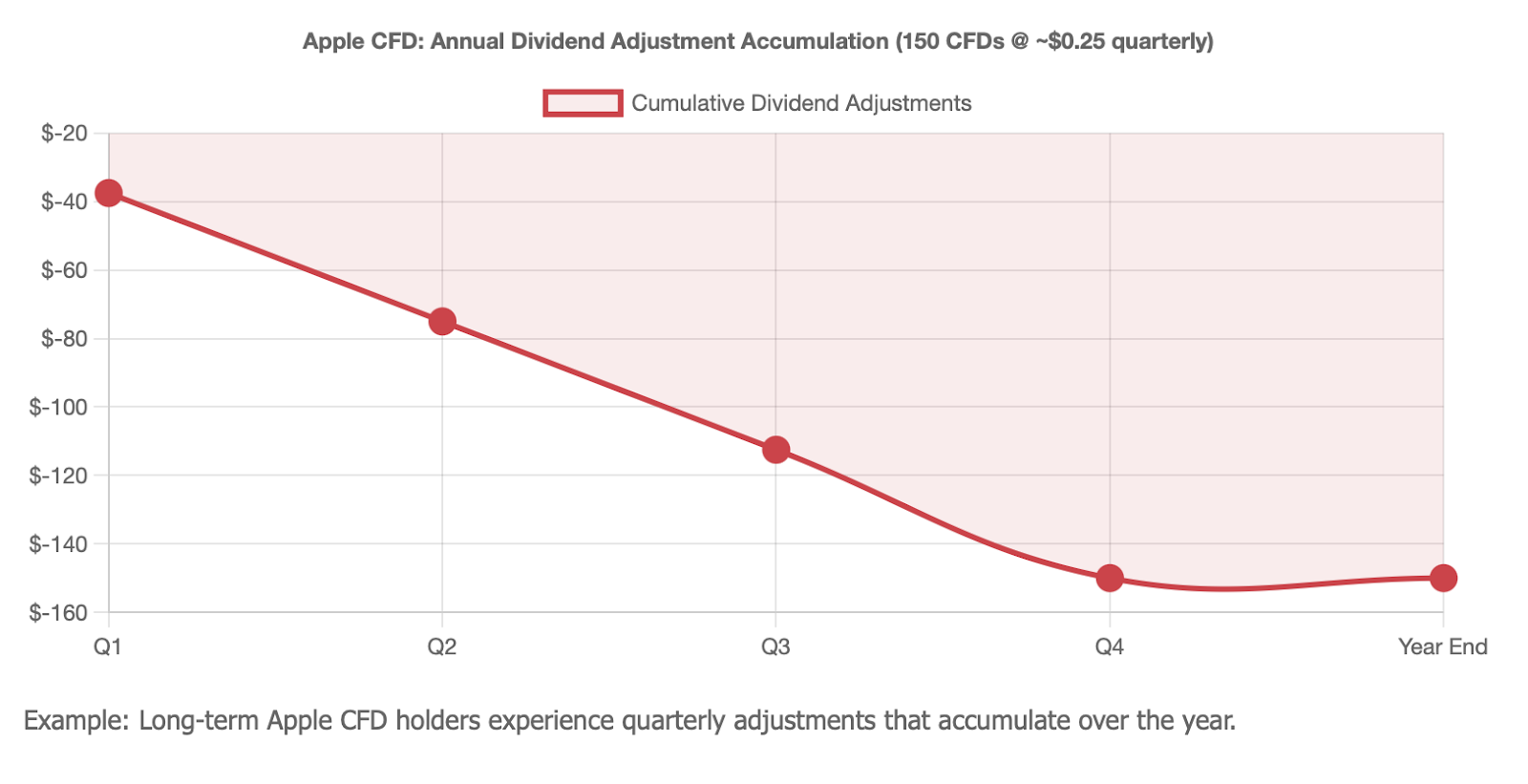
The "Apple" CFDs long-term holding strategy highlights this idea. Apple pays dividends quarterly, and the price drops accordingly each time. It becomes an accumulation effect for the long-term holders. They must also consider those adjustments on their annual returns.
Common Mistakes and Considerations with Dividend Adjustments
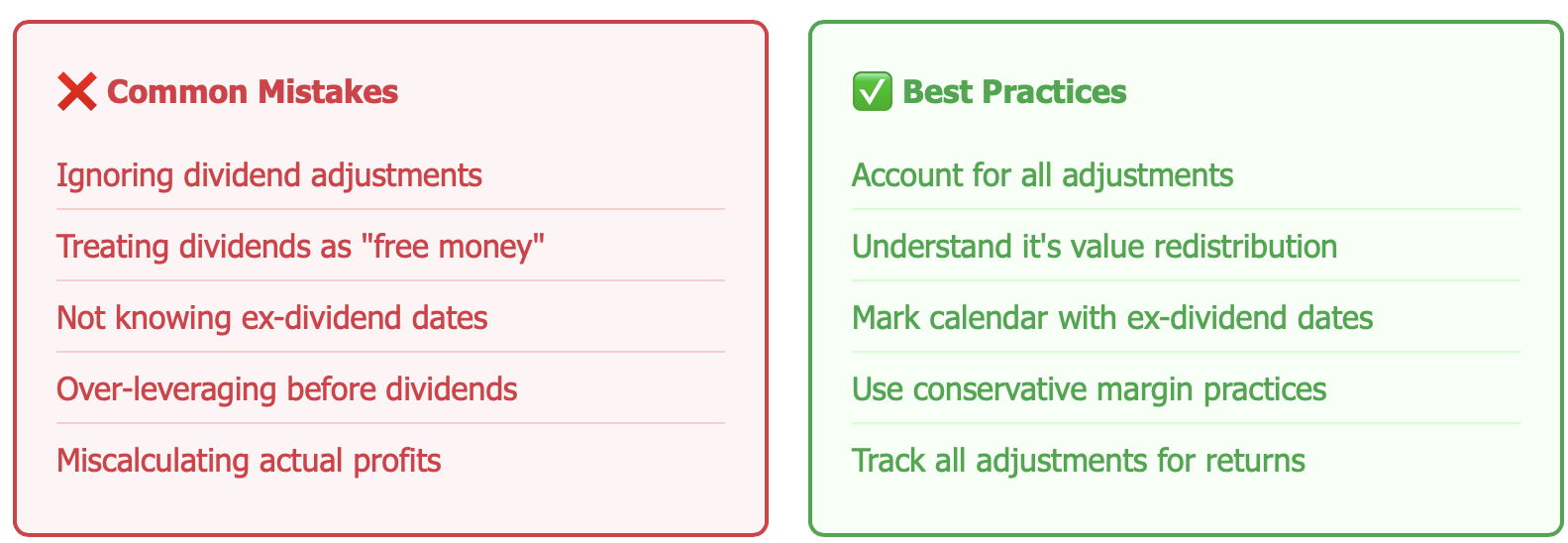
Traders commonly make several significant mistakes when it comes to dividend adjustments. The biggest mistake is simply ignoring adjustments. Accepting dividends leads to profit and loss miscalculations. You think you've earned more than you actually have and/or you think you've lost more than you actually have. Either way, your records are not accurate.
Another common mistake is treating dividends as "free money," which is a common misconception by novice traders. Many traders will receive a dividend payment and mistakenly think they added cash or money to their account. When, in fact, the price or value of the security also decreases at the exact same time. The payment of the dividend isn't free money - it is a redistribution of value. You receive a dividend payment, and lose an exactly equal amount due to the price reduction.
Each platform for CFDs handles dividend adjustments uniquely. Some brokers will utilize price adjustments, and some platforms will utilize cash adjustments, but other brokers charge for dividend adjustment fees. Each brokerage will have their own policy. So as a trader, you should know your brokers policies. You should also understand how your CFD trading platform or broker can handle dividend payments to you.
Knowing the timing for dividends is key. You must know the Ex-Dividend date. You must know the amount for the dividend. If you know these two factors, you can then make plans concerning your trading strategy. You can decide whether to hold a position or sell the security prior to the date for dividend payment. You would also be able to estimate for your potential position the expected value for your position accurately.
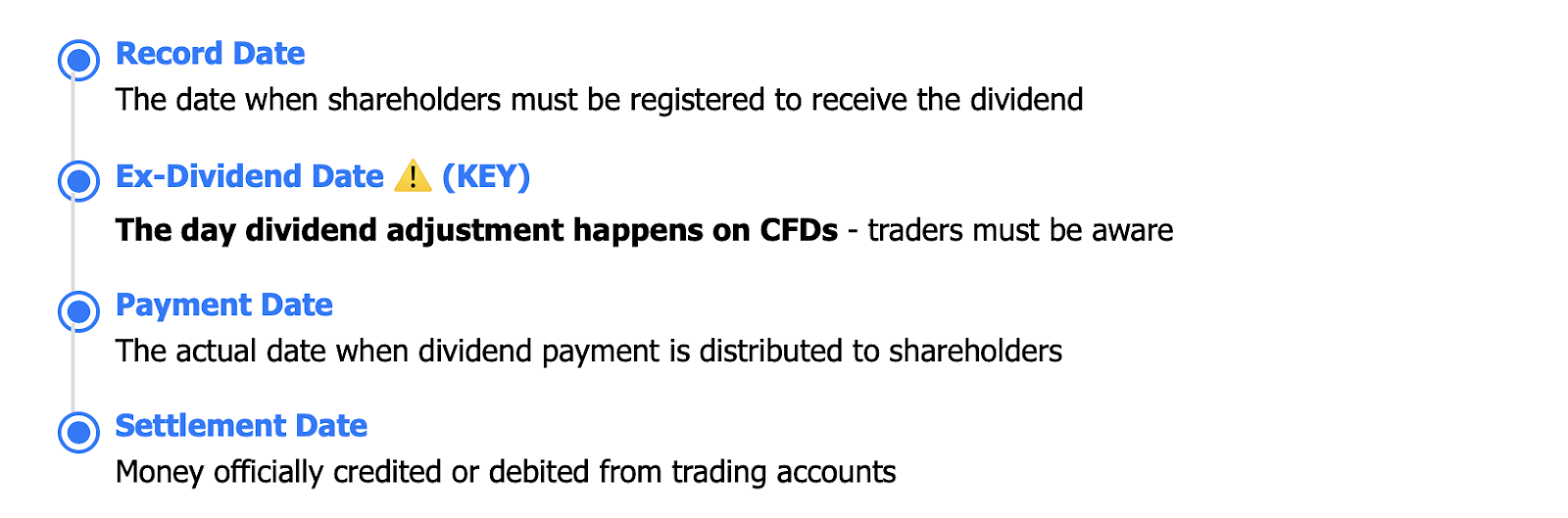
There are different factors to consider with short-term holdings than going long term. For example, if you are leveraging a position for only one day, the impact of dividend adjustment will not apply to your situation. If you are holding it for several months, you will have multiple dividend adjustments to consider. You need to account for that. You should check the ex-dividend date before you initiate any position.
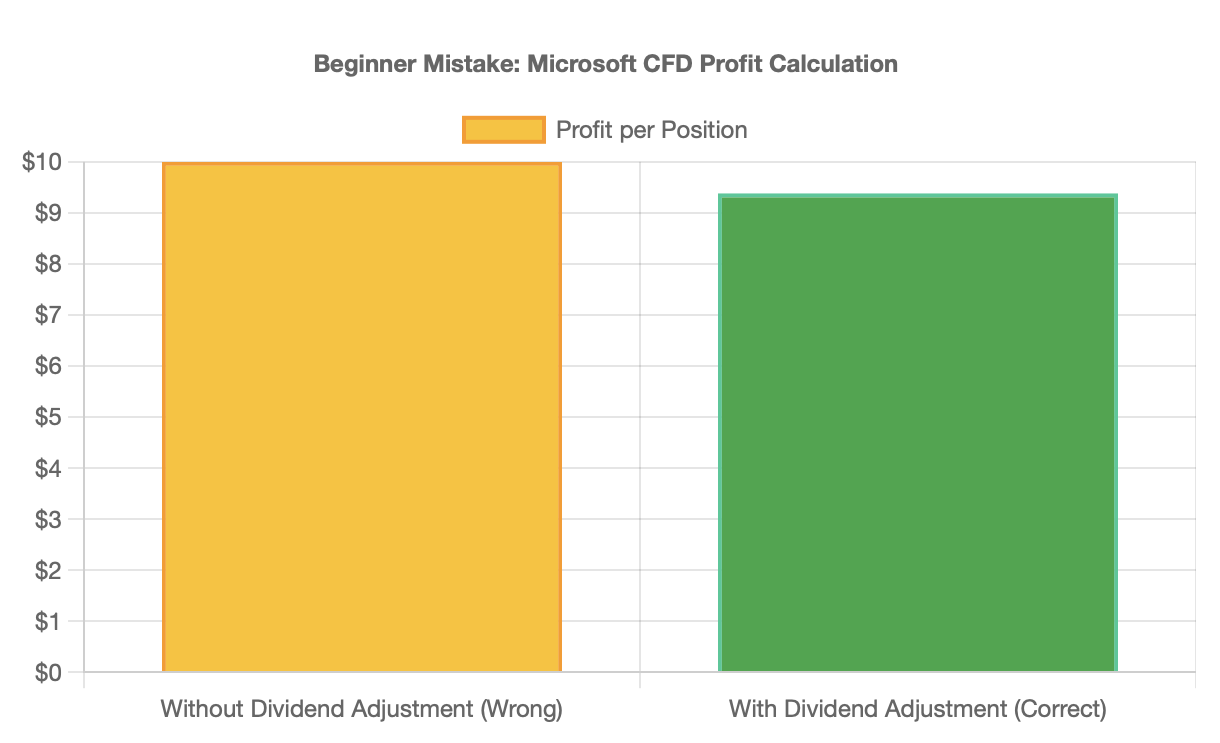
Here’s a real example to show the risk of miscalculating your profit outlook. A beginner opened up Microsoft CFDs at $300. The price moved to $310. He calculated $10 in profit by position, but when he was long held, a $0.62 dividend adjustment occurred on that position. The actual profit was $9.38 by position. This individual made an obvious error and resolved this error by making wrong assumptions on a future position size.
Another example is when margin is in place. Dividend adjustments lower your position value. When they happen, they inadvertently lower your overall account equity. If you are trading on margin, this will increase your margin ratio, which may call for a margin call. Has to have sufficient margin cushion built-in. Don't trade is full of limits of leveraging to peak equity.
Conclusion and Actionable Tips for Dividend Adjustments
Dividend adjustments are an important part of CFD trading, and failure to understand them can lead to costly mistakes. Knowing how they work allows you to calculate profit correctly and plan strategies accordingly.
Here's what you need to know. On ex-dividend dates, CFD prices are adjusted downwards by the dividend amount per share. The price reduces by the amount of the dividend, decreasing the value of your position (and profits/losses) by this amount as well.
Watch for ex-dividend dates on stock you trade. You can add the ex-dividend to your calendar as a reminder. Also, check your broker's policy on dividend adjustments and how your CFD trading platform determines the adjustment. Being prepared reduces surprises.
You should keep track of all the dividend adjustments that occur over the time you hold a stock. When you calculate your returns for the year, be sure to add the adjustments to get a full picture. Balancing the income you receive from dividends vs the adjustments to your position price gives you a more accurate picture of your true returns.
If you trade on margin, have a sufficient buffer to margin if you hold positions during the announcement of dividends. Don't maximize your leverage before dividend announcements. Also account that your position value may decline due to dividend adjustments. By adopting a conservative margin practice you can protect your account.
Dividends worldwide have an adjustment effect. Specifically, every CFD market globally experiences dividends. Whether you trade UK stocks, US stocks, or European stocks, dividends matter! Like all CFDS, CFDS should always reflect the underlying asset value.
When it comes to educating, you can look to Apple, Microsoft, and Coca-Cola as learners. These companies pay dividends regularly. The patterns and adjustments of their dividends can be easily forecasted. Watch how the CFD marketplaces react to normal dividend distributions. For example, look at the quarterly adjustments in the CFD prices. Observing these adjustments will help you consider how the full marketplace is reacting.
Dividend adjustment is one strategy in a toolbox for a trader trading in CFDS. The adjustment can help wipe away the mysterious price changes in the marketplace. The adjustment can also help you as you plan your strategies. And, finally, it can help to eliminate any loss of aesthetic errors in your calculations.
Start using dividend adjustment analysis in your trading today with BtcDana.com. This week, review your broker to determine if they have a dividend policy in place. Planning around and looking into dividend policies will improve your trading performance.